
Rear-end accident attorney oakland ca commercial truck: A practical guide
Getting rear-ended by a commercial truck in Oakland usually creates a more complicated claim than a typical two-car crash, because you may be dealing with the driver’s insurer, the trucking company’s policy, and sometimes a third-party carrier all at once. A rear-end accident attorney oakland ca commercial truck case calls for is generally one who knows how to identify every layer of coverage and preserve evidence before it disappears.
Key Takeaways
- Multiple insurance layers: Commercial truck crashes often involve the driver’s policy, the motor carrier’s commercial liability policy, and sometimes cargo or umbrella coverage.
- Evidence has a shelf life: Electronic logging device (ELD) data and dashcam footage may be overwritten within days or weeks without a preservation request.
- Corporate defendants respond fast: Trucking companies frequently dispatch adjusters and investigators within hours of a reported crash.
- Several parties may share liability: The driver, the motor carrier, and occasionally a leasing or maintenance company could all be named.
- Cost isn’t usually a barrier: A no-fee, contingency-based arrangement means you generally don’t pay upfront to pursue a claim.
At a Glance: Commercial Truck Rear-End Claims in Oakland
| Factor | Typical Passenger Car Crash | Commercial Truck Rear-End Crash |
|---|---|---|
| Insurance layers involved | Usually one driver policy | Driver policy plus company liability policy, sometimes umbrella coverage |
| Minimum CA liability limits | $30,000/$60,000 | Interstate carriers are generally subject to federal minimum coverage rules, which can be considerably higher, depending on the cargo and vehicle type |
| Evidence at risk | Photos, witness statements | ELD/hours-of-service data, dashcam footage, maintenance logs |
| Potential defendants | The driver | Driver, motor carrier, possibly leasing or maintenance company |
| Response speed from defense | Varies | Often within hours via dedicated claims teams |
| Injury severity risk | Lower average impact force | Generally higher due to vehicle weight and momentum |
1. Why Commercial Truck Rear-End Crashes Are Different in Oakland
Oakland’s freight corridors, including I-880, I-580, and the streets feeding the Port of Oakland, carry a steady stream of delivery vans, box trucks, and tractor-trailers alongside daily commuter traffic. When one of these vehicles rear-ends a passenger car, the physics alone make the crash more serious. A loaded commercial truck can weigh many times more than a sedan, and it needs a longer distance to stop.
Because of that weight difference, injuries from a commercial truck rear-end crash tend to be more severe than in a typical fender-bender. Beyond the physical impact, these cases usually involve more moving parts legally. It’s rarely just “the driver hit me.” There’s often a company behind that driver, and that company has its own insurance, its own policies, and its own legal team.
If you were rear-ended by a truck making local deliveries or hauling freight through Oakland, the case may resemble the coverage questions discussed in Oceanside Rear-End Crash: Is CA Minimum Coverage Enough?, but with commercial policies that generally carry much higher limits than the state’s minimum requirements.
2. The Layers of Insurance You May Be Dealing With
California requires drivers to carry at least $30,000 per person and $60,000 per accident in liability coverage. Commercial trucking, however, operates under a different framework. Interstate carriers are generally subject to federal minimum liability coverage requirements that can be considerably higher than state minimums, with the specific amount depending on the cargo and vehicle type involved.
That can sound like good news, and in some ways it may be, since there’s potentially more coverage available to pay for medical bills, lost wages, and vehicle damage. But more layers also mean more parties reviewing your claim, more paperwork, and more opportunities for delay. You could be dealing with:
- The truck driver’s own auto policy, if one exists separately from the company’s coverage
- The motor carrier’s commercial general liability or auto liability policy
- A cargo owner’s or freight broker’s policy, in cases involving leased trucks or subcontracted hauling
- An umbrella or excess policy that a larger fleet operator may carry above its primary coverage
Sorting out which policy responds first, and how much each one might contribute, is rarely straightforward without help. This is one area where a claim against a corporate defendant differs sharply from a routine claim against another driver’s personal insurer, similar in spirit to the coverage gaps discussed in Rear-ended by uninsured driver what happens next, except here the challenge is usually too many potential payers rather than none.
3. Evidence That Can Disappear Fast
Commercial trucks generate a surprising amount of digital evidence, and much of it doesn’t stick around long. Electronic logging devices (ELDs) track a driver’s hours of service and can show whether the driver was fatigued or over their legal driving limit. Many fleets also use dashcams or telematics systems that record speed, braking, and following distance.
The catch is that this data often gets overwritten automatically within days or weeks unless someone formally requests that it be preserved. Maintenance logs and driver qualification files can also matter, especially if brake failure or driver fatigue played a role. Once that data is gone, it’s generally gone for good.
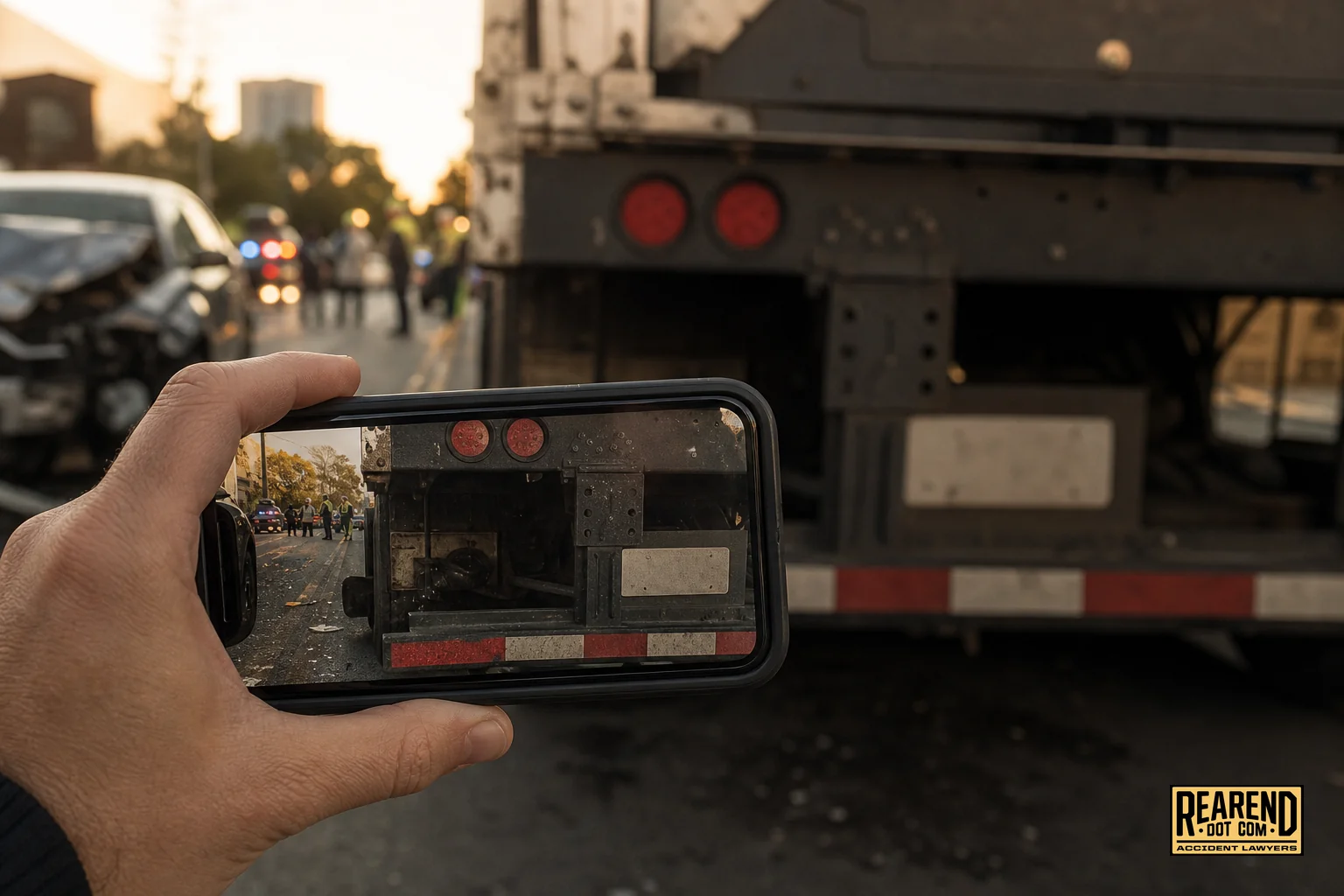
If you were rear-ended by a truck, try to record the truck’s DOT number, license plate, and the company name visible on the vehicle before it leaves the scene. This information helps identify the correct carrier and speeds up the process of sending a preservation letter, which formally asks the company to retain relevant records before they’re routinely deleted.
Evidence preservation in commercial truck cases often has to happen within days, not months, to be effective.
4. Who Can Be Named as a Defendant
Depending on the facts, more than one party may bear responsibility for a commercial truck rear-end crash. Potential defendants can include:
- The driver, whose actions behind the wheel caused the collision
- The motor carrier or trucking company, which may be held responsible for the driver’s actions under a legal theory called vicarious liability, since the driver was generally working within the scope of employment
- A leasing company or owner-operator, in situations where the truck itself was leased or subcontracted to another business
- A third-party maintenance or loading company, in less common cases where a mechanical failure or improper cargo load contributed to the crash
Figuring out which of these parties, if any, share liability generally requires reviewing company records, driver logs, and sometimes maintenance history, which is part of why these claims take longer to resolve than a simple two-car rear-end case like the one described in Rear-Ended at a Red Light Who Pays?.
5. How Corporate Defense Teams Respond
Trucking companies and their insurers usually move quickly after a reported crash. Some dispatch investigators or adjusters to the scene within hours, particularly if the crash involves a serious injury or a total loss. Their goal is to gather statements and documentation while memories are fresh, and while you may still be dealing with the immediate aftermath of the collision.
You may receive a call from an adjuster asking for a recorded statement or offering an early settlement. It’s worth knowing you generally don’t have to answer detailed questions on the spot, a point covered in more depth in Insurance adjuster called me after accident should i talk. Corporate defendants typically have legal counsel involved from the earliest stages, which is one reason unrepresented victims can find themselves at a disadvantage when negotiating alone.
6. What Affects Settlement Value in Truck Rear-End Cases
Several factors tend to shape how much a commercial truck rear-end claim might be worth. These include:
- Injury severity: Higher-impact collisions often lead to more extensive medical treatment and longer recovery periods.
- Available coverage: Larger commercial policies may allow for compensation beyond what a standard passenger auto policy could cover.
- Lost wages and future care needs: Time away from work and ongoing treatment can add significantly to a claim’s value.
- Comparative fault questions: If there’s a dispute over who caused the crash, that can affect the final settlement amount.
For a broader breakdown of how these variables interact, see Rear-end accident settlement calculator is it accurate, which explains why generic online tools rarely capture the nuances of a commercial vehicle claim.
7. How Personalized Legal Support Helps Level the Field
Facing a corporate defendant and its insurance company without guidance can feel like an uneven fight, largely because it often is. An attorney who focuses on rear-end collision cases, rather than a general practice spread across many types of injury law, may be better positioned to recognize the specific documentation a truck case requires and move quickly to request it.

Personalized support typically starts with a free case evaluation to review what happened, identify potential defendants, and outline next steps. Because representation is usually offered on a no-fee, contingency basis, meaning payment generally comes only if the case results in compensation, cost isn’t typically a barrier to getting help. If you’re weighing whether this kind of arrangement applies to your situation, Rear-End Accident Attorney Oakland CA No Fee: Who Qualifies and How It Works walks through how that generally works.
Beyond the legal side, coordinating vehicle repairs after a serious truck collision can be its own headache. If your car needs bodywork, you can use the tool to Find Trusted Local Auto Body Shops near you to get that part of the process moving.
8. Steps to Take If a Commercial Truck Rear-Ended You in Oakland
- Get medical attention promptly. Some injuries from higher-impact crashes aren’t obvious right away.
- Document the truck’s identifying details. Photograph the DOT number, license plate, and company name if visible.
- Avoid giving a recorded statement to the trucking company’s insurer before you understand your options.
- Ask about a preservation letter early. ELD and dashcam data can be lost quickly.
- Track your symptoms and expenses. This record can matter later, especially for injuries like those described in Neck Pain Days After a Rear-End Accident.
- Get a free case evaluation to understand which parties and policies might be involved in your specific crash.
FAQ: Oakland Commercial Truck Rear-End Accidents
What should I do about rear end collision repair after a truck crash?
Once your claim is underway, you can generally move forward with rear end collision repair through a shop of your choosing. Getting an estimate early helps document the extent of damage, which can support your claim. Many victims use resources like Find Trusted Local Auto Body Shops to locate a shop familiar with insurance claim paperwork.
Is California’s minimum coverage enough if a commercial truck hit me?
Commercial carriers usually carry coverage well above California’s $30,000/$60,000 minimum, often considerably higher depending on the vehicle and cargo. Whether that coverage is enough depends on the severity of your injuries and losses, which is why identifying all available policies matters.
How long do these claims typically take?
Commercial truck rear-end claims often take longer than standard two-car crashes because of the number of parties and policies involved. Cases can range from a few months to over a year, particularly when injuries are still being treated or liability is disputed among multiple defendants.
Can I still pursue a claim if I wasn’t sure who to blame at the scene?
Yes, you generally can. Liability questions in multi-party truck crashes are often sorted out during the investigation, not at the roadside. If you’re unsure how fault gets determined in more complex situations, Multi car pileup rear-end accident who is liable covers similar principles that can apply here.
If a commercial truck rear-ended you in Oakland, the insurance layers, evidence deadlines, and corporate defendants involved make this a case where personalized guidance can matter. You can Start My Claim today, or review your claim in just a few clicks for free to see what your options look like before evidence and deadlines start working against you.
Prior results do not guarantee a similar outcome. – Rearend.com
Related Articles


Need Legal Help After a Rear-End Accident?
Get a free consultation with our experienced legal team