
Multi car pileup rear-end accident who is liable: A practical guide
A multi car pileup rear-end accident who is liable question rarely has one simple answer, because these crashes often involve several separate impacts, each with its own cause. Liability usually gets divided among the drivers whose actions actually contributed to the chain of collisions, based on evidence like impact patterns, following distance, and witness accounts, rather than assigned automatically to whoever hit the car in front of them.
Key Takeaways
- Fault is rarely all-or-nothing: California uses comparative negligence, so two or more drivers can each be assigned a percentage of fault in a chain-reaction crash.
- Impact sequence matters: Whether one driver pushed several cars forward in a single hit, or multiple separate collisions occurred, changes who pays and how much.
- Insurers may point at each other: When several policies are involved, each carrier may try to shift blame toward another driver to reduce its own payout.
- Minimum coverage may fall short: California’s minimum liability limits, $30,000 per person and $60,000 per accident, can be quickly exhausted when several vehicles and injured people are involved.
- Documentation is decisive: Photos of damage patterns, dashcam footage, and witness statements often carry more weight than the initial police report in sorting out a pileup.
At a Glance: Multi-Car Pileup Liability Basics
| Scenario | Likely Liability Pattern | Why It Happens |
|---|---|---|
| Single hard hit pushes 3+ cars forward | Rear driver often primarily liable | One force initiated the whole chain |
| Multiple separate rear impacts | Fault split among several drivers | Each driver failed to stop independently |
| Middle car hit from behind, pushed into car ahead | Middle driver may bear little to no fault | They didn’t choose to hit the car in front |
| Sudden, unexplained hard braking by lead car | Lead driver may share some fault | Could be seen as contributing to the pileup |
| Weather or road hazard involved | Fault still tied to following distance | Drivers are generally expected to adjust for conditions |
| Minimum insurance policy involved | Payout capped near $30,000/$60,000 | California’s minimum coverage limits |
How Chain-Reaction Crashes Usually Unfold
Picture a stretch of the 405 during evening traffic. Cars are stopped or crawling. Somewhere back in the line, one driver doesn’t notice the slowdown in time. The impact pushes that car into the one ahead, and depending on speed and spacing, that force can carry through two, three, or more vehicles before it stops. In some pileups, though, the story is different: several drivers each fail to stop in time, and the crash is really a series of smaller, separate collisions happening within seconds of each other.
This distinction is the center of a multi car pileup rear-end accident who is liable analysis. A driver stuck in the middle of the chain often assumes they’re at fault simply because their car hit the vehicle in front of them. That’s not usually how it works. If your car was pushed forward by the force of the hit from behind, you generally did not cause the impact ahead of you, and that matters for how your claim gets evaluated.
1. Identify How Many Impacts Actually Occurred
The first practical step in any pileup case is figuring out how many distinct collisions took place. A single push-through event, where one driver’s impact carries through multiple cars, tends to concentrate liability on that one driver. Multiple separate impacts, where several drivers each closed the gap too fast, usually mean fault gets divided among them.
This isn’t always obvious from the scene alone. Insurance adjusters and attorneys often rely on damage patterns (crush depth, paint transfer, and the order of impacts) to reconstruct what actually happened. A car with damage to both its front and rear bumper, for instance, is a strong signal it was caught in the middle of a chain reaction rather than the one that started it.
2. Understand How Fault Gets Apportioned Among Several Drivers
California follows a pure comparative negligence rule, meaning fault can be split across any number of drivers based on their share of responsibility. In a three-car or four-car pileup, this could look like one driver bearing 70% of the fault, another 20%, and a third 10%, depending on what the evidence shows about following distance, speed, and reaction time.
Each driver’s own insurer is typically responsible for their share of the payout. That means your compensation may come from more than one policy, and each insurer will likely negotiate based only on the percentage they believe their driver caused. This is one reason pileup claims tend to move slower and involve more back-and-forth than a standard two-car rear-end case.
3. Know the Common Liability Patterns in a Pileup
Some patterns show up often enough in chain-reaction crashes that they’re worth understanding before you talk to an adjuster.
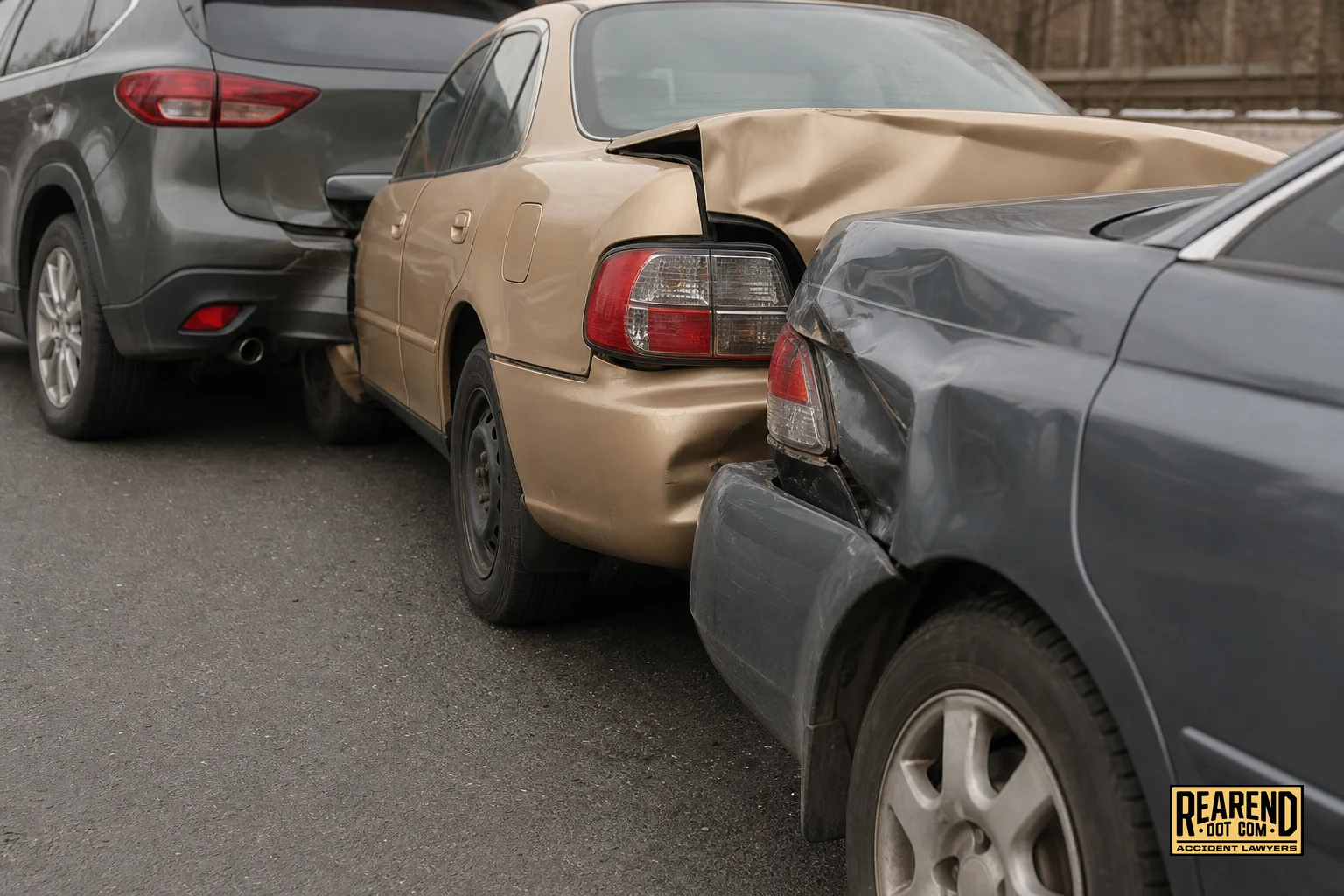
- The “domino” pileup: One driver hits the car behind at speed, pushing it into the next car, and so on. The initiating driver often carries most of the fault.
- The “independent multi-hit” pileup: Several drivers each fail to stop in time within seconds of one another, sometimes because of a stalled vehicle or sudden slowdown. Fault may be split several ways.
- The “sandwiched” driver: A driver stopped safely gets hit from behind and pushed into the car ahead. This driver is frequently found to hold little or no fault for the front-end impact, since they didn’t control that collision.
- The sudden-stop question: If the lead driver braked hard for no apparent reason, some fault could potentially be assigned to them, though courts and insurers look closely at whether the stop was reasonably foreseeable.
If you’re unsure which pattern applies to your crash, reviewing how fault typically works in simpler two-car scenarios can help. Our breakdown of who pays when you’re rear-ended at a red light covers the baseline rules that also apply, in modified form, to multi-vehicle chains.
4. Gather Evidence That Separates the Impacts
Because pileups often involve more than one insurer and more than one story, evidence tends to carry extra weight. Useful documentation includes:
- Photos of all four sides of every involved vehicle, not just the obvious damage
- Dashcam footage from your car or, when available, from other drivers nearby
- Contact information and statements from witnesses who saw the sequence unfold
- The official police report, understanding that officers arriving after the fact may not perfectly capture the order of impacts
It’s worth knowing that a flawed or incomplete police report doesn’t necessarily end your claim. As we’ve covered in detail, you can generally still file a claim if the police report is wrong, especially when supported by photos, medical records, and other evidence gathered independently.
5. Watch for Multiple Insurance Companies Pointing at Each Other
Multi-vehicle claims can turn into a standoff. Each insurer has an incentive to argue that another driver in the chain caused more of the damage, since that shifts cost away from their own policyholder. This can slow down settlement offers and leave injured drivers waiting weeks or months longer than they would in a simple two-car case.
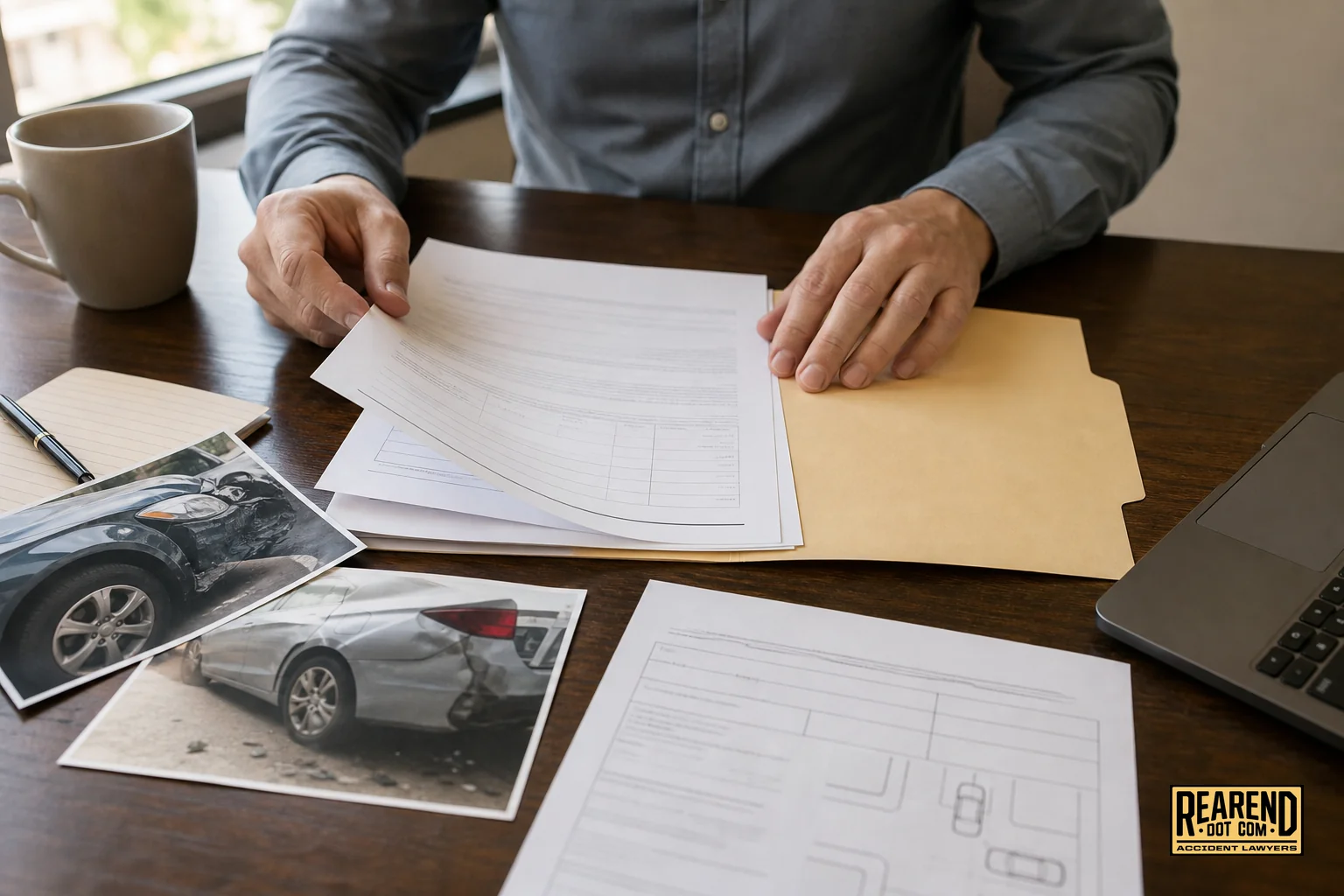
If you’ve already had an adjuster call you directly after your crash, it’s worth pausing before giving a recorded statement, particularly in a pileup where the details of who did what are still being sorted out. Our guide on what to do when an insurance adjuster called you after an accident walks through what you’re generally required to share versus what can wait.
This is also where minimum coverage limits become a real concern. California requires drivers to carry at least $30,000 per person and $60,000 per accident in liability coverage. In a pileup with several injured people, that $60,000 cap can be reached quickly, potentially leaving a shortfall even after fault is sorted out. If you were involved in a chain-reaction crash near the coast, our piece on whether California’s minimum coverage is enough after an Oceanside crash looks at this issue in more depth.
6. Why Pileup Cases Often Call for Attorneys Experienced With Rear-End Dynamics
Sorting out a multi car pileup rear-end accident who is liable determination generally takes more than reading a police report. It calls for someone who understands how force transfers between vehicles, how to read damage patterns across several cars, and how to negotiate with multiple insurance companies at once, without letting one carrier’s version of events dominate the narrative.
It’s worth being precise about terminology here: there’s no formal legal specialization for these cases. Rather than describing an attorney as a “specialized auto accident attorney,” it’s more accurate to look for a skilled accident attorney who has handled numerous rear-end cases, including chain-reaction crashes involving three or more vehicles. That kind of hands-on experience with sequential impacts, comparative fault splits, and multi-insurer negotiations tends to matter more than a label.
In a pileup, the driver in the middle is often the one most at risk of being blamed unfairly, simply because their car touched two others. Sorting that out usually takes evidence, not assumptions.
If you’re comparing attorneys after a pileup, our guide on red flags when hiring a personal injury lawyer and our list of rear-end settlement amount factors can help you ask sharper questions before signing anything.
Rear-End Collision Repair After a Pileup
Once liability starts to take shape, many drivers turn their attention to getting their vehicle repaired. In a chain-reaction crash, damage can be layered, front and rear, so it’s worth having a shop document the full extent of the harm before repairs begin, not just the most visible dents. This documentation can matter later if additional damage is discovered mid-repair or if a second insurer disputes their share of the cost.
Timing repair work around an active multi-party claim can be tricky, since you may be waiting on more than one insurance company to weigh in. If you need help locating a shop that regularly works with accident claims like these, you can Find Trusted Local Auto Body Shops that understand how to coordinate documentation with a pending claim.
Frequently Asked Questions
How much does a rear-end accident settlement pay out in a pileup?
There’s no fixed number. Payouts in multi-vehicle claims depend on medical bills, lost wages, vehicle damage, and how fault is split among the drivers involved. Because several policies may be contributing, the total recovery can differ significantly from a standard two-car case. Our overview of rear-end settlement payouts and what factors affect the amount breaks down the variables adjusters typically weigh.
Can I sue if I was rear-ended in a multi-car pileup?
Generally, yes. If you were rear-ended, whether by one driver or as part of a larger chain, you may have grounds to pursue compensation from the driver or drivers found responsible. Fault in a pileup is often shared, so any claim would likely need to account for each responsible party’s percentage.
How long does a rear-end accident settlement take when several vehicles are involved?
Multi-vehicle claims often take longer than single-impact cases, since several insurers may need to agree on fault percentages before any offers are finalized. It’s not unusual for these cases to take several additional weeks or months compared to a straightforward two-car claim.
What questions should I ask a rear-end accident attorney about a pileup case?
Ask how many multi-vehicle or chain-reaction cases they’ve handled, how they approach reconstructing impact sequences, and how they plan to deal with more than one insurance company at the same time. Their answers can reveal how comfortable they actually are with this more complex type of claim.
Next Steps After a Multi-Car Pileup
Chain-reaction crashes involving three or more vehicles rarely sort themselves out cleanly, and the drivers stuck in the middle often carry the heaviest burden of proof. If you’re trying to figure out your share of fault, dealing with multiple insurers, or simply unsure where your claim stands, you don’t have to work through it without guidance. You can Start My Claim today, or take a moment to review your claim in just a few clicks for free and get a clearer picture of where you stand before talking to any insurance adjuster.
Related Articles


Need Legal Help After a Rear-End Accident?
Get a free consultation with our experienced legal team