
The Rear-End Accident Checklist for the First 24 Hours After a Crash
The first 24 hours after a rear-end crash shape what happens to your claim for months afterward. Following a rear-end accident checklist for the first 24 hours, meaning checking for injuries, calling police, documenting the scene, seeing a doctor, and notifying your insurer, can help protect both your health and your ability to recover compensation later.
Key Takeaways
- Medical care within hours matters: Whiplash and soft tissue symptoms often take 24 to 72 hours to fully surface, so a same-day exam creates a medical record tied directly to the crash date.
- Photos beat memory: Vehicle damage, license plates, road position, and skid marks can fade from memory fast, but photos taken at the scene generally hold up better in a claim.
- A police report number is worth tracking down: Insurance adjusters usually ask for it, and it can support your version of events if the other driver disputes fault.
- California’s minimum coverage may not cover much: State law requires only $30,000 per person and $60,000 per accident in liability coverage, an amount that can fall short after medical bills and lost wages add up.
- A free case evaluation costs nothing and can happen fast: Reviewing your claim early may help you avoid saying something to an adjuster that could hurt your case.
First 24 Hours At a Glance
| Timeframe | Action | Why It Matters |
|---|---|---|
| 0-10 minutes | Check for injuries, move to safety if possible | Adrenaline can mask pain; safety comes first |
| 10-30 minutes | Call police, get a report number | Creates an official record of the crash |
| 15-45 minutes | Photograph the scene and exchange information | Documents damage and preserves witness contact info |
| 1-6 hours | Seek medical evaluation | Symptoms like whiplash may not appear right away |
| Same day | Notify your own insurance company | Most policies require prompt reporting |
| Within 24 hours | Start a claim file: receipts, photos, notes | Builds the paper trail your claim depends on |
| Within 24 hours | Request a free case evaluation | Helps you understand your options before talking to an adjuster again |
1. Check for Injuries and Move to Safety
Right after impact, adrenaline can hide pain that shows up later. Stay in your vehicle for a moment and check yourself for obvious injuries before moving. If you and your vehicle can be moved safely, pull to the shoulder and turn on your hazard lights. This protects you from a second collision while you sort out next steps.
If you feel any neck stiffness, dizziness, or numbness, even mild, note the time it started. That detail may matter later when a doctor asks when your symptoms began.
2. Call the Police and Get a Report Number
Calling the police after a rear-end collision, even a minor one, generally works in your favor. Officers document the scene, note vehicle positions, and sometimes record statements from both drivers. Ask for the report number before the officer leaves, since you’ll likely need it when you file an insurance claim or speak with an attorney.
Stick to the facts when you talk to the responding officer. Describe what happened without guessing at speeds or making assumptions about the other driver’s intent. If the report ends up with errors, know that a mistaken report doesn’t automatically end your claim, but it helps to catch inaccuracies early.
3. Document the Scene With Photos and Notes
Take photos before vehicles are moved, if it’s safe to do so. Capture damage to both cars, license plates, the road surface, skid marks, and the general layout of the intersection or lane. Wide shots that show the full scene are just as useful as close-ups of the dented bumper.
Write down or record a quick voice memo about the weather, lighting, and traffic conditions. If anyone stopped to watch, ask for their name and phone number. A witness who saw the other driver fail to brake in time can matter more than you’d expect if the at-fault driver later disputes what happened.
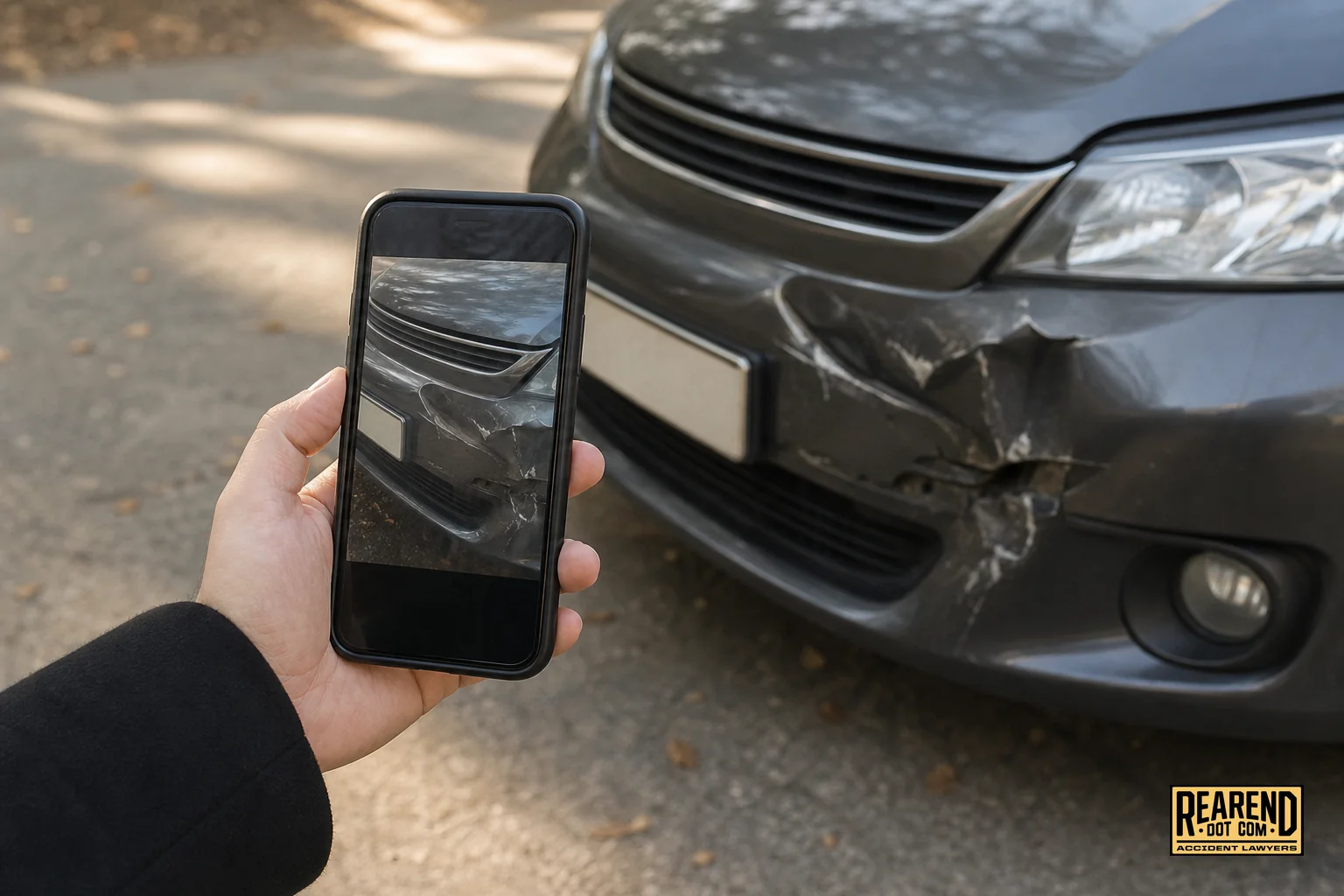
For a deeper look at what to do in the minutes right after impact, see Rear-Ended While Stopped in Traffic What to Do in the First Hour.
4. Exchange Information, Not Opinions
Trade names, phone numbers, insurance carriers, and policy numbers with the other driver. Keep the conversation limited to logistics. Avoid apologizing or speculating about who was at fault, even out of politeness, since those comments can end up in an insurance file later.
If the other driver’s insurance company calls you within the first day asking for a recorded statement, you’re generally not required to give one on the spot. It’s reasonable to say you’ll follow up once you’ve had a chance to see a doctor and gather your thoughts. If you’re stopped at a light when this happens, Rear-Ended at a Red Light Who Pays? A Step-by-Step Breakdown walks through how fault is usually determined.
5. Seek Medical Care Within Hours, Not Days
Whiplash and other soft tissue injuries don’t always announce themselves right away. Inflammation can build for 24 to 72 hours before pain, stiffness, or headaches become noticeable. Getting checked out the same day, at urgent care or an emergency room, creates a medical record dated to the crash itself, which can matter later if an insurer questions when your injury started.
Tell the treating provider about every symptom, even ones that feel minor, like a slight headache or tightness in your shoulder. Symptoms that seem small on day one sometimes turn out to be significant days later. If you notice neck pain a few days after your crash, Neck Pain Days After a Rear-End Accident: Why It Happens and What to Track explains what to watch for and how to track it.
6. Notify Your Own Insurance Company
Most auto policies require you to report an accident promptly, so call your insurer the same day if you can. Give them the basic facts: date, location, and that a police report was filed. You don’t need to describe your injuries in detail at this stage, and it’s fine to say your medical evaluation is still in progress.
If the other driver only carries California’s minimum liability coverage, which is $30,000 per person and $60,000 per accident, your payout options may be limited if injuries and vehicle damage add up quickly. Your own policy’s uninsured or underinsured motorist coverage can sometimes fill that gap. For a closer look at how thin that minimum coverage can be, read Oceanside Rear-End Crash: Is CA Minimum Coverage Enough?
7. Start a Claim File and Track Everything
Open a folder, physical or digital, and start dropping in everything related to the crash: photos, the police report number, medical paperwork, repair estimates, and receipts for anything you paid out of pocket, like a rideshare to a follow-up appointment. A simple daily note about pain levels, missed work, or activities you couldn’t do can become useful later.
This habit matters more than most people realize. Insurance adjusters tend to respond better to claims backed by clear documentation than to ones built on memory alone.
8. Get a Free Case Evaluation Before Talking to the Adjuster Again
Once you’ve handled the immediate steps, it’s worth understanding your options before you go further with the insurance company on your own. A free case evaluation can give you a sense of whether your claim has real value and what factors, like medical treatment and lost wages, might affect it. You can review your claim in just a few clicks for free without any commitment.
Attorney matching is designed to be fast, so you’re not left waiting days to get a sense of your options. That kind of quick turnaround can matter when the other driver’s insurer is already calling you. rearend.com also offers Find Trusted Local Auto Body Shops assistance, so you’re not stuck sorting out vehicle repairs entirely on your own while your claim is still being reviewed.

If you’re weighing whether to handle the claim yourself or get help, How to Choose a Rear-End Accident Attorney Without Getting Burned and Red Flags When Hiring a Personal Injury Lawyer After a Rear-End Crash outline what to look for, though those specific slugs aren’t listed below, so instead see 10 Questions to Ask a Rear-End Accident Attorney Before You Sign Anything.
What to Do If You’re Outside California
These first-24-hours steps apply broadly, whether you’re dealing with a crash on the I-880 in Oakland, the 405 in Los Angeles, or a surface street in Riverside, Fresno, or Oceanside. Local rules around reporting thresholds and fault standards can vary somewhat by state, but the core sequence, safety first, then documentation, then medical care, then a claim, stays largely the same across the country.
If you’re in one of the areas rearend.com regularly serves, including San Diego, Los Angeles, Oakland, and San Jose, you can find location-specific guidance, like Rear-End Accident Claim Process Riverside CA: Step-by-Step After a Crash or Rear-End Accident Attorney Oakland CA No Fee: Who Qualifies and How It Works, for what tends to happen after those first 24 hours.
Frequently Asked Questions
Do I need a police report if there’s no visible damage?
It’s still generally worth calling the police, even for a low-speed impact with little visible damage. Soft tissue injuries don’t always match the amount of vehicle damage, and having an official report can support your claim if pain shows up in the following days.
How soon should I contact a lawyer?
There’s no strict rule here, but many claimants reach out within the first day or two, often after their initial medical visit. Getting a free case evaluation early can help you understand your options before you say something to the other driver’s insurer that could affect your claim later.
What if my car needs repair right away?
You can usually start the repair process alongside your injury claim. rearend.com’s Find Trusted Local Auto Body Shops tool can help you locate a shop near you without slowing down the rest of your claim.
What if I was a passenger, not the driver?
Passengers can generally still file a claim, often against a different insurance policy than the driver they were riding with. See Passenger Injured in Rear-End Accident Not Driver: A Practical Guide for more detail.
What if the other driver has no insurance?
This changes your options but doesn’t necessarily end your claim. Your own uninsured motorist coverage may apply. Rear-Ended by Uninsured Driver What Happens Next: A Practical Guide covers this scenario in more depth.
The first 24 hours after a rear-end crash go by fast, and it’s easy to miss a step while you’re dealing with pain, a damaged car, and a phone full of missed calls. Working through this rear-end accident checklist for the first 24 hours, safety, police, photos, medical care, insurance notice, and documentation, can put you in a stronger position before anyone from the other side gets involved. When you’re ready for the next step, you can Start My Claim and get a sense of where your case stands, at no cost and with no obligation to move forward.
Prior results do not guarantee a similar outcome. – Rearend.com
Related Articles


Need Legal Help After a Rear-End Accident?
Get a free consultation with our experienced legal team