
Oakland Rear-End Crash: Is CA Minimum Coverage Enough?
A rear-end crash on I-880 can total a bumper in seconds, but the financial fallout often runs far longer. If the at-fault driver only carries California’s minimum insurance coverage, an Oakland rear-end accident victim with real medical bills and vehicle damage may find the payout falls well short of what’s owed. Understanding the state’s minimum limits, and what to do when they’re not enough, is the first step toward getting fully compensated.
Key Takeaways
- California’s minimum liability limits: At-fault drivers are generally required to carry at least $30,000 per person and $60,000 per accident for bodily injury, plus $15,000 for property damage.
- Medical costs can outpace the minimum quickly: An ER visit, imaging, and a few weeks of physical therapy can approach or exceed $30,000 well before treatment ends.
- Multiple injured occupants split one pool of money: The $60,000 per-accident cap is shared among everyone hurt in the crash, which can shrink each person’s share.
- Underinsured motorist (UIM) coverage may fill the gap: Your own policy, not just the at-fault driver’s, could provide additional compensation if you carry this coverage.
- A free case evaluation can map out your options: Reviewing your policy and the at-fault driver’s coverage early can reveal avenues for compensation you might not know exist.
California Minimum Coverage At a Glance
| Coverage Type | California Minimum Requirement | What It Typically Covers | Where Gaps Commonly Appear |
|---|---|---|---|
| Bodily Injury Liability (per person) | $30,000 | Medical bills, pain and suffering for one injured person | Falls short after ER, imaging, PT, or specialist referrals |
| Bodily Injury Liability (per accident) | $60,000 | Total injury payout shared among all injured people | Splits thin when a passenger and driver are both hurt |
| Property Damage Liability | $15,000 | Repair or replacement of your vehicle | May not cover a newer or larger vehicle’s repair cost |
| Uninsured/Underinsured Motorist (UM/UIM) | Insurers must offer it; drivers can decline | Gap coverage when the at-fault driver’s limits run out | Only helps if you personally carry this coverage |
| Typical ER + imaging cost (reference) | Not a legal minimum, varies by case | Illustrates how quickly a claim can approach $30,000 | Costs vary widely by injury and provider |
1. Understand What California’s Minimum Coverage Actually Requires
California law sets a floor, not a ceiling, on how much liability insurance a driver needs to carry. The requirement is often shorthanded as “30/60/15.” That means an at-fault driver’s policy generally must include at least $30,000 in bodily injury coverage per person, $60,000 per accident, and $15,000 for property damage, according to the California DMV’s insurance requirements page.
These numbers describe the at-fault driver’s insurance obligation, not a cap on what your injuries or losses are actually worth. If your medical bills, lost wages, and vehicle damage add up to more than the policy provides, the shortfall doesn’t disappear. It becomes a question of where else compensation might come from, and that’s where many Oakland rear-end accident victims get stuck.
It’s worth knowing that a meaningful share of California drivers carry only the state minimum. That’s not a judgment on any individual driver’s choices; insurance is expensive, and minimum coverage satisfies the legal requirement to drive. But it does mean that after a rear-end crash, the driver who hit you may simply not have enough coverage to pay for everything you’re dealing with.
2. Why the Minimum Often Falls Short After a Rear-End Crash in Oakland
Oakland’s traffic corridors, including I-880, the MacArthur Maze, Broadway, and MacArthur Boulevard, see frequent stop-and-go congestion, especially during commute hours. That kind of traffic pattern is a common setting for rear-end collisions: a driver glances away, traffic ahead brakes suddenly, and there isn’t enough following distance to stop in time.
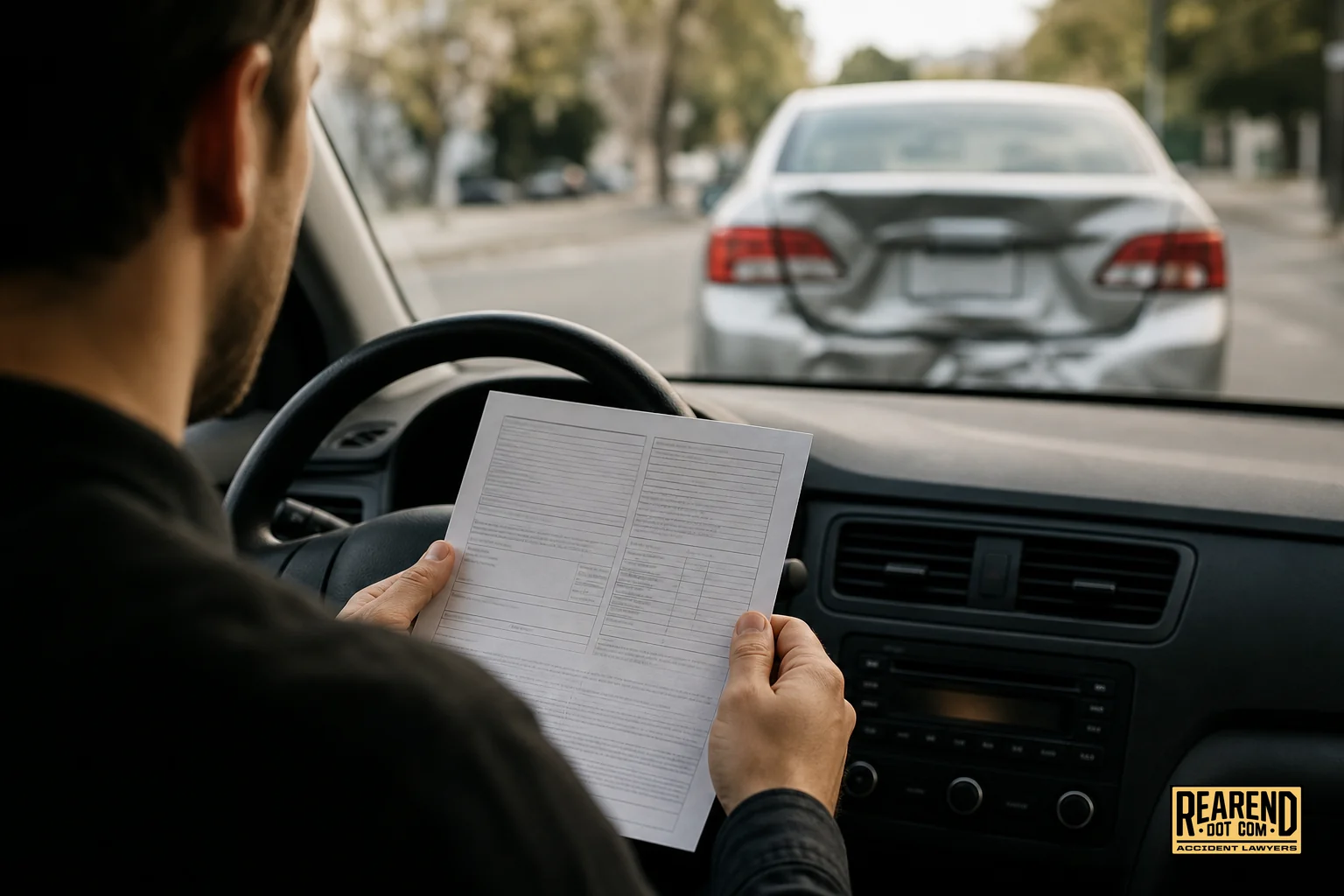
The physical impact of a rear-end hit is often described as minor from the outside, since bumpers absorb some force. But whiplash, disc injuries, and soft tissue damage are common even in what looks like a low-speed collision. Once you factor in a realistic treatment path, the numbers can climb faster than people expect:
- Emergency room visit and imaging: An ER trip with X-rays or a CT scan can represent a meaningful chunk of a $30,000 policy limit before any follow-up care even begins.
- Physical therapy or chiropractic care: Weeks or months of ongoing treatment add up, particularly if a specialist recommends an MRI or referral to an orthopedist.
- Lost wages: Missed work during recovery is a real financial loss that competes with medical bills for the same limited pool of insurance money.
- Vehicle repair or replacement: The $15,000 property damage minimum may not stretch far if your vehicle is newer or the damage extends beyond the bumper.
When more than one person is hurt, such as a driver and a passenger, the $60,000 per-accident cap has to stretch across everyone’s injuries. That can mean each person recovers considerably less than their bills actually total, even if the insurer pays out the full policy limit.
3. Signs Your Damages May Exceed the At-Fault Driver’s Policy Limits
Not every rear-end crash results in a shortfall. But certain patterns are worth paying attention to, because they often signal that a claim is approaching or exceeding what a minimum policy can cover:
- Treatment lasting more than a few weeks: Ongoing physical therapy, chiropractic visits, or pain management appointments add up quickly.
- A specialist referral or imaging recommendation: Being sent for an MRI, referred to an orthopedic surgeon, or told surgery may be needed usually signals a more serious injury and a larger bill.
- Missed work or reduced ability to work: Lost income, especially over multiple weeks, adds a category of damages beyond medical bills alone.
- A vehicle declared a total loss: If the property damage estimate approaches or exceeds $15,000, the property damage minimum may not fully cover replacement.
- Multiple people injured in the same crash: As noted above, this can shrink each person’s available share of the $60,000 per-accident limit.
If any of these apply to your situation, it may be worth learning more about the factors that affect a rear-end accident settlement amount before accepting any offer from an insurance company.
4. What Unrepresented Victims Can Do When Minimum Coverage Isn’t Enough
Handling a claim without legal guidance is possible, but it puts the burden of identifying every available source of compensation entirely on the victim, at a time when they’re also trying to recover physically. A few practical steps can help protect your position:
- Check your own auto policy for underinsured motorist coverage. This is often the single most important step when the at-fault driver’s limits look insufficient.
- Keep every medical record and bill organized. Insurers and adjusters will scrutinize documentation closely, so a complete paper trail matters.
- Avoid accepting an early settlement offer. Insurance adjusters may present a number before your treatment has concluded, which can undervalue your claim significantly.
- Be cautious with recorded statements. Adjusters sometimes ask for a recorded statement quickly after a crash, before you’ve had a chance to understand the full extent of your injuries.
- Get a free case evaluation. A review of your policy, the at-fault driver’s coverage, and your damages can help identify whether underinsured motorist coverage or other avenues apply to your situation. You can review your claim in just a few clicks for free to get a clearer picture of where you stand.
Many victims aren’t sure what separates a reasonable settlement offer from a lowball one. Reviewing the red flags to watch for when hiring a personal injury lawyer can also help you avoid representation that isn’t actually working in your interest.
5. Underinsured Motorist Coverage: The Overlooked Safety Net
Underinsured motorist (UIM) coverage is designed for exactly this situation: the other driver is at fault, but their policy isn’t enough to cover your damages. If you carry UIM coverage on your own auto policy, it can potentially step in to help pay the difference between what the at-fault driver’s insurer pays and what your claim is actually worth.
California insurers are required to offer UM/UIM coverage to policyholders, but drivers can reject it in writing. That means whether you have this protection depends on decisions made when your policy was purchased or renewed, sometimes years before the crash. It’s easy to overlook, since most drivers focus on their own liability coverage and rarely expect to need protection from someone else’s inadequate policy.
This is one reason a thorough claim review matters. Even though you weren’t at fault for the rear-end collision, your own policy could be a meaningful part of the path toward fuller compensation. If you’re unsure whether you carry UIM coverage or how it might apply, a free rear-end accident case evaluation in Oakland can help clarify what’s actually available to you.
6. Steps to Take After an Oakland Rear-End Collision
What you do in the days after a crash can shape how your claim unfolds later. These steps generally apply whether you decide to handle the claim yourself or bring in help:
-
Seek medical care promptly. Even if you feel only mild soreness, some injuries take days to fully present, and a documented visit close to the crash date supports your claim.
-
Request the police report. An official report documents the crash location, involved parties, and often an initial assessment of fault.
-
Exchange and record insurance information. Get the at-fault driver’s insurance company name and policy number, not just their name and phone number.
-
Photograph the scene and vehicle damage. Images of both vehicles, license plates, and the surrounding area can matter later.
-
Avoid giving a recorded statement to the other driver’s insurer without guidance. You’re generally not obligated to provide one, and early statements can sometimes be used against your claim.
-
Don’t sign a release until you understand what you’re giving up. Once you accept a settlement and sign a release, you typically can’t go back for more, even if bills come in later.
-
Get your vehicle assessed by a trusted shop. If you need help finding a reliable option, you can find trusted local auto body shops to get an accurate repair estimate.
If you’re weighing whether to handle negotiations yourself or bring in representation, it helps to understand how a rear-end accident lawyer’s role differs from an insurance adjuster’s, since the adjuster works for the insurance company, not for you.
How a Free Case Evaluation Can Help
When California’s minimum coverage doesn’t match the scope of your injuries or vehicle damage, figuring out your options on your own can feel overwhelming, especially while you’re still recovering. A free case evaluation is designed to remove some of that uncertainty. It typically involves a review of the crash details, your medical treatment so far, your own insurance policy, and the at-fault driver’s coverage, so you can see whether underinsured motorist coverage or other avenues might apply.
Rearend.com works on a no-fee-unless-you-win model, meaning there’s no upfront cost to have your claim reviewed. If you decide to move forward, an attorney who focuses specifically on rear-end collision cases can help push back against an insurer that’s undervaluing your claim, while you focus on recovery. The intake process is designed to be fast, and many claimants get a follow-up from the legal team within 24 hours of submitting their information.
If you’re still deciding whether representation makes sense for your situation, learning how to choose a rear-end accident attorney without getting burned is a useful next step before you sign anything.
Frequently Asked Questions
Is California a minimum coverage state?
California generally requires drivers to carry at least $30,000 per person and $60,000 per accident in bodily injury liability coverage, along with $15,000 in property damage coverage. Many drivers carry more, but the state minimum is what’s legally required.
What happens if the at-fault driver has no insurance at all?
If the at-fault driver is uninsured, your own uninsured motorist (UM) coverage, if you carry it, may be the primary source of compensation. This is separate from underinsured motorist coverage, which applies when the at-fault driver has some insurance but not enough.
Can I still recover more than the at-fault driver’s policy limit?
It may be possible, depending on your own coverage and the specifics of your case. Underinsured motorist coverage is one potential avenue, and in some cases, other sources of recovery may exist. A case evaluation can help identify what applies to your situation.
How much does it cost to get help from a rear-end accident attorney?
Many rear-end accident attorneys, including those connected through rearend.com, work on a contingency basis, meaning there’s generally no fee unless compensation is recovered. You can review how contingency fees work for rear-end accident cases for more detail on how this typically functions.
How long does it take to resolve a claim when coverage is limited?
Timelines vary depending on the complexity of your injuries, whether underinsured motorist coverage is involved, and how quickly records can be gathered. You can read more about what typically affects how long a rear-end accident settlement takes from filing to payment.
Being rear-ended in Oakland is stressful enough without also discovering the at-fault driver’s insurance may not cover your bills. If your medical treatment, lost wages, or vehicle damage seem likely to exceed California’s minimum coverage limits, don’t wait to find out where you actually stand. Start my claim today for a free, no-obligation review of your case, and find out whether underinsured motorist coverage or other options could help close the gap.
Related Articles


Need Legal Help After a Rear-End Accident?
Get a free consultation with our experienced legal team