
What’s the Minimum Car Insurance Coverage After a Crash?
A driver in Oakland gets rear-ended at a stoplight on Broadway. Her neck feels stiff that night, worse by morning. She goes to urgent care, then to physical therapy for six weeks. By the time the bills stop coming in, they add up to nearly $28,000. The at-fault driver, it turns out, carries the state minimum policy. She’s about to learn what that number actually means for her claim.
This scenario plays out across California every week, from San Diego to San Jose. What is minimum insurance coverage for car accident claims, and why does it matter so much when you’re the one who got hit? The short answer: California sets a legal floor for liability insurance, but that floor is often far below what a real injury actually costs. Understanding the gap between the minimum and your actual damages is one of the most important things a rear-end accident victim can do before signing anything or accepting an offer.
What Is Minimum Insurance Coverage for a Car Accident in California?
California law requires every driver to carry liability insurance with limits of at least $30,000 per person and $60,000 per accident for bodily injury, plus $15,000 for property damage. This is commonly shortened to “30/60/15” coverage. It’s the least amount of insurance a driver can legally carry, according to the California Department of Motor Vehicles.
These numbers apply whether the crash happens on the I-5 in San Diego, the 405 in Los Angeles, Broadway in Oakland, or a side street in San Jose. The minimum is a statewide legal requirement, not a local one, though your city or county may see it play out differently depending on traffic patterns and how often multi-car pileups happen.
Here’s the part that catches many victims off guard: the minimum is a legal floor, not a promise that your medical bills, lost wages, and vehicle damage will be covered. It’s simply the smallest amount of insurance a driver is allowed to carry. If your damages exceed that amount, and after a rear-end crash with real injuries, they often do, the insurance company generally isn’t required to pay more than the policy limit allows.
1. Understand What the $30,000/$60,000 Limits Actually Cover
Breaking down these numbers helps explain why they matter so much in a rear-end claim.
- $30,000 per person: This is the maximum the insurer will typically pay for one injured person’s bodily injury claim, regardless of how high the medical bills climb.
- $60,000 per accident: This is the total pool available if more than one person is hurt in the crash. If you and a passenger were both injured, you’re generally splitting that $60,000 between you, not each getting $30,000 automatically.
- $15,000 property damage: This is a separate cap for vehicle repairs or replacement. It’s not pulled from the same pool as injury claims, but it can still fall short of the cost to repair a newer vehicle or replace one that’s totaled.
These limits were set years ago and have not kept pace with the real cost of emergency care, imaging, physical therapy, or chiropractic treatment. A single trip to the ER with imaging can approach five figures before any follow-up care even starts. When a rear-end crash causes whiplash, disc injuries, or soft tissue damage that requires months of treatment, the $30,000 ceiling can be reached quickly, sometimes before treatment is even finished.
2. Recognize Why Rear-End Victims Get Hit Hardest by Low Limits

Rear-end collisions have a pattern that makes minimum coverage especially frustrating for victims. The impact often causes neck and back injuries that don’t show up on X-rays right away. Soft tissue damage, whiplash, and disc issues can take days or weeks to fully present, which means the true cost of treatment isn’t clear at the time of the crash.
Meanwhile, insurance adjusters know the policy limit before you do. If the at-fault driver only carries the state minimum, the adjuster may use that number as leverage, offering a quick settlement that sounds reasonable but sits well below what ongoing treatment and lost wages could add up to. This is one reason rear-end victims sometimes describe feeling lowballed. It’s not always because the injury is being disputed. It could be because the adjuster is managing a policy that was never designed to cover a serious claim in the first place.
Vehicle damage adds another layer. Many rear-end crashes total or nearly total the struck vehicle, especially with today’s repair costs and the price of replacement parts. A $15,000 property damage cap may not stretch far enough to replace a car that’s only a few years old, leaving victims to cover the difference or pursue other avenues.
If you’re unsure whether an offer reflects the real value of your claim, it may help to review the factors that can affect a rear-end accident settlement amount before you sign anything.
3. Check Whether the At-Fault Driver’s Coverage Is Actually Enough
Before you can know if you’re facing a coverage gap, you need to find out what insurance the other driver actually carries. This information usually comes from the police report, the insurance cards exchanged at the scene, or a claim number provided by the at-fault driver’s insurer.
Several signs suggest your damages may exceed the at-fault driver’s policy limits:
- You’ve had more than a few weeks of physical therapy or chiropractic care
- A doctor has recommended imaging, injections, or a referral to a specialist
- You’ve missed work and are losing income during recovery
- Your vehicle was totaled or the repair estimate is climbing toward $15,000
- You’re still experiencing pain or limited mobility weeks after the crash
If any of these sound familiar, it’s worth pausing before accepting a quick settlement offer. Once you sign a release, you generally can’t go back and ask for more, even if your treatment costs keep climbing. This is especially true for drivers in high-traffic corridors around San Diego, Los Angeles, and Oakland, where rear-end crashes at stoplights and on freeway on-ramps are common.
4. Explore Underinsured and Uninsured Motorist (UM/UIM) Coverage

If the at-fault driver’s minimum policy won’t cover your damages, your own policy may be able to help close the gap. This is where underinsured motorist (UIM) coverage and uninsured motorist (UM) coverage come in.
UM/UIM coverage is part of your own auto insurance policy, and it’s designed to step in when the at-fault driver either has no insurance or doesn’t carry enough to cover your damages. California insurers are required to offer this coverage, but drivers can decline it in writing, which means not everyone has it. That’s why checking your own declarations page matters just as much as checking the other driver’s coverage.
Here’s generally how a UIM claim can work: if the at-fault driver’s policy pays out its $30,000 limit and your damages are higher, you may be able to file a claim against your own UIM coverage for the difference, up to your policy’s limits. The process involves notifying your insurer, providing documentation of your damages, and often negotiating, since your own insurance company is still a business assessing risk and cost.
It’s worth noting that pursuing a UM/UIM claim can get complicated, particularly around notice deadlines and how the claim interacts with the at-fault driver’s settlement. This is an area where many rear-end victims benefit from guidance, since the paperwork and timing rules aren’t always intuitive.
5. Know Your Options When Minimum Coverage Isn’t Enough
If you’ve confirmed that the at-fault driver’s policy limits won’t cover your full damages, you generally have a few paths to consider:
- File a UM/UIM claim with your own insurer, if you carry that coverage, to seek the difference between the at-fault driver’s payout and your actual damages.
- Pursue the at-fault driver personally for the amount beyond their policy limit. This route can be difficult, since collecting a judgment from an individual without significant assets isn’t always realistic.
- Look for additional liable parties. In some cases, another party, such as an employer if the at-fault driver was working, or a vehicle owner if it wasn’t their car, may share liability and have separate insurance coverage.
- Document everything early. Medical records, repair estimates, pay stubs showing lost wages, and photos from the scene all help support a claim, whether it’s against the at-fault driver’s insurer or your own UM/UIM coverage.
Timing matters here. Some of these options have shorter windows than others, and accepting a settlement from the at-fault driver’s insurer before exploring UM/UIM options could affect what you’re able to recover later. If you’re early in the process, reviewing what to do in the first 72 hours after being rear-ended can help you avoid common missteps.
6. Work With an Attorney Who Focuses on Rear-End Cases
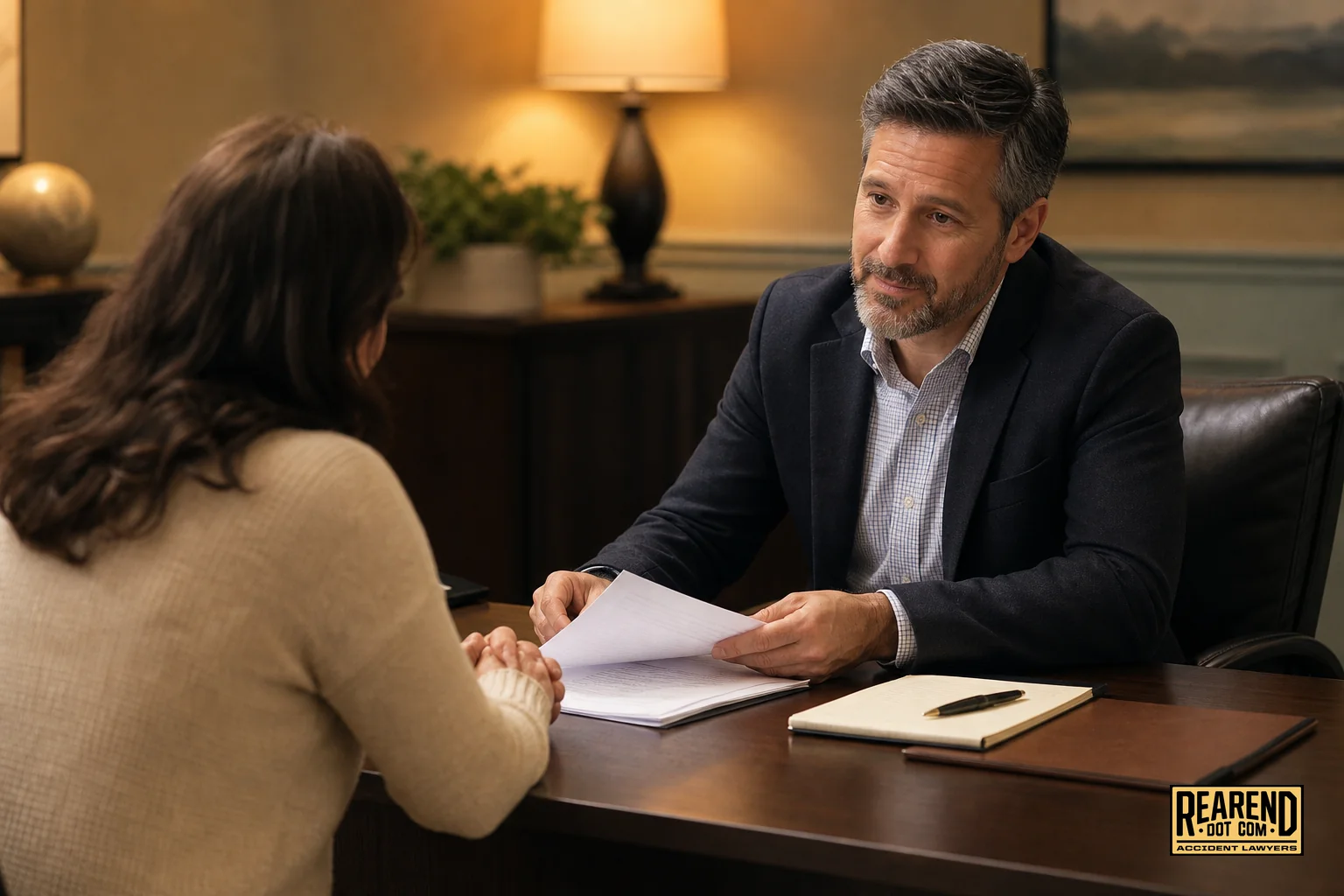
There’s no formal legal “specialization” certification tied to rear-end collision cases specifically, and it’s worth being cautious of anyone who claims otherwise without naming the certifying organization behind it. A more accurate way to think about it is finding an accident attorney who has handled numerous rear-end cases, someone who focuses their practice on this type of crash and is familiar with the patterns that come with it, like delayed soft tissue injuries, minimum-policy lowball offers, and UM/UIM claims.
An attorney who focuses on rear-end cases can help you:
- Determine whether the at-fault driver’s coverage is likely to fall short of your damages
- Review your own policy for UM/UIM coverage and help you understand your options
- Communicate with insurance adjusters so you’re not navigating lowball tactics on your own
- Help organize medical records, repair estimates, and wage loss documentation to support your claim
RearEnd.com offers a free case evaluation for people who’ve been rear-ended, with no obligation and no fees unless compensation is recovered. The intake process is designed to be fast, so you’re not waiting weeks to get basic answers about your situation. Every case is different, and prior outcomes do not guarantee a similar outcome in a new case, but getting clear information early can help you avoid decisions you might regret later.
If you’re weighing whether to bring in help at all, it may be useful to first review red flags to watch for when hiring a personal injury lawyer, or compare your options with how to choose a rear-end accident attorney without getting burned.
Frequently Asked Questions About Minimum Coverage and Rear-End Claims
What is minimum insurance coverage for car accident claims in California?
California requires drivers to carry at least $30,000 per person and $60,000 per accident in bodily injury liability coverage, plus $15,000 in property damage coverage. This is often referred to as 30/60/15 coverage, and it applies statewide.
Can I pursue the at-fault driver for more than their policy limit?
In some situations, yes, though collecting funds beyond an insurance payout can be difficult if the at-fault driver doesn’t have significant personal assets. Many victims instead look to their own underinsured motorist coverage to help close the gap, when that coverage is available.
How much does a rear-end accident settlement pay out when the at-fault driver only has minimum coverage?
It depends on the specifics of the crash, the injuries involved, and whether UM/UIM coverage or other liable parties come into play. Settlement amounts vary widely case by case, and prior results do not predict the outcome of any new claim.
Do I need my own attorney if the at-fault driver only has minimum coverage?
Not everyone needs legal representation, but when damages appear likely to exceed the at-fault driver’s policy limits, having someone review your options, including UM/UIM coverage, can help you understand what’s realistically available before you accept any offer.
How long does a rear-end accident settlement take when UM/UIM coverage is involved?
Cases involving a UM/UIM claim can sometimes take longer than a standard claim, since it may involve negotiating with two insurers instead of one. Learn more about what affects how long a rear-end accident settlement takes from filing to payment.
Don’t Let Minimum Coverage Decide What Your Claim Is Worth
Finding out the at-fault driver only carries California’s minimum policy can feel like the ground shifting under you, especially when your medical bills and vehicle damage don’t fit neatly under that cap. But minimum coverage doesn’t have to be the final word on what you recover. Between your own UM/UIM coverage, other potentially liable parties, and careful documentation, there may be more options available than the first adjuster’s phone call suggests.
If you were rear-ended and you’re unsure whether the at-fault driver’s coverage will be enough, you can review your claim in just a few clicks for free. There’s no cost and no obligation to move forward. When you’re ready to get clear answers about your situation, start my claim and a member of our team will follow up within 24 hours to walk through what you’re facing and what your options may look like.
Disclaimer: The information provided on Rearend.com is for general informational purposes only and does not constitute legal advice.
Related Articles

Need Legal Help After a Rear-End Accident?
Get a free consultation with our experienced legal team