
Rear-End Settlement Payouts: What Factors Affect the Amount?
An adjuster once told a Los Angeles claimant, almost casually, that her “case is worth about $4,000.” She had a bulging disc, six weeks of physical therapy, and a totaled sedan. She almost signed. Then she paused and asked a simple question: how did they arrive at that number? The adjuster couldn’t fully explain it, because the truth is that rear-end accident settlement payouts aren’t calculated from a single formula. They’re built from several moving parts, and understanding those parts is often the difference between accepting a lowball offer and negotiating one that better reflects what happened to you.
If you’re asking how much does a rear-end accident settlement pay out, the honest answer is: it depends on your medical treatment, your lost income, your property damage, the at-fault driver’s insurance limits, and how clearly fault can be shown. This guide walks through each of these variables so you know what to document and what to expect, whether you’re in San Diego, Los Angeles, Oakland, San Jose, or anywhere else in California. Prior results do not guarantee a similar outcome, and every claim is evaluated on its own facts.
What Determines a Rear-End Accident Settlement Payout?
A settlement payout is generally made up of two categories: economic damages (medical bills, lost wages, property repair costs) and non-economic damages (pain and suffering, loss of enjoyment of life). Insurance companies weigh these against the at-fault driver’s policy limits, the strength of your evidence, and sometimes against arguments that you share some blame for the crash.
Because rear-end collisions often involve a driver who failed to stop in time, liability tends to be more straightforward than in other crash types. That clarity can work in your favor, but it doesn’t automatically mean a larger check. The size of the payout still comes down to documentation and math, not assumptions.
Below, we’ll break down the main factors one at a time, so you can see where your own claim might land and what you can do to support it.
Medical Treatment Costs: The Core of Most Payouts
Medical expenses usually carry the most weight in a rear-end settlement. This includes emergency room visits, diagnostic imaging like X-rays or MRIs, chiropractic care, physical therapy, prescription costs, and any future treatment a doctor says you’ll likely need. Adjusters often use your total medical bills as a baseline, then apply a multiplier or a separate calculation for pain and suffering on top of that base.
Soft tissue injuries, like whiplash, are common in rear-end crashes and can be undervalued if treatment isn’t well documented. A gap between the crash date and your first doctor visit, or long breaks between therapy sessions, can give an insurer a reason to argue your injury wasn’t serious. Consistent, well-documented care tends to support a stronger claim. For a deeper look at how these variables interact, see our breakdown of rear-end accident settlement amount factors that victims rarely know about.
What to Document
- Every medical visit related to the crash, including follow-ups
- Prescription receipts and out-of-pocket costs
- Written notes from your doctor about future treatment needs
- Photos of visible injuries, if any, taken soon after the crash
Lost Wages and Reduced Earning Capacity
If your injuries kept you out of work, that lost income is generally recoverable as part of your claim. This applies whether you missed a few days for medical appointments or several weeks during recovery. If your injury affects your ability to perform your job duties long-term, an argument can sometimes be made for reduced future earning capacity, though that typically requires stronger documentation, such as a doctor’s statement about permanent limitations.
To support this part of your claim, keep pay stubs from before and after the crash, and ask your employer for a written statement confirming the days or hours you missed. Self-employed claimants should keep invoices, contracts, or tax records that show a drop in income tied to the recovery period.
Property Damage and Vehicle Repair Costs
Property damage is usually handled as its own line item within the overall claim. This covers the cost to repair your vehicle, or if the damage is severe enough, the vehicle’s actual cash value if it’s declared a total loss. Rental car costs while your vehicle is in the shop may also be recoverable, and some claimants pursue a diminished value claim if the vehicle is worth less after the accident even once repaired.

Getting an accurate repair estimate matters here. Lowball repair quotes from an insurer’s preferred shop are a common complaint among accident victims. RearEnd.com’s auto body shop referral assistance connects claimants with shops that provide realistic estimates, which can help make sure this part of your payout reflects the actual damage rather than a number designed to save the insurer money.
Insurance Policy Limits: Why California’s Minimum Coverage Matters
Here’s something many accident victims don’t realize until they’re deep into negotiations: your settlement can never exceed the at-fault driver’s available insurance coverage, no matter how strong your medical documentation is. California requires drivers to carry a minimum liability coverage of $30,000 per person and $60,000 per accident. If the at-fault driver only carries the state minimum, that $30,000 becomes a hard ceiling on what their insurer will pay for your injuries, regardless of whether your medical bills and lost wages add up to more.
This is a common and often frustrating reality for claimants in San Diego, Los Angeles, Oakland, San Jose, and across the state. A crash with serious injuries and minimum coverage can leave a significant gap between what you’re owed and what the at-fault driver’s policy can actually pay. If you’re weighing whether the minimum limits apply to your situation, our city-specific guides, including what to expect from a rear-end accident attorney in San Diego, walk through how local claims typically unfold under these limits.
Uninsured and Underinsured Motorist (UM/UIM) Coverage: Closing the Gap
This is where uninsured motorist (UM) and underinsured motorist (UIM) coverage on your own auto policy can become one of the most important, and most overlooked, parts of a rear-end claim. If the driver who hit you has no insurance at all, or if their policy limits are too low to cover your damages, UM/UIM coverage on your own policy may allow you to recover additional compensation, even though the claim is technically filed against your own insurer rather than theirs.
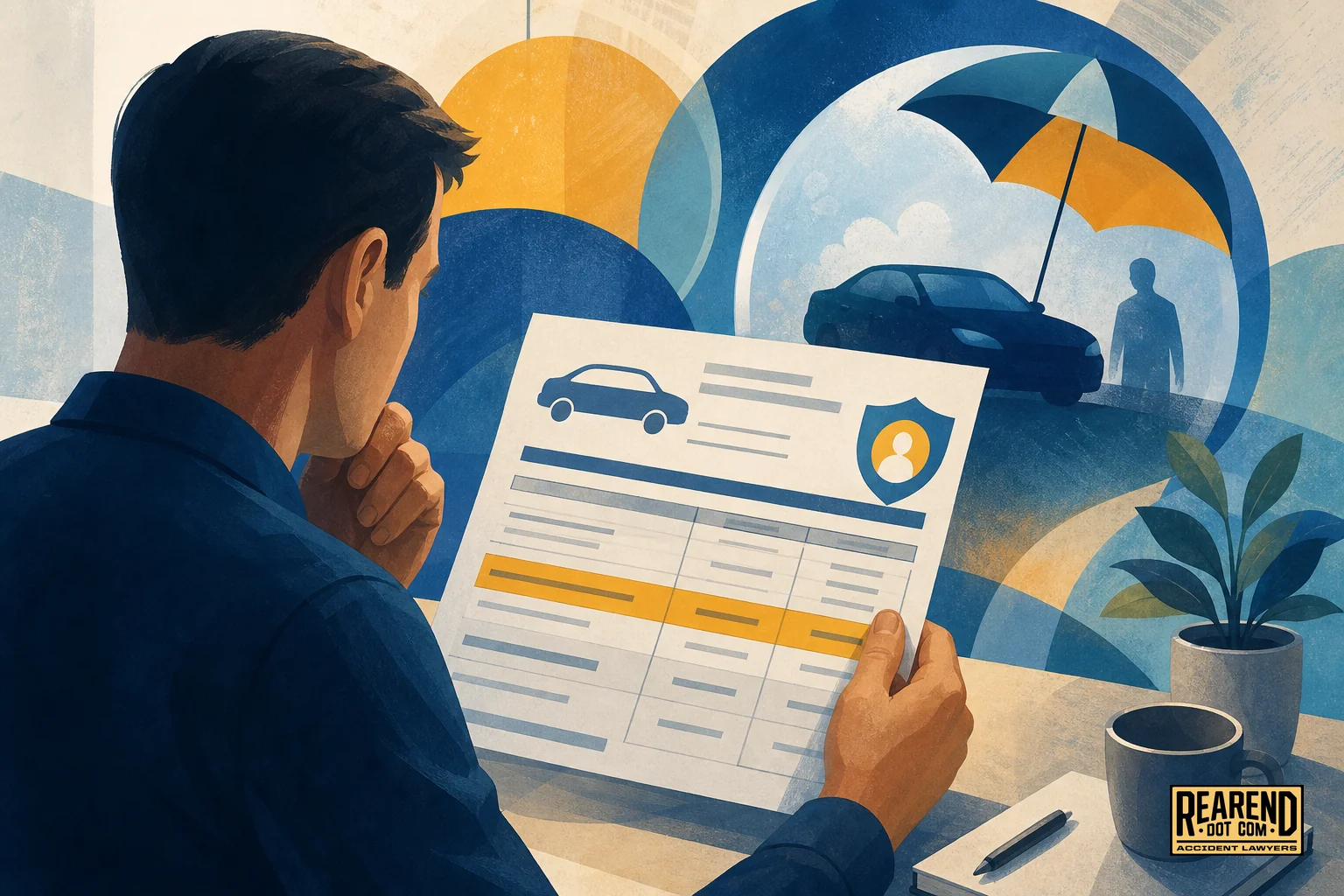
In California, insurers are generally required to offer UM/UIM coverage, though drivers can decline it in writing. Many people don’t recall whether they accepted or declined this coverage when they signed up for their policy years earlier. Checking your declarations page, or asking your insurance agent directly, is a simple step that could reveal coverage you didn’t know you had.
A few things worth understanding about UM/UIM claims:
- UM coverage generally applies when the at-fault driver has no insurance at all, or in some hit-and-run situations.
- UIM coverage generally applies when the at-fault driver has insurance, but their policy limits (such as the $30,000/$60,000 minimum) aren’t enough to cover your damages.
- Your UM/UIM limits are often similar to your liability limits unless you specifically purchased higher amounts.
- Because you’re filing against your own insurer, the process can feel different, and having a clear understanding of your policy terms upfront may help avoid confusion later.
Many unrepresented victims assume that if the at-fault driver has minimal or no coverage, their claim is effectively over. That assumption can be costly. Reviewing your own policy for UM/UIM coverage is often a necessary step before concluding there’s nothing left to recover.
Medical Payments (MedPay) Coverage: Fast Help Regardless of Fault
Medical Payments coverage, commonly called MedPay, is an optional add-on to many California auto policies that can pay for medical treatment related to a crash, generally regardless of who caused it. Unlike a liability claim, which can take weeks or months to resolve, MedPay often pays out faster, which can help cover bills while the larger settlement negotiation is still underway.
MedPay limits are typically modest, often in the range of a few thousand dollars, but that amount can matter a great deal in the early weeks after a crash when medical bills start arriving and the liability claim hasn’t been resolved yet. Checking whether you have MedPay coverage, and how much, is worth doing early. It’s a detail that’s easy to overlook but can meaningfully ease financial pressure while your claim moves forward.
Reviewing your own auto policy for UM/UIM and MedPay coverage takes a few minutes, but it can change what you’re able to recover after a rear-end crash. It’s one of the simplest steps an unrepresented victim can take before assuming a low insurance limit is the end of the story.
Liability and Comparative Fault: How Clear Fault Affects Value
Rear-end collisions are often viewed as having relatively clear liability, since the following driver is generally expected to maintain a safe following distance. That said, “generally” isn’t “always.” Insurers occasionally argue that the lead driver stopped abruptly without cause, or that a third vehicle contributed to the chain of events in a multi-car pileup. Under California’s comparative negligence rules, if you’re found partially at fault, your payout can be reduced by that percentage.
Strong evidence helps counter these arguments. This includes the police report, dashcam footage if available, photos of the scene and vehicle positions, and contact information for any witnesses. The more clearly the evidence supports the other driver’s fault, the less room there is for the insurer to chip away at your payout with comparative fault arguments.
How These Factors Come Together During Negotiation
Once medical treatment is largely complete (or a doctor has provided a clear picture of future needs), these categories are typically compiled into a demand letter sent to the at-fault driver’s insurer. That letter usually includes medical records and bills, lost wage documentation, property damage estimates, and a summary of how liability is established. The insurer then responds with a counteroffer, and negotiation begins from there.
This is often where unrepresented victims feel outmatched. Insurance adjusters negotiate claims for a living, and their opening offers are frequently lower than what supporting documentation would justify. Knowing what red flags to watch for during this stage matters. Our guide on red flags when hiring a personal injury lawyer after a rear-end crash can help you avoid compounding one problem with another, and our piece on how to choose a rear-end accident attorney without getting burned outlines what questions to ask before you sign with anyone.
If you’re in Los Angeles specifically, it also helps to understand the adjuster’s role from the outset. Our breakdown of a rear-end accident lawyer vs insurance adjuster in Los Angeles explains whose interests each side is actually representing during negotiation.
Frequently Asked Questions About Rear-End Settlement Payouts
How much does a rear-end accident settlement pay out on average?
There’s no single average that applies to every case, because payouts depend on medical costs, lost wages, property damage, and available insurance limits. A claim involving minor soft tissue injuries and minimum policy limits will typically resolve differently than one involving surgery, extended time off work, and higher liability coverage. Our related post on settlement amount factors that victims rarely know about goes deeper into how these variables interact.
Does a rear-end accident settlement include pain and suffering?
Many settlements include a component for pain and suffering alongside economic damages like medical bills and lost wages. Insurers often calculate this using your medical costs as a starting point, adjusted based on injury severity, documented impact on daily life, and recovery time.
What if the at-fault driver has no insurance or too little coverage?
This is where uninsured and underinsured motorist coverage on your own policy may come into play. If the at-fault driver’s coverage doesn’t fully cover your damages, or they carry no insurance at all, your UM/UIM coverage could allow you to pursue additional compensation. Checking your own declarations page early is a practical first step.
How long does it take to get a rear-end accident settlement payout?
Timing varies based on how quickly you finish medical treatment, how responsive the insurer is, and whether the claim needs to go beyond initial negotiation. Our detailed guide on how long a rear-end accident settlement takes from filing to payment walks through each stage of that timeline.
Can I still recover compensation if I don’t hire an attorney?
Some claimants do handle their claims without legal representation, particularly for very minor incidents. However, given how insurers calculate offers and the number of moving parts involved, many victims choose to at least get a free case evaluation before deciding. If you’re in Oakland, our page on whether a free rear-end accident case evaluation is worth pursuing outlines what that process typically looks like.
Get Clarity Before You Accept Any Offer
An insurance adjuster’s first number is rarely the final word, and understanding the factors behind your rear-end accident settlement payout, medical costs, lost wages, property damage, policy limits, UM/UIM coverage, and MedPay, puts you in a stronger position at the negotiating table. You don’t have to guess at what your claim might be worth or navigate insurance company tactics on your own.
RearEnd.com offers a free case evaluation with no obligation, and representation works on a no-fees-unless-you-win basis. If you want to see where your documentation stands and what factors might apply to your specific situation, you can start your claim today, or take a few minutes to review your claim in just a few clicks for free before you respond to any settlement offer.
Disclaimer: The information provided on Rearend.com is for general informational purposes only and does not constitute legal advice.
Need Legal Help After a Rear-End Accident?
Get a free consultation with our experienced legal team