
How Do You Prove Fault in a Rear-End Accident?
Your neck is sore, your bumper is crushed, and the other driver is already telling the police officer it “wasn’t really my fault.” Now what? Figuring out how to prove fault in a rear-end accident is often the single biggest question victims have in the hours and days after a crash, and the answer matters a lot more than most people realize. Whether the collision happened on the I-5 in San Diego, the 101 in San Jose, or a side street in Oakland, the process of establishing who caused the wreck follows a similar pattern across California.
This guide walks through the legal presumption that often applies to rear-end crashes, the evidence that actually holds up with insurance adjusters, and the situations where fault gets disputed even when the facts seem obvious. If you’re trying to figure out your next move, this is the place to start.
What Fault Really Means After a Rear-End Crash
Fault, in legal terms, refers to which driver’s actions caused the collision and the resulting damage or injury. In California, this connects to the state’s comparative negligence rules, which allow fault to be divided between parties rather than assigned entirely to one side. That distinction matters because it shapes how much compensation a victim can recover, even in cases that seem straightforward.
Many people assume that being rear-ended automatically means the driver behind is at fault. That assumption is often correct, but it’s not automatic. Insurance companies and courts look at the specific circumstances of the crash, not just the position of the vehicles when it ended. Understanding that difference early can save victims from accepting a settlement that undervalues their claim.
California traffic law generally requires drivers to maintain a safe following distance, which is one reason the trailing driver is frequently found responsible. Still, “frequently” is not “every time,” and that gap is exactly where disputes tend to start.
The Legal Presumption of Rear-Driver Responsibility
Courts and insurance adjusters commonly start from the position that the driver in the rear had a duty to leave enough space to stop safely. If that driver was following too closely, distracted, or speeding, the presumption points toward their liability. This is sometimes referred to informally as the “rear driver presumption,” though it isn’t an absolute rule written into a single statute.
Here’s where it gets more complicated. The presumption can be challenged, and insurers know it. A few scenarios where the lead driver could share some responsibility include:
- The lead driver reversed suddenly or unexpectedly into traffic
- Brake lights or taillights were broken or not functioning
- The front vehicle stopped abruptly without a legitimate safety reason, sometimes called “brake checking”
- The lead driver merged into the lane at an unsafe distance right before braking
- Multiple vehicles were involved in a chain-reaction crash, complicating who hit whom first
These exceptions don’t come up in most rear-end cases, but insurers may raise them anyway, hoping a victim will accept a reduced settlement rather than push back. That’s one reason having a skilled accident attorney who has handled numerous rear-end cases can make a real difference in how a claim is evaluated and negotiated.
Key Evidence That Helps Prove Fault
Evidence is what turns a presumption into a supported claim. Insurance companies don’t pay out based on assumptions; they respond to documentation. Here are the categories that carry the most weight when proving fault in a rear-end collision.
Police and Collision Reports
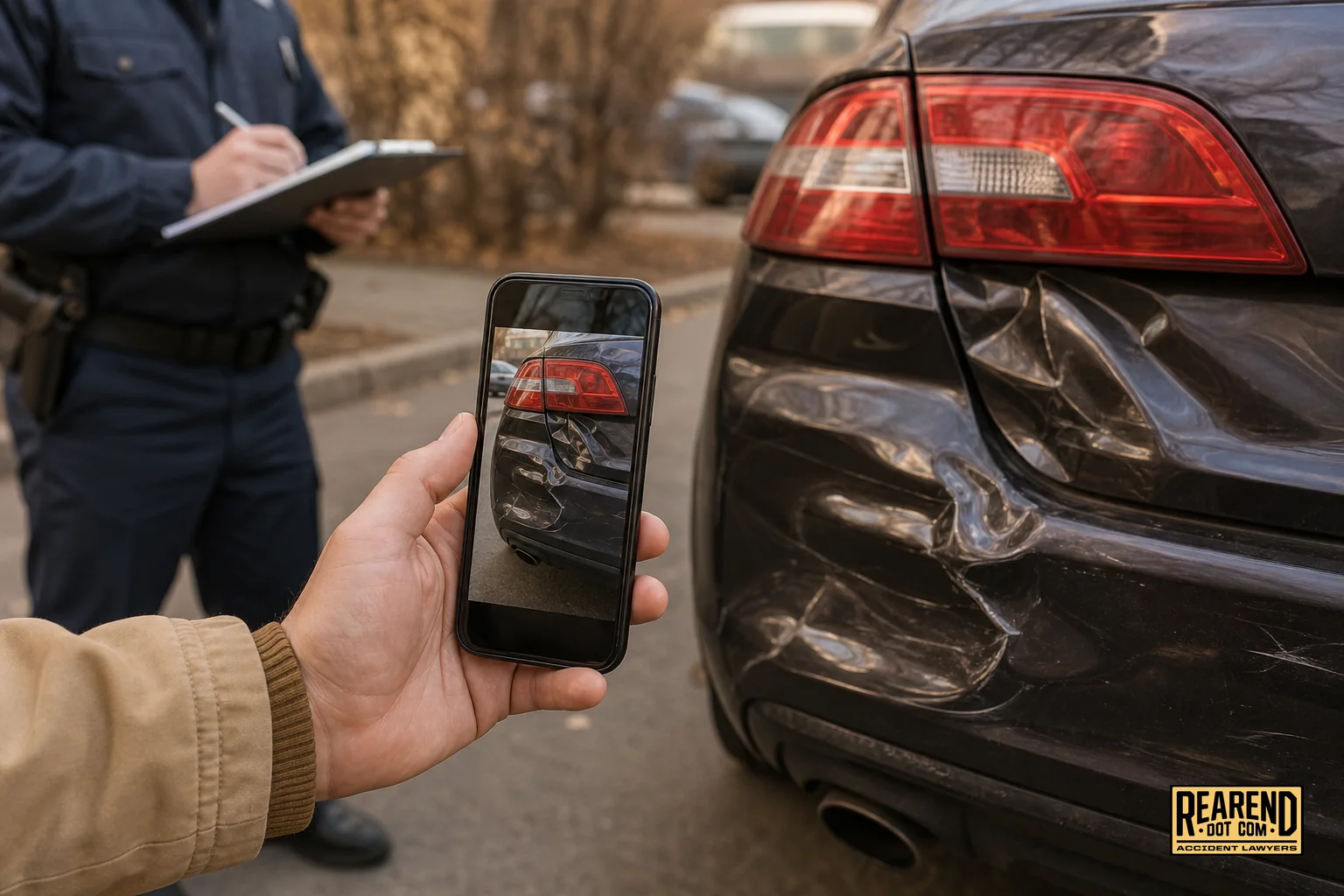
An official police report, sometimes called a traffic collision report in California, documents the officer’s observations at the scene, statements from both drivers, and often an initial opinion on contributing factors. It’s rarely the final word on fault, but it carries significant weight with insurers and can be a valuable anchor for the rest of the case.
Dashcam and Surveillance Footage
Video evidence is one of the most persuasive tools available. Dashcam footage from either vehicle, nearby traffic cameras, or a business’s exterior security camera can show exactly what happened in the seconds before impact. Footage capturing the following distance, brake lights, and speed often resolves disputes that would otherwise come down to conflicting stories.
Witness Statements
Independent witnesses, people not involved in the crash, can corroborate what happened. Their accounts are especially useful when there’s no video and the drivers disagree about the sequence of events. Getting names and contact information at the scene, before people drive off, is critical.
Photos of the Scene and Vehicle Damage
Photos of skid marks, vehicle positions, damage patterns, and road conditions can help reconstruct what happened. Damage location and severity often align with a specific version of events, which is why insurers request these images early in a claim.
Medical Records
Medical documentation doesn’t just support the value of an injury claim, it also helps tie injuries directly to the collision. Gaps in treatment or delayed visits can give an insurer a reason to argue the injury came from something else, so prompt and consistent care matters.
Vehicle Data and Event Data Recorders
Many modern vehicles store data from an event data recorder, sometimes called a “black box,” that can capture speed, braking, and throttle input in the moments before a crash. This data isn’t always requested, but in disputed cases it can be a deciding factor.
If you’re unsure which of these apply to your situation, reviewing what happened during the first 72 hours after being rear-ended can help clarify what evidence may still be available and what might already be gone.
When Insurance Companies Try to Dispute Fault
Even in cases that look clear-cut, insurers sometimes push back. This isn’t necessarily because the facts are genuinely in question, it’s often a business decision aimed at reducing a payout. Common tactics include:
- Arguing sudden or unnecessary stopping by the lead driver, even without supporting evidence
- Claiming comparative fault to reduce the settlement percentage owed
- Requesting a recorded statement early, before a victim understands how their words might be used
- Delaying the claims process in hopes the victim accepts a lower offer out of financial pressure
California’s minimum liability coverage requirements add another layer to this. Drivers in the state are generally required to carry at least $30,000 per person and $60,000 per accident in bodily injury liability coverage. When damages exceed those minimums, which happens often in cases involving ongoing medical treatment, insurers may look harder for reasons to dispute fault or reduce the payout, since a full liability finding could exceed the at-fault driver’s policy limits.
This is a major reason victims shouldn’t assume an insurer will simply “do the right thing” once fault seems obvious. If you’re wondering whether an adjuster is treating your claim fairly, this breakdown of how insurers handle rear-end claims covers the warning signs to watch for.
How an Attorney Strengthens Your Fault Evidence
Proving fault isn’t only about having evidence, it’s about presenting it in a way that holds up under an insurer’s scrutiny. An attorney who focuses on rear-end cases typically knows which documentation to request quickly, before footage gets overwritten or witnesses become hard to reach.

Some of the ways legal representation can support a fault claim include:
- Sending preservation letters to businesses or municipalities to secure surveillance footage before it’s deleted
- Coordinating with accident reconstruction professionals in disputed or complex cases
- Reviewing police reports for errors or missing details that could weaken the claim
- Handling all communication with the insurance adjuster, so victims don’t unintentionally make statements that get used against them
- Organizing medical records in a way that clearly connects injuries to the collision timeline
This kind of support tends to matter most in cases where the insurer is actively pushing back on fault or trying to minimize the payout. It’s also why many victims choose to work with a firm that has handled numerous rear-end collision claims, rather than a general practice attorney juggling many different case types. RearEnd Legal’s model is built specifically around this type of case, with no fees unless the claim results in compensation, so cost isn’t a barrier to getting help early, when evidence matters most.
If you’re not sure whether your case needs legal help, reviewing your options with a free case evaluation can clarify what evidence you already have and what might still need to be gathered.
What to Do Right After the Crash to Protect Your Fault Claim
The steps taken in the immediate aftermath of a rear-end crash often determine how strong the fault evidence ends up being. A few practical actions can make a meaningful difference:
- Call the police so an official report is created, even if the damage looks minor at first.
- Take photos and video of both vehicles, the road, skid marks, and any visible injuries before anything is moved or repaired.
- Collect witness information, including names and phone numbers, before people leave the scene.
- Avoid discussing fault at the scene, even casual statements like “I didn’t see you stop” can be used later to suggest shared responsibility.
- Seek medical attention promptly, even if injuries seem minor, since some symptoms from soft tissue injuries appear days later.
- Avoid giving a recorded statement to the other driver’s insurer without speaking to an attorney first.
Skipping any of these steps doesn’t necessarily end a claim, but it can make proving fault more difficult later, particularly if the insurer is looking for reasons to dispute liability. For a more detailed breakdown by location, see how the rear-end accident legal process plays out in Oceanside or how San Jose claims can slow down when evidence isn’t gathered early.
Frequently Asked Questions About Proving Fault in a Rear-End Accident
Can the front driver ever be at fault in a rear-end crash?
Yes, in some circumstances. If the lead driver reversed unexpectedly, had non-functioning brake lights, or stopped abruptly without a safety reason, fault may shift partially or fully in their direction. These situations are less common but do occur, which is why gathering evidence still matters even when fault seems obvious.
What if there were no witnesses to the crash?
A lack of witnesses doesn’t mean a claim can’t be supported. Police reports, vehicle damage patterns, dashcam footage, nearby surveillance video, and even event data recorder information can help establish what happened without an eyewitness account.
Does a police report decide fault for good?
Not necessarily. A police report is an important piece of evidence, but it isn’t the final legal determination of fault. Insurers and, if needed, courts weigh the report alongside other evidence such as photos, witness statements, and medical records.
Can I still recover compensation if I share some fault?
Possibly. California follows a comparative negligence system, meaning compensation may be reduced by the percentage of fault assigned to you rather than eliminated entirely. This is one reason it’s worth having your case reviewed rather than assuming a partial fault argument disqualifies your claim.
How long do I have to gather evidence after a rear-end accident?
Some evidence, like surveillance footage, may only be retained for a short window before it’s deleted, so acting quickly is important. California’s statute of limitations for personal injury claims generally allows a longer period to file a lawsuit, but that doesn’t mean evidence will still be available if you wait. Learn more about California’s filing deadlines through the California Code of Civil Procedure.
Getting the Right Support for Your Rear-End Claim
Proving fault in a rear-end accident often comes down to acting quickly, documenting thoroughly, and understanding how insurers evaluate a claim behind the scenes. Victims who navigate this process alone sometimes lose access to evidence, or unintentionally say something that gives an adjuster room to dispute liability. If you’re weighing whether to handle a claim yourself, it may help to first review some of the red flags to watch for when hiring a personal injury lawyer, so you know what good representation should actually look like.
If you’ve been rear-ended and you’re not sure whether your evidence is strong enough to support a full claim, reviewing your claim in just a few clicks for free is a reasonable first step. There’s no cost to find out where you stand, and no obligation to move forward. When you’re ready to take action, you can start your claim and get a clearer picture of what proving fault could mean for your specific situation.
Disclaimer: The information provided on Rearend.com is for general informational purposes only and does not constitute legal advice.
Related Articles


Need Legal Help After a Rear-End Accident?
Get a free consultation with our experienced legal team