
Rear-End Accident Claim Process Riverside CA: Step-by-Step After a Crash
Forty-eight hours after a rear-end crash on the 91 Freeway near Corona, a Riverside County resident got a call from the at-fault driver’s insurance company. The adjuster was friendly, the offer sounded reasonable, and the victim, still sore, still confused, almost said yes. What she didn’t know was that she hadn’t yet seen a doctor, hadn’t filed a police report request, and had no idea California gives her two years to pursue a claim. She nearly walked away from possible additional funds she was legally owed.
The rear-end accident claim process in Riverside, CA is not overly complicated, but it has a specific sequence. Miss a step, skip a deadline, or say the wrong thing to an adjuster, and your compensation shrinks fast. This guide walks you through every phase in order, so you know exactly what to do and when to do it.
What the Riverside Claim Process Actually Looks Like
California is a fault-based state, which means the driver who caused the crash is financially responsible for the damages. In a rear-end collision, fault almost always falls on the driver who struck from behind, but “almost always” is not the same as “automatically.” Insurance companies still investigate, still dispute, and still look for any reason to reduce what they pay you.
The Riverside claim process generally moves through two possible tracks. The first is an insurance claim, either through your own policy or the at-fault driver’s insurer. The second is a personal injury lawsuit filed in Riverside County Superior Court. Most cases resolve through the insurance track, but having the lawsuit option in your back pocket changes how seriously insurers take your claim.
Riverside County also has its own procedural realities: high traffic volume on the 91, 60, and 215 freeways generates a steady stream of rear-end crashes, and local insurers know the territory. Out-of-state insurers, common when the at-fault driver is passing through, sometimes try to apply different standards. Knowing the California rules protects you from that tactic.
1. Secure the Scene and Document Everything
The moments right after a crash are chaotic, but they’re also when the most valuable evidence exists. Your first priority is safety, move vehicles out of traffic if possible and check for injuries. Then, before anything else changes, start documenting.
- Call 911 or Riverside PD. If the crash happened on a city street, Riverside Police Department typically responds. On the 91, 60, or 215, the California Highway Patrol (CHP) usually takes the report. Either way, get a report filed. The report number is your anchor for the entire claim.
- Photograph everything. Take wide shots of both vehicles, close-ups of all damage, the road surface, any skid marks, traffic signals, and the surrounding area. Photograph the other driver’s license, registration, and insurance card.
- Collect witness information. Names and phone numbers from anyone who saw the crash. Witnesses become harder to reach with every passing day.
- Write down your own account. Memory fades quickly after trauma. A voice memo or quick notes on your phone, recorded at the scene, can be more accurate than anything you recall a week later.
Do not apologize, admit fault, or speculate about what happened. Stick to factual exchanges with the other driver and the responding officer.
2. Seek Medical Attention, Even If You Feel Fine
Soft tissue injuries, whiplash, muscle strains, ligament damage, are the most common result of rear-end collisions, and they frequently don’t produce obvious symptoms for 24 to 72 hours. Adrenaline masks pain. Inflammation builds slowly. By the time you feel it, you may have already told an adjuster you’re “doing okay.”
See a doctor as soon as possible after the crash. Riverside University Health System, Riverside Community Hospital, and numerous urgent care clinics throughout the Inland Empire can evaluate you quickly. If your injuries are serious, go to the emergency room immediately.
From a claims standpoint, a gap in medical treatment is one of the most damaging things that can happen to your case. Insurers argue that if you were truly hurt, you would have sought care right away. Every day between the crash and your first medical visit is a gap they will use against you.
Keep records of every appointment, every prescription, every diagnosis, and every out-of-pocket expense. These documents form the financial backbone of your claim. For more on what factors affect your final settlement amount, see Rear-End Accident Settlement Amount Factors That Victims Rarely Know About.
3. Report the Crash to Your Insurance Company
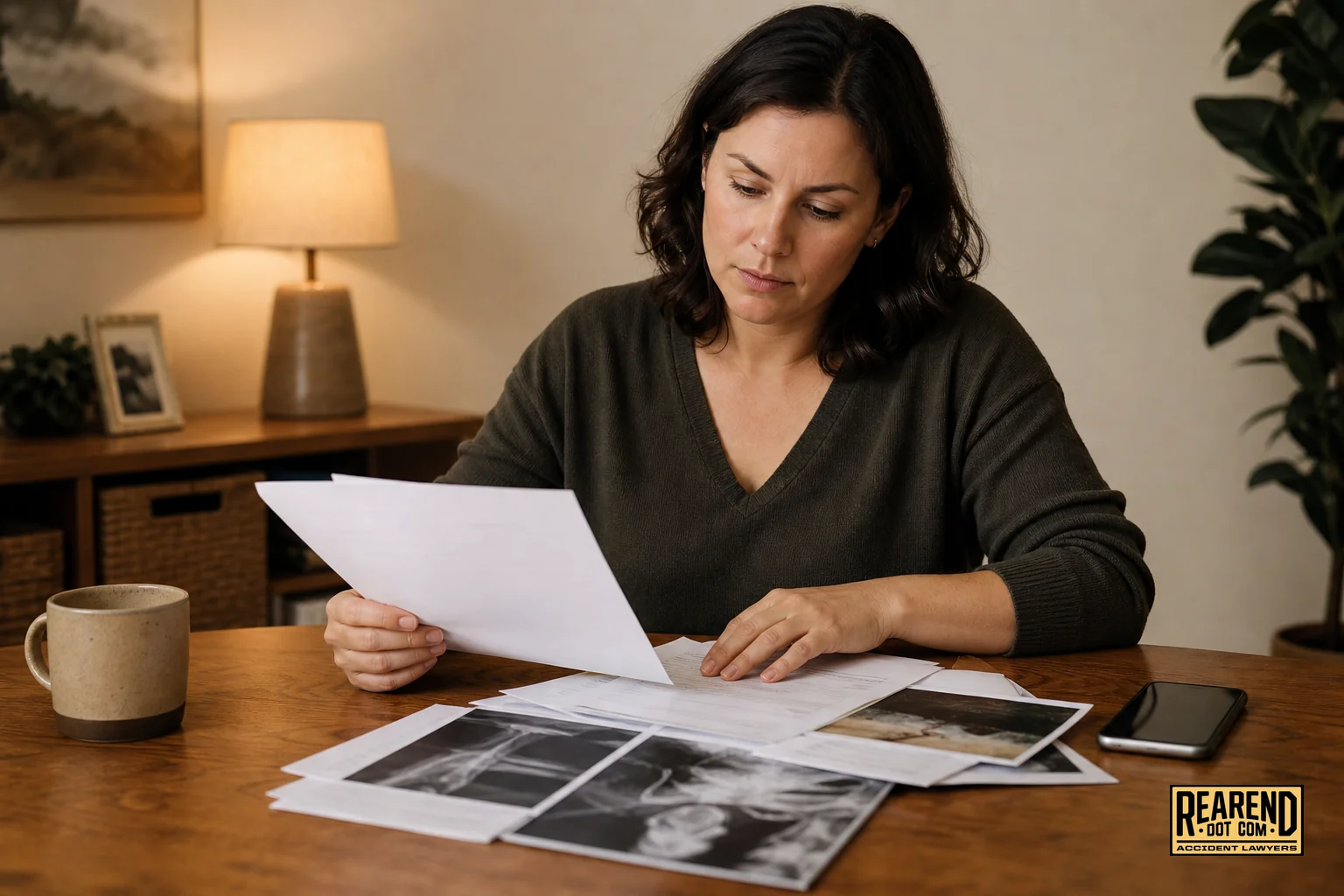
California law requires you to report accidents to your insurer promptly, most policies define this as “within a reasonable time,” and some set specific windows. Failing to report can give your insurer grounds to deny coverage, even if the other driver was entirely at fault.
When you call, report the facts: date, time, location, the other driver’s information, and that you’ve sought medical attention. That’s it. You are not required to give a recorded statement to your own insurer in most circumstances, and you should be cautious about doing so before you’ve spoken with an attorney.
What to Watch Out For
- Recorded statements: Your insurer may ask for one. The at-fault driver’s insurer will almost certainly ask for one. You have the right to decline until you’ve had legal guidance. Anything you say can be used to reduce your payout.
- Uninsured/underinsured motorist (UM/UIM) coverage: If the at-fault driver has no insurance or insufficient coverage, your own UM/UIM policy may be your primary source of compensation. Riverside County sees a meaningful number of uninsured drivers, knowing your own policy limits matters.
- Medical payments (MedPay) coverage: If you carry MedPay, it can cover immediate medical costs regardless of fault, giving you financial breathing room while the liability claim is resolved.
If you’re unsure whether to give a statement or how to handle your insurer’s questions, understanding who the adjuster actually works for is a good place to start.
4. File the At-Fault Driver’s Insurance Claim (Third-Party Claim)
Once you have the at-fault driver’s insurance information, from the police report or the exchange at the scene, you can open a third-party claim directly with their insurer. This is separate from anything you do with your own insurance company.
California follows a pure comparative fault rule under Civil Code § 1714. That means even if you were partially responsible for the crash, you can still recover damages, your award is simply reduced by your percentage of fault. In a rear-end collision, the following driver is almost always found primarily at fault, but insurers sometimes try to assign partial blame to the front driver (sudden braking, brake lights not working, etc.). Don’t accept that framing without pushback.
Dealing With Out-of-State Insurers
Riverside County sits along major interstate corridors, the 10, 15, and 40 all pass through or near the region. Drivers from Nevada, Arizona, and other states are involved in local crashes regularly. When the at-fault driver’s insurer is based out of state, they may try to apply their home state’s standards or drag out the process hoping you’ll accept less. California law still governs your claim. An attorney familiar with the Riverside claims environment can push back effectively when out-of-state insurers stall.
What the Adjuster Is Actually Doing
When the at-fault driver’s adjuster calls you, they are gathering information to minimize what their company pays. They are not on your side. They may sound sympathetic, but their job is to close your claim for as little as possible. Politely decline to give a recorded statement until you’ve had a chance to review your legal options.
5. Know Riverside County’s Filing Deadlines
Deadlines in the California claims process are not suggestions. Missing them can permanently eliminate your right to compensation, regardless of how strong your case is.
- Personal injury statute of limitations: Under California Code of Civil Procedure § 335.1, you have two years from the date of the crash to file a personal injury lawsuit. If you miss this window, your case is almost certainly gone.
- Property damage: California allows three years for property damage claims under CCP § 338.
- Government entity exception: If your crash involved a government vehicle (city bus, county vehicle, CHP cruiser) or was caused by a dangerous road condition maintained by a public agency, you must file a government tort claim within six months of the incident. This is a hard deadline with very limited exceptions.
- Minor victims: If the injured person is a minor, the two-year clock generally doesn’t start until they turn 18, but there are exceptions, and you should not rely on this without legal advice.
Two years sounds like a long time. It isn’t. Medical treatment takes months. Demand packages take time to assemble. Negotiations can drag. Starting the process early gives you leverage; waiting until the deadline approaches gives it to the insurer.
For a deeper look at how long the full process typically takes, see How Long Does a Rear-End Accident Settlement Take From Filing to Payment?
6. Build Your Demand Package

Once your medical treatment is complete, or you’ve reached maximum medical improvement (MMI), meaning your condition has stabilized, it’s time to assemble your demand package. This is the formal document you (or your attorney) send to the at-fault insurer laying out exactly what you’re owed and why.
What Goes Into a Strong Demand Letter
- Medical records and bills: Every treatment, every provider, every dollar spent. Emergency room visits, specialist appointments, physical therapy, chiropractic care, imaging (MRI, X-ray), and prescription costs all belong here.
- Lost wages documentation: Pay stubs, employer letters, or tax records showing income you couldn’t earn because of your injuries.
- Property damage: Repair estimates or total loss valuation for your vehicle, plus rental car costs.
- Pain and suffering: California allows recovery for non-economic damages, the physical pain, emotional distress, and reduced quality of life caused by the crash. These are harder to quantify but often represent the largest portion of a settlement.
- Future medical costs: If your injuries require ongoing treatment, those projected costs belong in the demand as well.
The quality of your documentation directly affects the number the insurer is willing to put on the table. A demand package with thorough, organized records signals that you’re prepared to fight. A thin, disorganized package signals that you might accept less. Insurers read both signals clearly.
An attorney who regularly handles rear-end cases knows how to frame non-economic damages in a way that’s persuasive and defensible, which is one of the most significant ways legal representation changes outcomes.
7. Negotiate the Settlement or File a Lawsuit
After the demand package is submitted, the insurer will respond, usually with a counteroffer that’s lower than your demand. This begins the negotiation phase. Back-and-forth exchanges are normal. The question is whether the final number reflects the true value of your claim.
When to Accept and When to Push Back
Accepting too early is one of the most common mistakes rear-end accident victims make. Once you sign a release, you cannot go back for more, even if your injuries turn out to be worse than initially thought. Before accepting any offer, make sure:
- Your medical treatment is complete or your future costs are accounted for
- All economic damages (bills, wages, property) are fully covered
- Non-economic damages are meaningfully included, not just token amounts
- You’ve had an attorney review the offer, even if you haven’t hired one yet
Filing in Riverside County Superior Court
If negotiations stall or the insurer refuses to make a fair offer, filing a lawsuit in Riverside County Superior Court is the next step. This doesn’t mean the case goes to trial, the vast majority of personal injury lawsuits settle before trial, often because the filing itself signals that you’re serious. Mediation is also available as a structured alternative to trial, where a neutral third party helps both sides reach an agreement.
Filing a lawsuit also restarts the clock on the insurer’s urgency. Cases that sat dormant for months often move quickly once a complaint is filed.
How an Attorney Who Focuses on Rear-End Cases Changes the Outcome

Unrepresented accident victims consistently receive lower settlement offers than those with legal representation. This isn’t speculation, it’s a pattern insurers rely on. When you don’t have an attorney, adjusters know you’re less likely to file a lawsuit, less likely to know the true value of your claim, and more likely to accept the first reasonable-sounding number they offer.
An attorney who focuses on rear-end collision cases brings specific knowledge to each stage of the process described above:
- At the documentation stage: They know what evidence matters and how to preserve it before it disappears.
- During medical treatment: They can connect you with providers who understand injury documentation for legal purposes.
- When building the demand: They know how to calculate and argue for non-economic damages that insurers routinely undervalue.
- In negotiations: They have leverage the insurer takes seriously, because they’ve filed lawsuits before and will do it again.
At Rearend.com, the intake process is straightforward: submit your information online, and a member of the legal team follows up within 24 hours. There are no upfront fees. The contingency model means you pay nothing unless compensation is recovered on your behalf. For a clear breakdown of how that fee structure works, see Rear-End Accident Lawyer Cost & Fees.
If you’re still deciding whether to hire an attorney at all, it’s worth reading about red flags to watch for when hiring a personal injury lawyer, so you know what a trustworthy attorney relationship actually looks like. And if you want to understand what the Riverside-specific claim experience looks like with legal representation, this guide on maximizing your Riverside claim covers it in depth.
If you’ve already been rear-ended and haven’t yet taken legal action, review your claim in just a few clicks for free, it takes a few minutes and costs nothing.
Frequently Asked Questions About the Riverside Rear-End Claim Process
How long does the claim process take in Riverside County?
It varies significantly based on injury severity, insurer cooperation, and whether a lawsuit is filed. Minor claims with clear liability can resolve in a few months. Cases involving serious injuries, disputed fault, or uncooperative insurers can take one to two years or longer. For a detailed breakdown, see How Long Does a Rear-End Accident Settlement Take?
Can I still file a claim if the other driver was uninsured?
Yes. If you carry uninsured motorist (UM) coverage, your own policy steps in to cover your damages. You can also pursue the at-fault driver personally through a civil lawsuit, though collecting from an uninsured individual can be difficult. An attorney can help you identify all available sources of compensation.
What if the at-fault driver’s insurer is based out of state?
California law still governs your claim. Out-of-state insurers must comply with California’s insurance regulations and cannot apply their home state’s lower standards. If they stall or misrepresent your rights, an attorney can escalate the matter quickly.
Do I need an attorney for a minor rear-end crash?
Not always, but even in seemingly minor crashes, injuries can emerge days later, and a quick free case evaluation costs you nothing. If your injuries are significant, having an attorney almost always results in a higher net recovery even after fees. See How Much Does a Rear-End Accident Lawyer Cost on a Contingency Basis? for a realistic look at the math.
What if I was partially at fault for the crash?
California’s pure comparative fault rule means you can still recover damages even if you were partially responsible. Your compensation is reduced by your percentage of fault, so if you were found 20% at fault, you recover 80% of your total damages. Don’t assume partial fault means no recovery. It doesn’t.
What if I have no visible injuries but still feel pain?
Soft tissue injuries, nerve damage, and psychological trauma from a crash are all compensable even without visible wounds. See Can I Sue If I Was Rear-Ended With No Visible Injuries? for a full explanation of how these claims work.
Take the Next Step Before the Window Closes
The rear-end accident claim process in Riverside, CA has a clear sequence, but it also has hard deadlines, strategic decision points, and an insurance industry that profits when victims don’t know their rights. Every step you take early, from documenting the scene to seeking medical care to understanding your filing deadlines, protects the value of your claim.
You don’t have to navigate this alone. Rearend.com connects rear-end collision victims in Riverside County with attorneys who handle these cases every day, on a no-fee-unless-you-win basis. There’s no financial risk to finding out where you stand.
Start your claim today, a member of the legal team will follow up within 24 hours to walk you through your options.
Disclaimer: The information provided on Rearend.com is for general informational purposes only and does not constitute legal advice.
Related Articles


Need Legal Help After a Rear-End Accident?
Get a free consultation with our experienced legal team