
Filing a Third-Party Insurance Claim Against the Driver Who Rear-Ended You
A third-party insurance claim is the claim you file with the at-fault driver’s insurer after a rear-end crash in California. Get a medical evaluation first, then exchange information, open the claim, think carefully before a recorded statement, document your damages in writing, and press for answers if the insurer stalls.
Key Takeaways
- Doctor first: A medical evaluation comes before insurance paperwork, because rear-end injuries can surface hours or days later and your records anchor the claim.
- Open the claim in writing: Get the claim number and adjuster’s name, then follow every phone call with a short email that lists the facts you gave.
- Recorded statements: You can usually ask to postpone one with the other driver’s insurer until you know your injuries and understand the questions.
- Build the file early: Medical bills, work records, photos, estimates and a symptom journal show what the crash cost you.
- Do not sign fast: A release usually closes the claim, so read it before you sign anything.
Third-Party Insurance Claim at a Glance
| Step | What you do | What to keep |
|---|---|---|
| 1. Medical evaluation | See a doctor, urgent care or the ER the same day or as soon as symptoms appear | Visit summaries, diagnoses, bills, referrals |
| 2. Scene exchange | Swap names, contact details, license, plate, insurer and policy number | Photos of cards, plates, damage and the scene |
| 3. Open the claim | Report the crash to the at-fault driver’s insurer and your own insurer | Claim number, adjuster name, call log |
| 4. Recorded statement | Ask for time, stick to facts, skip guesses about injuries | Notes on what the adjuster asked |
| 5. Document damages | Gather bills, pay records, repair estimates and symptom notes | One organized folder, paper or digital |
| 6. Stalled claim | Send dated written requests, then escalate | Copies of every message and response |
If another driver hit you from behind in San Diego, Los Angeles, Oakland, San Jose or anywhere else in California, the steps below follow the order most people need them. We built this guide at rearend.com for drivers who have not hired an attorney yet and want a clear process. It explains how claims work. It does not promise any result, and every claim turns on its own facts.
1. Get a Medical Evaluation Before Any Insurance Paperwork
Your health comes ahead of the claim. A doctor’s visit also creates the first dated record linking your symptoms to the crash. An adjuster who sees a gap between the collision and your first appointment may question whether the crash caused your pain.

Why symptoms can wait to appear
Adrenaline hides pain at the scene. Neck stiffness, headaches, back pain, dizziness and tingling in the arms often show up the next day or later. A low-speed bump can still strain soft tissue, and a minor-looking bumper does not tell you what happened to your body.
Many people tell the other driver “I’m fine” at the scene, then wake up unable to turn their head. Skip that sentence. Say instead that you plan to get checked.
What to do in the first days
- Call 911 or go to the ER if you have severe pain, confusion, vomiting, loss of consciousness, numbness or trouble breathing.
- Book a visit with your doctor or an urgent care clinic within a day or two if symptoms seem milder.
- Tell the provider you were in a rear-end collision and describe every symptom, even small ones.
- Follow the treatment plan and attend follow-up visits. Missed visits give an insurer room to argue your injuries were minor.
- Save visit summaries, referrals, prescriptions and bills in one folder.
Our guide to what to do after being rear-ended in the first 72 hours covers the early days in more detail.
What Is a Third-Party Insurance Claim After a Rear-End Crash?
A third-party insurance claim is a request for payment you send to the at-fault driver’s insurance company, not your own. In a rear-end crash, you are the third party. The claim asks that insurer to cover your medical bills, vehicle damage, lost income and other losses from the collision.
A first-party claim goes to your own insurer under coverage you bought, such as collision or MedPay. You can sometimes use both paths on the same crash. Which one fits depends on fault, your policy and the damage involved.
2. What Information Should You Exchange at the Scene?
Exchange the other driver’s full name, phone number, driver’s license number, license plate, vehicle details, insurance company and policy number. Photograph the insurance card and plate rather than copying them by hand. Add witness contacts and, if police respond, the report number and officer name.
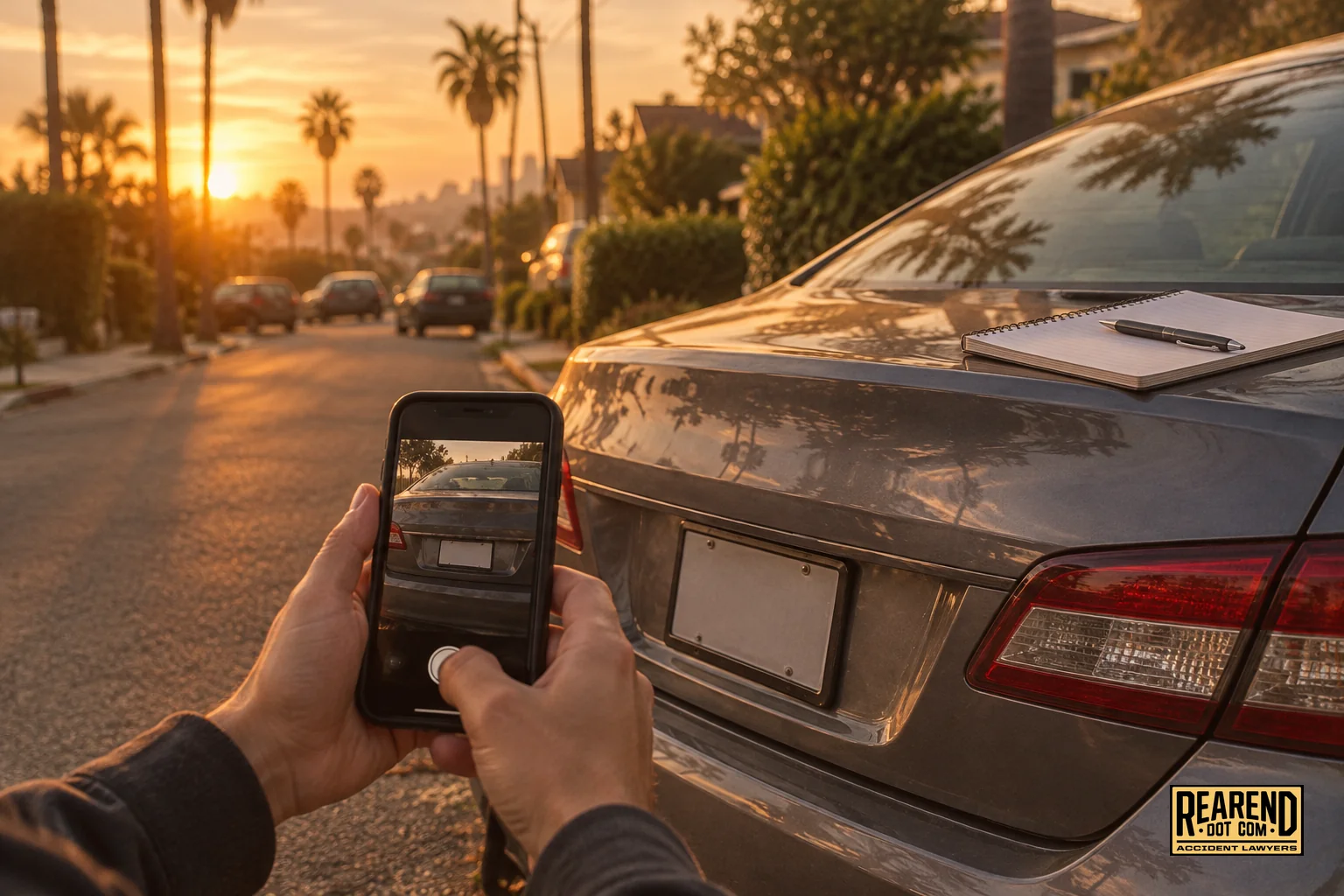
A scene checklist you can use
- Move to a safe spot if the cars can be driven, and turn on hazard lights.
- Call 911 if anyone seems hurt, and ask for police to respond.
- Photograph both vehicles from several angles, the road, traffic signs, skid marks and the weather.
- Photograph the other driver’s license, plate and insurance card.
- Get names and numbers from witnesses before they leave.
- Write down the time, location, and what you remember about the other driver’s speed and behavior.
What to leave out at the scene
Skip apologies and guesses about fault. Do not argue with the other driver, and do not accept cash to skip the insurance process. If the other driver refuses to share details or seems unsure about coverage, give what you have to the police and step back.
A photo of an insurance card does not prove the policy is active. The insurer confirms that when you report the claim. If the driver has no coverage or leaves the scene, your own policy may offer protection, so tell your insurer quickly.
California coverage notes
California requires drivers to carry liability insurance (see the California Department of Insurance), and the at-fault driver’s policy is where a third-party claim usually goes first. Filing deadlines vary by state and by type of case. Personal injury and property damage claims can carry different deadlines, so do not wait for the insurer to bring one up. Ask an attorney or check official state resources early.
3. How Do You Open the Claim With the Other Driver’s Insurer?
Call the at-fault driver’s insurer or use its online claim portal, give the policy holder’s name, the date, location and basic facts, and ask for a claim number and adjuster’s name. Send the police report once you have it. Tell your own insurer about the crash too.
What to have in front of you
Gather the other driver’s policy number, the date and place of the crash, the police report number, your contact details and your vehicle information. Keep the first call short and factual. You are reporting a crash, not arguing your whole case.
Steps for opening the claim
- Report the crash to the other driver’s insurer soon after it happens.
- Write down the claim number, adjuster’s name, direct phone number and email.
- Describe what happened in plain facts: where you were, that you were stopped or slowing, and where the other car hit yours.
- Say you are getting medical care, and avoid saying you are uninjured or fully recovered.
- Send a short follow-up email that lists what you reported and the date and time of the call.
- Start a contact log with the date, name and summary of every call and message.
Property damage and injury claims move at different speeds
Vehicle damage often gets a faster answer because an appraiser can inspect the car. Injury claims tend to take longer because treatment has to progress before anyone can describe the full picture. Settling one part does not require settling the other, so ask the adjuster to confirm in writing which part of the claim a payment covers.
For repairs, you can pick your own shop. If you want help finding one, you can find trusted local auto body shops through rearend.com.
Think hard before you sign a release
When an insurer offers a payment, it usually asks you to sign a release. That document generally ends your right to seek more money for the same crash, even if your symptoms get worse later. Read it slowly. If your treatment is still going, ask whether the offer fits what you know today.
4. Should You Give a Recorded Statement?
Generally, you can decline or postpone a recorded statement to the other driver’s insurer. Your own insurer may ask for cooperation under your policy, which is a different situation. Before you agree to record anything for the at-fault driver’s company, know your injuries, understand the questions and consider talking to an attorney.
Why adjusters ask for one
The adjuster is gathering facts about fault, speed, injuries and your medical history. A recorded statement locks in your words. Later, small inconsistencies, such as saying you felt fine on day one, can be used to question how serious the injuries are.
If you decide to give one
- Ask for the questions’ general topics ahead of time and pick a time when you feel clear-headed.
- Stay with facts you know. If you do not know, say so instead of guessing at speeds, distances or medical details.
- Describe symptoms as they are today, and mention that you are still being evaluated.
- Decline questions about your past medical history that go beyond the crash, and ask why the adjuster needs them.
- Take notes, and ask for a copy of the recording or transcript.
- Stop the call if you feel pressured, and ask to continue later.
A short script that works
Try this: “I’m still getting medical care and I would like to wait on a recorded statement. I can send you the police report and my contact details now.” A polite, calm refusal does not harm a claim, and you can revisit the request when your treatment is further along.
Our comparison of a rear-end accident lawyer vs an insurance adjuster explains how the two roles differ. One works for the insurer. The other works for you.
5. How Do You Document Your Damages?
Keep medical records and bills, proof of missed work, photos of injuries and vehicle damage, repair estimates, receipts for related costs and a daily symptom journal. Store copies in one folder. Insurers weigh claims against paperwork, so a dated, organized file gives your claim a clearer footing.

Medical documentation
Ask each provider for visit notes and itemized bills. Keep pharmacy receipts, physical therapy records, imaging results and referrals. If you use health insurance, MedPay or a lien-based arrangement, keep the paperwork that shows who paid what. Our article on who pays medical bills after a rear-end crash walks through those options.
Income and work records
If you missed work, collect pay stubs from before and after the crash, a note from your employer on missed days and hours, and a doctor’s note about any work restrictions. Self-employed drivers can add invoices, bank deposits and tax records that show income before the collision.
Vehicle and property records
Take photos before any repairs. Keep the estimate, repair invoice, rental receipts and towing bills. Photograph damage to items inside the car, like a laptop or child seat. Hidden damage often appears after teardown, so keep supplemental estimates too.
The symptom journal
Write a few lines each day: pain level, which activities you could not do, sleep problems, missed events and medications taken. Keep entries factual and consistent. A journal helps you describe changes over weeks, which is hard to recall from memory months later.
Keep a simple tracking sheet
| Category | Examples to save | Where it comes from |
|---|---|---|
| Medical | Visit notes, itemized bills, prescriptions, imaging | Doctors, clinics, pharmacy, hospital billing office |
| Income | Pay stubs, employer letter, work restriction notes | Employer, payroll portal, your physician |
| Vehicle | Photos, estimates, invoices, rental and tow receipts | Repair shop, appraiser, rental company |
| Daily impact | Symptom journal, photos of bruising, missed events | You, updated each day |
| Communication | Claim number, call log, emails, letters | Insurer, your own records |
6. What If the Insurer Stalls, Delays or Denies?
Send a dated written request that asks for a status update and the reason for any delay, then follow up on a set schedule. If the insurer keeps stalling or denies the claim, file a complaint with the California Department of Insurance and talk with an attorney about your next options.
Common stall tactics
Insurers sometimes ask for the same records twice, say the file is “under review,” change adjusters without notice or stop returning calls. Some push a quick low offer before your treatment finishes. None of this proves bad faith on its own, but a pattern is worth recording.
A step-by-step response
- Reply in writing and ask for a specific date when the insurer expects a decision.
- List what you already sent, with dates, so the adjuster cannot say the records are missing.
- Ask in writing which document or fact the insurer still needs.
- Escalate to the adjuster’s supervisor if two follow-ups go unanswered.
- File a complaint with the California Department of Insurance if delays continue or the insurer does not explain its position.
- Do not accept a lowball offer or sign a release just to end the waiting.
- Speak with an attorney about the delay, a denial or a low offer.
Our post on a delayed rear-end claim and what to do about it goes deeper on pushing a slow file forward. If the insurer denies the claim outright, our guide on what happens when insurance denies a rear-end claim explains the options.
Watch the deadlines
Writing to an adjuster does not stop a legal filing deadline. In California, the deadlines for injury lawsuits, property damage claims and government-related claims can all differ. I cannot give you a verified figure for each here, so check the California Code of Civil Procedure for the statute of limitations on injury and property claims. Ask the California Department of Insurance or an attorney to confirm which one applies to you, and do it early.
The California Department of Insurance guide to what comes after an accident explains what documentation you must provide for your loss.
A sample timeline using these steps
This is a hypothetical, not a real case. Suppose you are rear-ended on day 0 and see a doctor on day 1. On day 2 you report the crash to the other insurer and get a claim number. That evening you email the adjuster what you reported.
In week 2 you send the police report and first medical bills. If the adjuster asks for a recorded statement, you politely postpone it. If no answer comes after two written follow-ups, you ask for the supervisor, then file a complaint with the California Department of Insurance. Keep every message dated.
When to Bring in an Attorney Who Focuses on Rear-End Cases
You may handle a small property-only claim yourself. If you have injuries, ongoing treatment, a disputed fault argument or an insurer that stalls, an attorney who focuses on rear-end accident cases can take over the calls, gather records and deal with the adjuster for you.
Personal injury cases at rearend.com are handled on a contingency fee basis. There are no hourly fees, no upfront cost, and you do not pay unless we recover compensation on your behalf. The case review is free and has no obligation. For fee details, see our page on rear-end accident lawyer cost and fees.
Once you submit your information, our legal team will contact you within 24 hours to discuss your case. Submitting a contact form does not create an attorney-client relationship. That happens only through a formal, signed engagement agreement.
If you want a sense of the factors that shape a claim, you can calculate an estimate of what your potential claim could be worth. Treat it as a starting point for questions, since results vary and no tool can predict a case outcome.
Frequently Asked Questions
Do I have to use the other driver’s insurance company to repair my car?
No. You can usually choose your own repair shop, even when the at-fault driver’s insurer is paying. The insurer may suggest a shop, but the suggestion is optional. Get your own estimate and keep copies of every document the shop gives you.
How soon should I report a rear-end crash to the other driver’s insurer?
Report it as soon as you have the policy information, ideally within days. A prompt report starts the claim file and helps the insurer inspect the damage. Reporting does not mean you must settle, and it does not require a recorded statement.
What if the other driver’s insurer says I was partly at fault?
Fault in a rear-end crash is often assigned to the rear driver, but insurers sometimes argue otherwise, for instance after a sudden stop. Keep photos, witness details and the police report. Ask the adjuster to explain the reasoning in writing, and consider getting legal help before you respond.
Does a police report matter for my claim?
A police report gives the insurer an early, neutral record of the crash. It helps, but a claim can sometimes go forward without one if you have photos, witnesses and medical records. Ask police for the report number at the scene and request a copy later.
Do past results predict how my claim will go?
No. Past results, case studies and settlement amounts do not guarantee or predict future outcomes. Each case depends on its own facts, injuries, evidence and insurance coverage.
Take the Next Step on Your Claim
You do not have to sort through a third-party insurance claim alone. If you were rear-ended in California and want a clear read on your situation, start your claim review at rearend.com. Submit your information in minutes, and we match you with an attorney who focuses on rear-end accident cases. You can also reach us at (505) REAR-END or info@rearend.com.
Recommended Resources
Start My Claim Find Trusted Local Auto Body Shops Calculate an estimate of what your potential claim could be worth
Related Articles


Need Legal Help After a Rear-End Accident?
Get a free consultation with our experienced legal team