
Rear-Ended by a Semi-Truck: How Truck Accident Claims Differ
When you are rear-ended by a semi, your claim usually differs from an ordinary car crash in three ways. More parties may share responsibility, including the driver and the trucking company. Federal trucking rules create records that may show what happened. And key evidence, such as black-box data and logbooks, can be lost if no one asks for it quickly.
Key Takeaways
- More parties: The truck driver, the carrier that employs or hires the driver, and sometimes a maintenance shop or cargo loader may each play a role in what went wrong.
- Federal rules: Commercial trucks fall under federal motor carrier safety regulations, which create inspection, driver and hours records that a standard car crash does not have.
- Evidence moves fast: Event data recorders (black boxes) can capture only a short window of data, and carriers hold the logbooks and maintenance files, so a preservation request should go out early.
- Coverage can differ: California sets the minimum liability limits for ordinary drivers at $30,000 per person and $60,000 per accident, and commercial policies can be larger. Check the current minimums with the California Department of Insurance or DMV.
Rear-Ended by a Semi-Truck at a Glance
| Issue | Typical car-on-car rear-end claim | Semi-truck rear-end claim |
|---|---|---|
| Who may be responsible | Usually the following driver and that driver’s insurer | The driver, the trucking company, and possibly a maintenance provider, cargo loader or parts maker |
| Rules that apply | State traffic laws and insurance rules | State law plus federal motor carrier safety rules |
| Key evidence | Photos, police report, repair estimate, witnesses | All of those, plus black-box data, driver logbooks, inspection and driver qualification records |
| Who holds the evidence | Mostly you and the other driver | Largely the carrier, which is why early preservation requests matter |
| Insurance | California minimum is $30,000 per person and $60,000 per accident | Commercial policies can be larger; the amount depends on the carrier and policy |
| Injury risk | Ranges from minor to serious | A heavy vehicle can cause serious injuries, so prompt medical evaluation matters even if you feel okay |
| Timing | Filing deadlines vary by state and case type | Same deadline rules, plus evidence that can be overwritten or discarded |
How Is a Claim Different When a Semi Rear-Ends Your Car?
A semi-truck claim usually involves more people, more rules and more evidence than a typical car-on-car rear-end claim. The driver, the trucking company and other businesses may share responsibility, federal safety regulations create paper and electronic records, and much of the proof sits with the carrier rather than with you.
In an ordinary rear-end crash, the story is often simple. One driver followed too closely or looked away, and the other car took the hit. If you want the basics of how fault is shown in that setting, our guide on how to prove fault in a rear-end accident walks through it.
A semi changes the picture. A loaded tractor-trailer is far heavier than a passenger car, so the force of impact can be much greater. That may mean more serious injuries, longer treatment and larger medical bills, all of which tend to draw closer attention from insurers.
The business side also changes. The truck usually belongs to, or runs for, a company with its own insurance, safety department and legal team. Those teams often start gathering information soon after a serious crash, so your side benefits from moving quickly too.
Fault still depends on the facts
Fault rules vary by state, and California has its own approach. Rear-end crashes often point toward the following driver, but that is a starting point, not a verdict. Sudden stops, mechanical problems, road conditions and multiple vehicles can all complicate the picture.
That is why semi cases lean so heavily on records and data. They help show speed, braking, driver alertness and truck condition, instead of leaving the claim to competing memories.
Where Semi-Truck Rear-End Crashes Happen in California
Heavy trucks share the road with ordinary drivers across the state. Freight moves along Central Valley corridors such as Interstate 5 and State Route 99, and port traffic from Los Angeles, Long Beach and Oakland feeds long-haul and local truck routes.
If you drive in San Diego, Los Angeles, Oakland or San Jose, you likely pass tractor-trailers on a regular commute. Stop-and-go traffic is a common setting for rear-end crashes, and a driver who cannot slow a heavy rig in time may strike the car ahead.
If your crash happened in the Bay Area and involved a commercial truck, our practical guide on a rear-end accident attorney in Oakland involving a commercial truck covers local considerations in more detail.
What Federal Trucking Rules Could Matter in Your Claim?
Federal motor carrier safety rules, overseen by the Federal Motor Carrier Safety Administration (FMCSA), govern how commercial trucks and drivers operate. They cover areas such as driver hours, vehicle inspection, driver qualification, and drug and alcohol testing, and each area can generate records that may help show what happened before a crash.
The FMCSA describes itself as the lead federal agency for regulating and overseeing the safety of commercial motor vehicles, with a mission to reduce crashes, injuries and fatalities involving large trucks and buses. Carriers that haul for hire register with the agency, and FMCSA explains how operating authority registration status is checked.
You do not need to memorize the regulations. What matters for your claim is what they produce: a paper trail. If a rule required a record, a lawyer can ask whether the carrier kept it, and whether it matches what the driver did.
Records that federal rules may create
- Hours and logbook records: Show how long the driver had been working and resting before the crash.
- Inspection and maintenance files: Show whether brakes, tires and other systems were checked and repaired.
- Driver qualification file: Typically holds license, training and employment history information.
- Drug and alcohol testing records: May show testing after a serious crash and under routine programs.
- Cargo records: Show what the truck was hauling and how it was loaded, which can affect stopping distance.
Not every crash will reveal a rule violation. A record might also show that the driver and carrier followed the rules. Either way, the documents give your side something concrete to review.
Who Could Be Liable When a Semi Rear-Ends You?
The truck driver is the first person many people think of, but the trucking company that employs or contracts with the driver may also be responsible. Depending on the facts, a maintenance shop, a cargo loader or a parts maker could play a role too. A careful review of the evidence helps sort out who.
This is a major difference from a standard rear-end claim, where the focus usually stays on one driver and one insurer. Each possible party may have its own insurance and its own lawyers, which can make a claim slower and more contested.
The driver
The driver’s actions are often the starting point. Questions include speed, following distance, distraction, fatigue and whether the driver reacted in time. Driver records and any dashcam video can speak to these points.
The trucking company
A carrier may be responsible for what its driver does on the job. It may also face questions about its own conduct, such as how it screened and trained drivers, how it scheduled loads, and whether it kept its trucks in safe working order. The facts of each case drive these questions, and the outcome is not something anyone can predict in advance.
Other businesses
If a brake failure, a poorly secured load or a defective part contributed to the crash, other companies could be involved. These theories take time and records to explore, which is another reason to preserve evidence early.
What Evidence Matters After a Semi Rear-Ends You?
Black-box data, driver logbooks and carrier records tend to matter most because they show speed, braking and driver hours before impact. Photos, witness names, dashcam footage and medical records add to the picture. Much of this is held by the trucking company, so a written request to preserve it should go out quickly.
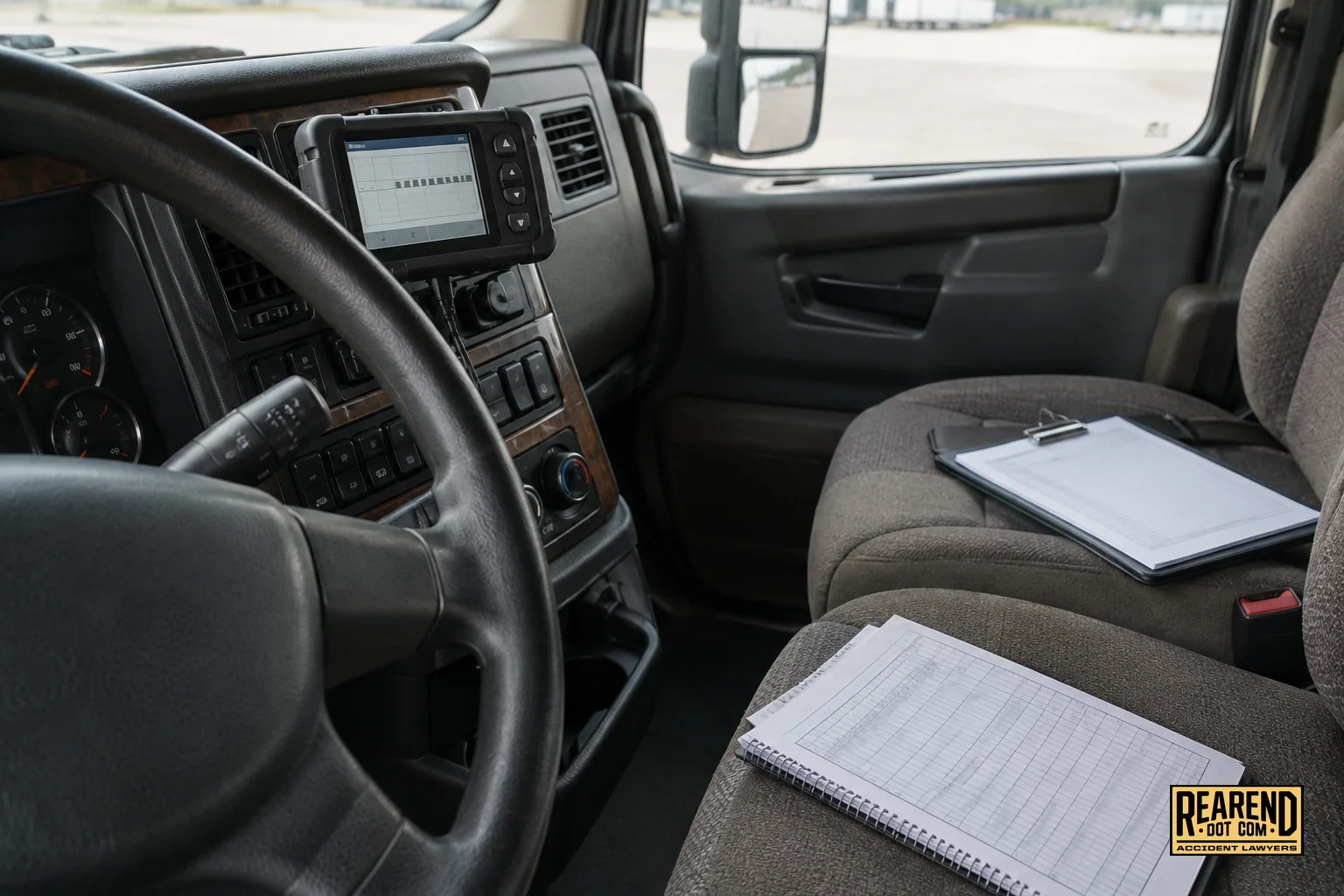
Black-box (event data recorder) data
Some commercial vehicles, and many passenger vehicles, carry event data recorders. Purdue Extension notes that, depending on year and make, some vehicles record the last 5 seconds to 60 seconds of a crash, and the data can include vehicle speed leading up to impact.
That short window is the reason for speed. If the truck is repaired, sold, returned to service or the recorder is overwritten, that snapshot may be lost. Your own car may hold a recorder too, so avoid scrapping or repairing it before you talk with a lawyer about preserving the data.
Logbooks and electronic logging data
Hours records can show whether a driver was within the limits set by federal rules or may have been fatigued. Electronic logs, dispatch messages and trip records can be compared with each other. A mismatch between them can raise questions worth asking.
Maintenance, inspection and driver files
Brake service history, inspection reports and the driver’s qualification file can show whether the truck and driver were ready for the road. A lawyer can send a preservation letter asking the carrier to keep these items instead of discarding them under routine schedules.
What you can gather yourself
- Photos of both vehicles, the road, skid marks, signage and weather.
- The truck’s company name or logo, license plate and DOT number, if visible.
- Names and contact details for witnesses.
- Nearby business cameras or traffic cameras that may have recorded the crash; ask about them promptly since many systems overwrite footage.
- Your medical records, bills and a short symptom diary.
A hypothetical example
Suppose a driver is stopped in slow traffic on a California freeway and a tractor-trailer hits the car from behind. The driver tells the police he braked, but a witness says the truck looked like it never slowed. Black-box speed and braking data, dashcam footage and the driver’s hours record could help test those two accounts. This is an illustration only, not a real case or a prediction of any result.
Could safety technology play a role?
A 2020 AP News report on a study said electronics could stop 40% of big-truck rear crashes. If a truck had, or lacked, features like automatic emergency braking or collision warning, that may become one more fact to examine. It does not decide fault by itself.
Do Semi-Truck Claims Involve Higher Insurance Limits?
Commercial trucks can be backed by larger policies than the minimum an ordinary California driver must carry, but the amount depends on the carrier, the type of cargo and the policies in place. No one can say what coverage applies until the policies are requested and reviewed.
For context, California requires minimum liability coverage of $30,000 per person and $60,000 per accident for bodily injury. Those limits are modest next to the cost of serious injuries, which is why coverage questions come up in many rear-end cases, even without a truck involved.
With a semi, there may be more than one policy to look at. The driver, the carrier and other businesses could each have separate coverage. A lawyer can ask for policy information through the claim process, and your own policy may also matter, for example if you carry medical payments or uninsured and underinsured motorist coverage.
Please keep one point in mind. Larger limits on paper do not mean a larger payment. What a claim is worth depends on your injuries, your treatment, your documented losses, the facts of fault and the law that applies. We do not estimate or promise settlement amounts.
If you simply want a rough, non-binding sense of the factors involved, you can calculate an estimate of what your potential claim could be worth. Treat any figure as a starting point for questions, since results vary and an estimate does not predict what an insurer will offer.
What Should You Do After Being Rear-Ended by a Semi?
Get to safety, call 911 if anyone is hurt, report the crash to police, document the scene, and get a medical evaluation soon after, even if you feel fine. Then avoid giving recorded statements to insurers until you understand your options, and ask a lawyer about preserving the truck’s records.

- Stop and stay safe. The California Department of Insurance advises stopping immediately, moving only if it is safe to do so, calling 911 if there are injuries, and calling the police. On a freeway, stay buckled in your vehicle if stepping out looks dangerous.
- Call 911 and ask for medical help. Adrenaline can hide pain. Paramedics can check you at the scene, and a record of that visit helps later.
- Get the police report started. Note the officer’s name and report number, and ask how to get a copy.
- Collect the truck and driver details. Photograph the license plate, company name or logo, DOT number and the driver’s information if the driver provides it. Names of any witnesses help as well.
- Photograph everything. Capture vehicle positions, damage, skid marks, road signs and your visible injuries before cars are moved, when it is safe to do so.
- See a doctor soon. Go to urgent care or an emergency room the same day for serious symptoms. For milder ones, schedule a visit within the next day or two and follow the treatment plan.
- Be careful with statements. Share basic facts with police. With insurers, you can say you are getting medical care and reviewing your options. Our guide on what to do after being rear-ended in the first 72 hours adds more detail on this stretch.
- Do not repair or scrap your car yet. Your vehicle holds damage patterns and possibly recorder data. Ask about preserving it first. If you need help finding repairs afterward, you can find trusted local auto body shops through rearend.com.
- Talk with a lawyer promptly. A semi case involves records that can disappear, so an early conversation helps your side move on preservation requests.
A simple decision rule
If the truck was a commercial vehicle and you have any injury, even a mild one, treat it as a case worth reviewing early. If you have no symptoms and only cosmetic damage, you may still want a medical check, because some injuries show up later. Our article on whether you can sue after a rear-end crash with no visible injuries explains why.
Why Do Prompt Medical Care and Quick Action Matter?
Prompt medical care creates a record linking your symptoms to the crash, and quick action gives your legal team time to request evidence before it is overwritten or discarded. Waiting can also let filing deadlines approach, and those deadlines vary by state and type of case.
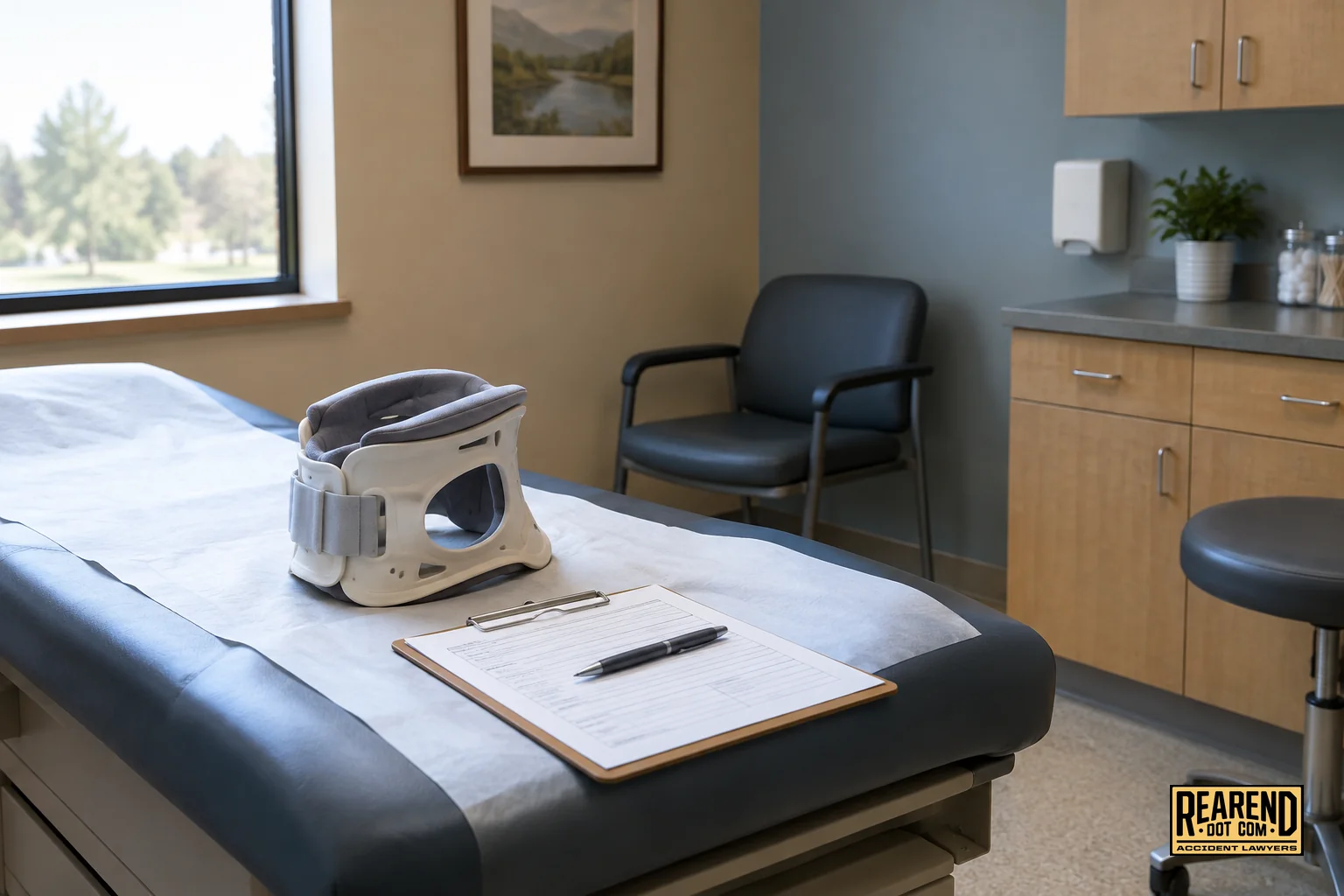
Medical care protects your health and your claim
Neck, back and head injuries can take hours or days to show. Insurers sometimes point to gaps between the crash and the first treatment, or between visits, as a reason to question how serious an injury is. Seeing a provider soon and following the plan helps close those gaps.
Tell the provider about every area that hurts, even if it seems minor. Keep copies of bills, referrals and notes about missed work. Those records become part of how any claim is explained.
Evidence has a short shelf life
Black-box data can be overwritten, trucks go back into service, video gets recorded over, and carriers may discard files under routine schedules. A guide to rear-end truck crashes in California, published by a law firm, notes that waiting too long can make evidence harder to secure and a case weaker. Early preservation requests exist for that reason.
Deadlines vary
Across the U.S., personal injury filing deadlines vary by state and type of case. Some claims, such as those involving a public entity, can have shorter notice windows than others. If you are unsure which applies to you, ask promptly instead of assuming you have plenty of time.
How rearend.com Can Help After a Semi-Truck Crash
rearend.com focuses on rear-end accident cases and offers a free, no-obligation case review. You pay nothing up front, and you don’t pay a dime unless we recover compensation on your behalf. Submitting the online form starts intake, but it does not create an attorney-client relationship.
We describe our work plainly: we handle rear-end accident cases, and our attorneys focus on them. There is no formal legal specialization in this area, so we do not claim a certification. What we can offer is a process built around rear-end crashes, from intake through claim handling.
The online questionnaire takes a few minutes. After you submit it, our legal team will contact you within 24 hours to discuss your case. An attorney-client relationship is formed only through a signed engagement agreement, so you can ask questions first with no obligation.
For a semi-truck claim, we can talk with you about the steps that tend to matter early, including medical documentation, evidence preservation and who may need to be notified. Fault rules vary by state, and every case turns on its own facts, so we cannot promise any outcome.
If you are still comparing options, our guides on how to evaluate a rear-end accident attorney and rear-end accident lawyer cost and fees explain what to ask and how contingency billing works.
Frequently Asked Questions
Can I sue the trucking company if a semi rear-ends me?
In some cases, yes. A trucking company may be responsible for a driver’s actions when the driver was working for it, and it may also have its own responsibility for matters like hiring, training or maintenance. Whether a claim exists depends on the facts, so a case review is the practical next step.
Is the semi driver automatically at fault in a rear-end crash?
No. Rear-end crashes often point toward the following driver, but fault rules vary by state, and the facts still have to be proved. Evidence such as black-box data, video and witness accounts can support or challenge each side’s version of events.
How long does a semi-truck claim take?
There is no set timeline. Truck claims can take longer than ordinary car claims because more parties, records and insurers are involved, and because injuries may need time to be fully understood. Treatment, evidence gathering and negotiations each affect the pace.
Should I talk to the trucking company’s insurance adjuster?
You may want to speak with a lawyer before giving a recorded statement or signing anything. An adjuster works for the insurer, and early statements can be used when the claim is evaluated. You can usually share basic contact details and say that you are getting medical care and reviewing your options.
Take the Next Step After Being Rear-Ended by a Semi
A semi-truck crash leaves a short window for gathering evidence and a long list of questions about medical care, insurance and responsibility. You do not have to sort it out alone, and starting early keeps your options open.
Start your claim review in a few clicks, free and with no obligation. You can also call (505) REAR-END or email info@rearend.com. This article is general information, not legal advice, and results depend on the facts of each case.
Recommended Resources
Start My Claim Find Trusted Local Auto Body Shops Calculate an estimate of what your potential claim could be worth
Related Articles


Need Legal Help After a Rear-End Accident?
Get a free consultation with our experienced legal team