
Is My Car Totaled? How California Insurers Decide After a Rear-End Crash
Your car is likely totaled when the cost to repair it, often added to what the wreck would sell for as salvage, reaches or passes the car’s actual cash value, meaning its fair market value just before the crash. California does not set one flat percentage, so the decision comes down to your adjuster’s math. If you were rear-ended, you can review that math and dispute it.
Key Takeaways
-
The test: California insurers compare repair cost plus salvage value with the car’s actual cash value, not a single percentage cutoff.
-
The value: Actual cash value generally means fair market value right before the crash, built from comparable local vehicles and adjusted for mileage, trim, options and condition.
-
The dispute: A low offer can be challenged in writing with the valuation report, service records and nearby comparable listings.
-
The loan: The lender is paid first, and any shortfall between the payout and your loan balance may still be yours unless gap coverage applies.
-
The release: Your car claim and any injury claim are separate, so read every release before you sign.
Total Loss at a Glance
|
Question |
Short answer |
Your next step |
|---|---|---|
|
How is a total loss decided? |
Repair cost plus salvage value is compared with actual cash value |
Ask for the written repair estimate and total loss determination |
|
What is actual cash value? |
The fair market value of your car right before the crash |
Request the full valuation report |
|
Who sets the first number? |
The insurer or a valuation vendor it uses |
Check trim, mileage, options and comparables |
|
Can the offer be disputed? |
Yes, usually in writing with evidence |
Send service records, photos and local listings |
|
What happens to a car loan? |
The lender is paid first; you get any remainder |
Ask the lender for a payoff letter and check for gap coverage |
|
Can you keep the car? |
Sometimes, with a lower payout and salvage paperwork |
Get the terms in writing before agreeing |
|
Does it affect an injury claim? |
The claims are separate |
Read any release closely before signing |
1. Is My Car Totaled? How California Insurers Make the Call
California insurers compare two numbers after a rear-end crash: the cost to repair your car, plus what the damaged car would sell for as salvage, against its actual cash value before the crash. When repair plus salvage reaches or exceeds that value, the car is usually declared a total loss.
On paper the calculation is simple. The adjuster estimates repairs, estimates what a salvage buyer would pay for the wrecked car, adds the two, and compares the result with actual cash value (ACV). California generally uses this repair-plus-salvage approach rather than a flat percentage cutoff, which is why an online “is my car totaled” calculator can only give you a rough idea.
Insurers also sometimes total a car when repairs come close to its value, even if the formula is not strictly met. A heavily damaged older car may be a poor repair risk, and the insurer may prefer to pay out and sell the wreck.
Which insurer does the math depends on how you file. In a rear-end crash where the other driver is at fault, the claim for your car usually goes to that driver’s insurer as a third-party claim. You can also use your own collision coverage. For a closer look at which policy pays, read Who Pays for Repairs After a Rear-End Accident?
What Damage Pushes a Rear-End Crash Toward a Total Loss?
Rear-end damage that reaches beyond the bumper cover tends to push a car toward a total loss. Bent frame rails, a buckled trunk floor, damaged rear body structure, deployed airbags, and ruined radar or camera sensors can each raise a repair bill quickly, especially on an older car with a lower market value.
A bumper cover is often the cheapest part of the story. Behind it sit the reinforcement bar, energy absorbers and, on many newer cars, sensors for parking, blind-spot warning and adaptive cruise control. Replacing and recalibrating those parts can add real cost.
Unibody construction matters too. Most passenger cars have no separate frame, so a hard hit can wrinkle the trunk floor and rear quarter panels and shift the geometry of the whole body. Straightening that structure takes labor, and the labor adds up.
Age and value work against you in one way. A car worth less on the market reaches the total loss line sooner, because the same repair bill is a bigger share of a smaller number. A pricey repair on a ten-year-old car and a modest repair on a new one can land on opposite sides of the line.
Why the First Estimate Can Change
The first estimate is often written from photos or a quick walk-around. Once a shop removes the bumper cover and starts a teardown, hidden damage tends to appear and the estimate can climb. When a supplement pushes the cost up, the claim can be reclassified from repairable to total loss.
That shift can feel abrupt. A car you expected back in a few weeks becomes a valuation question. If it happens to you, ask for the supplement in writing, along with the updated total loss determination.
Who Makes the Decision, and Can You Push Back?
The insurer’s adjuster makes the decision, usually after an inspection, photos, and sometimes a shop teardown. You can push back by asking for the written repair estimate and valuation, getting a second estimate, and pointing out damage the first review missed. A disagreement is common, and you can raise it in writing.
Here is what to request, and what counts as a pass:
-
The itemized repair estimate. Pass: each part and labor line is listed. Walk away from a verbal summary and keep asking in writing.
-
The total loss determination. Pass: it shows the repair figure, the salvage figure and the ACV the insurer used.
-
The valuation report. Pass: it lists your exact vehicle details and the comparable cars behind the number.
If the insurer says the car is repairable and you doubt it, a second opinion from a body shop you choose can help. The car may be unsafe after structural damage, and a documented disagreement is better than an assumption.
2. How Is Actual Cash Value Calculated in California?
Actual cash value in California generally means the fair market value of your car right before the crash, unless your policy defines it differently. Insurers estimate it from comparable vehicles sold or listed locally, then adjust for mileage, trim, options, and condition. Taxes and transfer fees are typically part of the total payment, so confirm this with your insurer.
Fair market value is the price a knowledgeable buyer would pay and a knowledgeable seller would accept, with neither under unusual pressure. It is not what you paid, what you still owe, or what a dealer would list the car for after detailing and a warranty.
Most insurers use a valuation vendor to pull comparable vehicles. The report typically lists cars with the same year, make, model and similar trim in your region, then adjusts their prices up or down for differences. A lower-mileage car gets an upward adjustment; one with worn tires or prior damage gets a downward one.
Location matters because used-car prices vary across the state. Buyers in San Diego, Los Angeles, Oakland, San Jose, Fresno, Riverside and Oceanside shop in somewhat different markets, with different supply and demand for the same model. A fair report uses comparables near you, not cars listed hundreds of miles away.
Taxes and fees deserve a look of their own. A total loss payment typically includes sales tax and the fees to transfer and register a replacement vehicle. If those lines are missing from the offer, ask where they are.
If you are using your own collision coverage, your deductible is usually subtracted from the payment. In a third-party claim against the at-fault driver’s insurer, your deductible is usually not part of the math, though the details depend on your situation.
What to Check on Your Valuation Report
Check that the report matches your car’s year, trim, mileage and options, that the comparable vehicles are close to yours and located near you, and that condition ratings are fair. Then confirm taxes and fees are included. Errors in any of these areas can lower the number.
Work through the report in this order:
-
Vehicle details. Match the VIN, year, trim level, engine and drivetrain to your registration. A base trim valued in place of a higher trim is a clear error to correct.
-
Mileage. Compare the odometer reading at the crash with the figure on the report. A higher number lowers value, so a typo costs you.
-
Options and upgrades. Look for sunroof, leather, tech packages, towing packages and aftermarket additions with receipts. Missing options are a common reason for a low number.
-
Condition rating. Pass: it reflects your car’s real shape using photos and records. Walk away from a rating that treats routine wear as major damage.
-
Comparable vehicles. Pass: the same model year and trim, similar mileage, and sellers in your region. If most comparables are different trims, much higher mileage, or far away, the report is weak.
-
Adjustments. Each upward or downward adjustment should have a stated reason and amount.
-
Taxes and fees. Confirm sales tax and transfer fees are listed in the total.
If the report passes these checks and the number still looks low against what you see on nearby listings, move to the dispute steps below. If it fails one or more, you already have your first argument.
3. How Do You Dispute a Low Total Loss Valuation?
Dispute a low valuation in writing. Request the full valuation report, gather proof of your car’s condition and features, find comparable listings near you, and send the adjuster a written rebuttal that names the number you want and why. If the insurer holds firm, ask for a supervisor or complain to the California Department of Insurance.
Insurers often open with a number that leaves room to move. The first offer is a starting point, and a documented counter can change it. Follow these steps in order:
-
Ask for the valuation report and the repair estimate in writing, and save every email and letter.
-
Collect proof of your car’s value: service and maintenance records, receipts for new tires, brakes or a battery, and photos taken before the crash. Dashboard photos showing mileage help too.
-
List the options and packages on your car with documentation, such as the window sticker or a build sheet.
-
Search for comparable cars near you with the same year, trim and similar mileage. Save screenshots with the date, price, mileage and VIN or listing link.
-
Write a rebuttal. Point to each error in the report, attach your evidence, and state the figure you are requesting.
-
If the adjuster does not move, ask to speak with a supervisor and keep the request in writing.
-
Check your own policy for an appraisal clause if you are dealing with your own insurer. It may offer a structured way to resolve a value disagreement.
-
Consider a complaint to the California Department of Insurance if you believe the claim is being mishandled.
Be specific. “This is too low” rarely changes a number. “The report values a base trim, but my car is the higher trim with a technology package, and three comparable listings within the region are priced higher” gives the adjuster something to act on.
Keep Property Damage Separate From Everything Else
Some insurers send paperwork that mixes the car payment with other claims. Read each form closely. If a document says it settles all claims from the crash, it may reach beyond your car, including injuries. Ask in writing whether a release covers only vehicle damage before you sign anything.
Time pressure can play a role as well. Storage fees on a damaged car may grow while you argue about value, and rental coverage may have limits. Ask the insurer about where the car will sit and for how long, and keep that question in your written record.
4. What Happens to My Car Loan If the Car Is Totaled?
When a financed car is totaled, the insurer generally pays the lender first, and you receive any amount left over. If the payout is less than your loan balance, you may still owe the difference unless gap coverage applies. Keep making loan payments until the lender confirms the account is paid off.
The lender holds a lien on the car, so it has a claim on the money before you do. Contact it soon after the crash and request a written payoff letter showing the amount needed to close the account. Insurers often ask for it.
Here is an illustration with made-up round numbers, not a prediction. Suppose a car is valued at $20,000 and the loan payoff is $23,000. Ignoring deductibles and fees, the $20,000 goes to the lender and a $3,000 balance remains. Gap coverage, if you have it, may cover that difference, subject to its terms.
That is why the valuation fight matters for people with loans. A higher ACV shrinks the gap. A small correction on trim or mileage can matter more to you than it seems.
Gap Coverage, Leases and Missed Payments
Check your loan or lease paperwork for gap coverage or a gap waiver. Dealers and lenders sometimes sell it at signing, and many owners forget they bought it. If you have it, call the provider and ask what it needs, such as the insurer’s settlement letter.
Leased cars work much the same way. The leasing company owns the car, so the payment goes to it, and gap protection is often built into the lease. Read the lease terms for what happens to any remaining balance.
Do not stop paying because the car is gone. Until the lender receives full payoff, the loan is still active, and late payments can hurt your credit. If the insurer is slow, tell the lender and ask for guidance in writing.
If you owe more than the car was worth, avoid rolling the old balance into a new loan without understanding the cost. That can start your next car payment behind.
5. Should I Take the Payout, Keep the Car, or Repair It?
Take the payout if the number is fair and repairs would be extensive. Keep the car if you can repair it affordably and safely, accepting a lower payout for the salvage value. Repair it if the insurer agrees to fix it, then ask about lost value. The right choice depends on the numbers and the car’s safety.
|
Option |
Fits when |
Watch for |
|---|---|---|
|
Accept the total loss payout |
The valuation checks out and repairs would be heavy |
Taxes and fees included; lender paid first |
|
Keep the car (owner retention) |
Damage is limited and repairs are affordable and safe |
Payout reduced by salvage value; salvage paperwork and resale limits |
|
Repair it |
The insurer treats it as repairable |
Structural quality, sensor calibration, and lost resale value |
|
Dispute and negotiate |
The report has errors or weak comparables |
Written evidence, a firm request figure, and a record of every contact |
What Does Keeping a Totaled Car Involve?
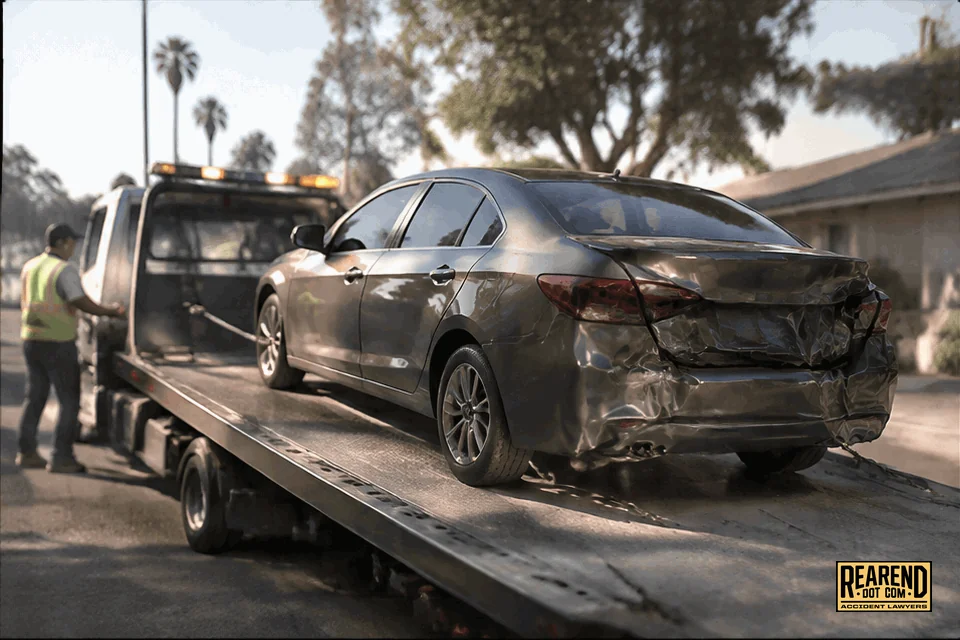
Keeping a totaled car usually means the insurer reduces your payout by the car’s salvage value, and the car needs salvage or non-repairable paperwork through the DMV. A car with that history is often harder to insure and sell. Get the terms in writing, including the salvage figure, before deciding.
Owner retention can make sense for an older, drivable car with limited damage, if a trusted shop confirms the repair is safe. It is a poor fit if the structure is bent, since safety systems may not work as designed after a rear impact.
If the Car Gets Repaired Instead
A repaired car can still be worth less than before the crash, even if the bodywork looks flawless. That gap is called diminished value. Read What Is a Diminished Value Claim After a Crash? to see how it works and what it requires.
6. Does a Total Loss Change My Rear-End Injury Claim?
A total loss settles your vehicle, not your injuries. Property damage and bodily injury are separate parts of a rear-end claim, and a car being totaled does not by itself set the value of an injury claim. Read any release carefully before you sign, since some forms reach beyond the car.
The two claims run on different tracks. The car is valued by market price. Injuries are looked at through medical records, treatment, missed work and how the crash affected your daily life. A heavily damaged car can go with minor injuries, and a lightly damaged car can go with serious ones.
If your car was totaled and you were not hurt, our post on a rear-end accident with a totaled car and no injuries reported covers what to watch for in the days after. Symptoms sometimes show up late, so a quiet first week does not close the question.
If you were also hurt, you may want a rough sense of how an injury claim is valued. You can calculate an estimate of what your potential claim could be worth. Treat the result as a conversation starter, not a prediction. Every claim depends on its own facts, and no tool can promise an outcome.
7. How Can Rearend.com Help After a Rear-End Total Loss?
Rearend.com offers a free case review for Californians who were rear-ended. You submit your information online, and we match you with an attorney. You pay nothing up front, and there is no fee unless we recover compensation on your behalf. Submitting the form does not create an attorney-client relationship.
Dealing with a total loss often means calls from adjusters, valuation reports you did not ask for, and a lender waiting on payoff paperwork. An attorney who focuses on rear-end accident cases can review the offer, explain how the claim is structured, and tell you whether the situation calls for legal help or can be handled directly. An attorney-client relationship begins only through a signed engagement agreement.
After you submit your details, our legal team will contact you within 24 hours to discuss your case. Have your insurance information, photos, the repair estimate and any valuation report nearby. If you prefer to talk, call (505) REAR-END or write to info@rearend.com.
If your rear-end crash left you with a total loss offer that does not add up, start your free claim review at rearend.com. It takes a few minutes, and you can ask questions before deciding on next steps. Rules and deadlines differ by case, and fault rules vary by state, so a review of your own facts is a good place to begin.
Frequently Asked Questions
Can I keep my car if it is totaled in California?
Often yes. Many insurers let you keep a totaled car and reduce your payout by its salvage value. The car then needs salvage or non-repairable paperwork through the DMV before it returns to the road, if it can be repaired at all. Ask for the terms in writing before you decide.
Do I have to accept the first total loss offer?
No. A first offer is a starting point. You can ask for the valuation report, submit your own comparable listings and service records, and negotiate. Read any payment paperwork before signing, since some forms describe the payment as a final settlement of claims that go beyond your vehicle.
What if I am still unsure whether my car is totaled?
Ask the insurer for its written repair estimate and total loss determination, then get an independent estimate from a shop you choose. Photograph the damage and keep your records. If the two estimates differ widely, send the difference to the adjuster in writing and request a reinspection.
Whatever the answer turns out to be, keep your paperwork organized and your requests in writing. The more specific your evidence, the harder it is for a low number to stand.
Recommended Resources
Start My Claim Find Trusted Local Auto Body Shops Calculate an estimate of what your potential claim could be worth
Related Articles


Need Legal Help After a Rear-End Accident?
Get a free consultation with our experienced legal team