
Fresno Crash: Should You Give a Recorded Statement?
Giving a recorded statement to an insurance company after a Fresno rear-end crash is generally not something you’re required to do for the other driver’s insurer, and doing it before you understand what’s being asked can weaken your claim. A rear-end accident attorney in Fresno, CA can review the request first, often through a free case evaluation, before you say a word. Below is a step-by-step walkthrough of how to handle a recorded statement request the right way.
Key Takeaways
- You’re generally not required to give a recorded statement to the at-fault driver’s insurer: Under California law, cooperation duties usually run to your own policy, not someone else’s.
- Adjusters can begin investigating soon after a claim is reported: Some carriers may review social media and treatment gaps as part of their process, so it’s worth being cautious early on.
- Recorded statements can be used to highlight inconsistencies or suggest partial fault: Even a casual “I’m fine” can be replayed later to minimize an injury claim.
- Documentation matters more than talking: Photos, the police report, and medical records carry more weight than an unprepared phone call.
- A free case evaluation can review the specific request before you respond: There’s no cost to ask a legal team whether, and how, to answer.
At a Glance: Recorded Statements After a Fresno Rear-End Crash
| Question | Short Answer |
|---|---|
| Must I give a statement to the other driver’s insurer? | Generally not required under California law |
| Must I give a statement to my own insurer? | Your policy may include a cooperation clause; check before refusing |
| How fast does the insurer’s investigation start? | Can start soon after the claim is reported |
| What can a statement be used for? | Highlighting inconsistencies, suggesting shared fault, minimizing injury severity |
| California minimum liability coverage | $30,000 per person / $60,000 per accident |
| Cost of a free case evaluation with rearend.com | No cost; no fee unless you win |
| What to gather before speaking to anyone | Photos, police report, medical records |
1. Understand Why the Insurance Company Is Asking for a Recorded Statement
An insurance company asks for a recorded statement because its investigation into a Fresno rear-end claim can start soon after the claim is reported. It doesn’t wait for fault to be settled. Adjusters want your account locked in early. They ask before you’ve seen a doctor, before you’ve reviewed the police report, and before you’ve spoken with anyone else about the crash.
That timing isn’t a coincidence. The at-fault driver’s insurance carrier begins its own investigation the moment a claim is reported, gathering recorded statements, checking social media activity, and looking for gaps in medical treatment that can later be used to reduce a payout.
This applies whether the call comes from the other driver’s insurer or your own. Either way, the adjuster’s job is to protect the company’s bottom line, not to build your case for you. That’s a structural fact of how claims departments work, not an accusation against any individual adjuster. Because these reviews start early and move on the insurer’s own schedule, there’s no single published timeline for when a decision comes back. If you want a concrete answer for your file, ask the adjuster directly for an expected decision date and get it in writing.
2. Confirm Whether You’re Actually Required to Give One in California
You’re generally not required to give a recorded statement to the other driver’s insurance company after a Fresno rear-end crash. Your own insurer is different. Many auto policies include a cooperation clause that could apply to you. Check your own policy language rather than assuming either way, and if the clause is unclear, ask your attorney to confirm exactly what it requires before you decline anything.
Under California law, you’re not required to provide a recorded statement to the adjuster representing the driver who hit you. Adjusters often frame the request as routine, something needed “just to get your side of the story.” In practice, that framing can obscure what the statement is actually for.
If the call is from your own carrier, the calculus changes. Policies frequently require reasonable cooperation with your own insurer’s investigation. Refusing outright could create separate problems with your own coverage. That’s exactly the kind of distinction worth reviewing with someone familiar with rear-end claims before you pick up the phone.
What to Say Instead of Answering on the Spot
You don’t have to refuse rudely or go silent. A short, polite script keeps the door open without locking in an unprepared account:
- Use: “I’d like to have my documentation and my attorney’s input before I give a recorded statement. Can you send the request in writing?”
- Use: “I’m not comfortable being recorded right now. I’ll follow up once I’ve reviewed the police report and my medical records.”
- Use: “I can confirm the basic facts — date, location, vehicles involved — but I’m not ready to go on record about fault or injuries yet.”
- Avoid: “I’m fine, nothing really happened.” (Can later be used to argue your injuries are minor or unrelated.)
- Avoid: Guessing at speed, distance, or timing if you’re not certain. Estimates offered casually can be treated as firm statements later.
- Avoid: Apologizing reflexively at the scene or on the call — a reflexive “sorry” can be logged as an admission, even when it’s just politeness.
3. Recognize What You Risk by Answering Questions Unprepared
Answering an adjuster’s questions without preparation risks giving the insurance company material it can use to dispute fault, downplay your injuries, or challenge your credibility later. None of that requires you to lie. It can happen through ordinary, honest answers given before you know the full picture.
A recorded statement becomes a permanent part of the claim file. If your account shifts even slightly as more facts emerge, an adjuster can point to that shift as an inconsistency. That’s true regardless of whether the change reflects normal memory recall after a stressful event.
How Adjusters Use Your Words Against You
Recorded statements from unprepared claimants are often used to highlight inconsistencies, suggest a partial fault, or minimize injury severity, according to one Fresno legal resource on insurer tactics. A question like “were you looking at anything else before the impact” can be framed innocuously but used to argue comparative fault later.
California follows a comparative fault system, meaning any percentage of blame assigned to you can reduce your recovery. A statement given days after a crash, before whiplash symptoms or other soft-tissue injuries surface, can also be used to argue your injuries were minor or unrelated to the impact. That’s a common friction point. People genuinely feel fine at the scene, only to develop pain over the following days.
4. Document Everything Before You Say Anything
Before you respond to any request for a recorded statement, gather the evidence that actually supports your version of events. Documentation carries more weight in a claim than an unprepared verbal account, and it doesn’t shift under questioning the way memory can.
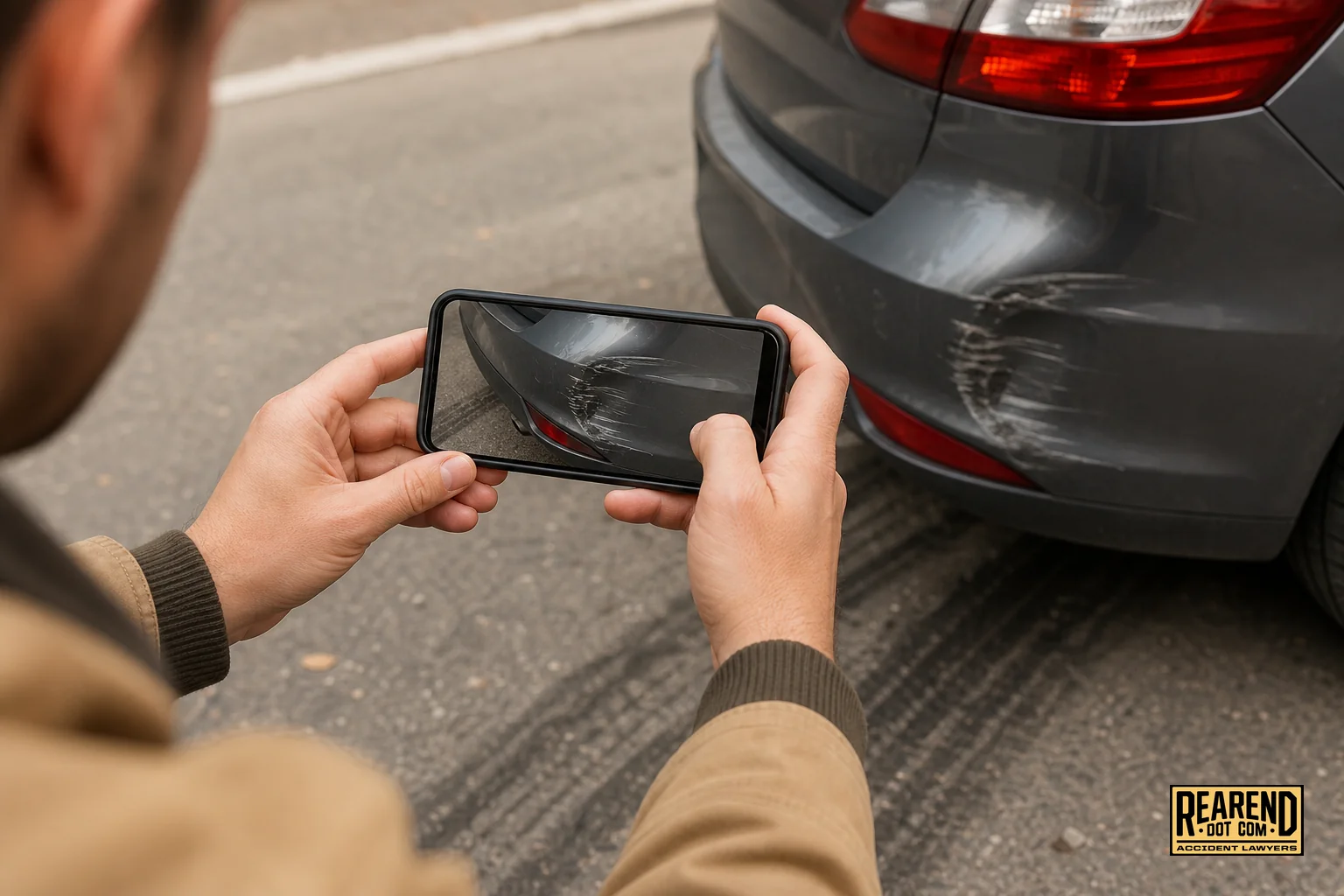
Start with the physical scene. One Fresno personal injury firm recommends that drivers thoroughly document the accident scene by taking numerous photos and videos, covering vehicle damage, skid marks, terrain, lighting, and weather conditions, along with pictures of any visible injury and the license plates of all vehicles involved.
Beyond photos, request a copy of the official police report as soon as it’s available. A Fresno report of this kind typically records the date, time, and location of the crash; the names, contact details, and insurance information for each driver and any witnesses; a diagram or narrative of how the vehicles collided; the responding officer’s observations of vehicle damage; and any citations issued at the scene. That combination of details is exactly what lets you check your own account against a neutral record before you say anything to an adjuster.
Another Fresno-focused resource on common claims mistakes notes that insurance claims are built on documentation, including photos, receipts, repair estimates, medical records, and police reports, rather than on memory alone. If you’re still working through the first hours after impact, our guide on what to do after being rear-ended in the first 72 hours walks through that documentation step by step.
Should You Talk to the Insurance Company Before Hiring a Fresno Rear-End Accident Attorney?
You don’t need to answer an adjuster’s questions before speaking with an attorney. Doing so first is usually the safer order. A free case evaluation can review the specific statement request, explain what it’s likely for, and flag anything that looks like it’s fishing for fault or minimizing injury.
Unrepresented claimants are often the ones adjusters target for early recorded statements, precisely because there’s no one reviewing the request on their behalf. rearend.com’s free case evaluation gives Fresno claimants that review before any statement is given, at no cost, with no fee unless the claim recovers money.
What Happens If Your Fresno Claim Gets Denied After a Recorded Statement?
A denial that follows a recorded statement often traces back to something said in that call, such as an ambiguous comment about fault or a description of injuries that later worsened. That connection isn’t automatic, but it’s common enough to check first.
If your claim has already been denied, our companion guide, Rear-End Accident Lawyer vs Insurance Adjuster: Who Works for You, breaks down how adjuster incentives differ from your own and what that means for a denied Fresno claim moving forward.
5. Get a Free Case Evaluation to Review the Request First
A free case evaluation with rearend.com starts with a short online questionnaire about your Fresno rear-end crash, including whether an insurer has already reached out for a recorded statement. That detail alone can shape the guidance you get back.
From there, a member of the legal team reviews your submission. They typically follow up within 24 hours to walk through next steps, including whether it makes sense to respond to the insurer’s request, and if so, how. Because the model is no-fee-unless-you-win, there’s no upfront cost tied to getting that review before you speak with an adjuster. If you’re still deciding whether legal help fits your budget, our breakdown of rear-end accident lawyer cost and fees covers how contingency arrangements typically work.
FAQ: Rear-Ended and Dealing With the Insurance Company
I’ve been rear-ended. What should I do first?
Check for injuries, call the police to file a report, and photograph the scene, including vehicle damage, license plates, and road conditions, before you discuss the crash with any insurance company. Seeking a prompt medical evaluation matters even if you feel fine at first.
Do I have to give a statement to my own insurer?
Possibly, depending on your policy’s cooperation clause, but that obligation is different from answering an unprepared call from the other driver’s insurance company. Review your policy or ask a legal team to check it before you respond either way.
Can I get my car repaired while my injury claim is still under review?
Often yes, since vehicle repairs and injury claims move on separate tracks in many cases. If you need help finding a shop, rearend.com’s directory of trusted local auto body shops can point you toward options near Fresno.
Rear-end crashes rarely wait for a convenient moment, and neither do the insurance companies handling them. If an adjuster has already asked you for a recorded statement, or you expect one to call, getting a free case evaluation reviewed first can help you understand what’s actually being asked and why. You can start your claim online in a few minutes, and if you want a sense of what a Fresno rear-end claim might be worth before you talk numbers with anyone, you can also calculate an estimate of what your potential claim could be worth. Neither step commits you to anything beyond getting informed before you speak with the insurance company.
Prior results do not guarantee a similar outcome. – Rearend.com
Prior results do not guarantee a similar outcome. — Rearend.com
Recommended Resources
Start My Claim Find Trusted Local Auto Body Shops Calculate an estimate of what your potential claim could be worth
Related Articles


Need Legal Help After a Rear-End Accident?
Get a free consultation with our experienced legal team