
Oceanside Rear-End Attorney: Personalized Case Support
At a Glance: Personalized Support vs High-Volume Firms
| Factor | Personalized Support Model | Generic High-Volume Firm |
|---|---|---|
| Point of contact | Same legal team member throughout your case | Often rotates through intake staff or paralegals |
| Case focus | Attorneys who focus on rear-end collision cases | Mixed caseload across many injury types |
| Initial response time | Follow-up call generally within 24 hours of submission | Can take several days depending on volume |
| Fee structure | Contingency basis, no fee unless you recover compensation | Varies; some firms use similar models but less transparently explained |
| Strategy approach | Built around your crash facts, medical treatment, and local road context | May rely on standardized claim templates |
| Communication style | Direct answers about your specific claim status | Status updates sometimes delayed by internal handoffs |
A rear-end accident attorney Oceanside CA drivers actually talk to, not a call center, is what personalized legal support means at rearend.com: a direct line to the person handling your file, a claim strategy built around your specific crash, and a free case evaluation before you owe anything. That distinction matters most once the insurance adjuster starts calling.
Key Takeaways
- Direct contact: You work with a legal team member who knows your file, rather than being routed through a general call center each time you call.
- Tailored strategy: Your claim approach accounts for specifics like impact location, medical history, and the at-fault driver’s policy limits, not a one-size template.
- Free case evaluation: An online questionnaire, a document review, and a follow-up call generally happen within about 24 hours, with no upfront cost.
- Contingency basis: Representation generally comes with no fee unless your case recovers compensation, which lowers the financial risk of getting help.
- Scale trade-off: Firms that take on large volumes of unrelated case types may have less bandwidth for the kind of ongoing, personal attention rear-end victims often want.

1. What Does Personalized Legal Support Actually Look Like in Oceanside?
It starts with knowing the roads. Oceanside crashes happen at predictable spots: backups on Interstate 5 near the SR-76 interchange, sudden stops on Coast Highway through the pier area, and rear-end impacts along Mission Avenue during school and beach traffic. A legal team that pays attention to these patterns can ask sharper questions from the first call.
Personalized support also means the person you speak with can pull up your file without transferring you three times. If you mention a symptom that started days after the crash, or a new estimate from a body shop, that detail should land with someone who already knows your case, not a stranger reading notes off a screen.
For military families connected to Camp Pendleton, this matters even more. Deployment schedules and PCS moves do not pause for a claim timeline, so a legal team that responds directly and quickly can help you stay informed even when your availability is limited. You can read more about what this looks like specifically in Rear-End Accident Legal Process Oceanside CA: What Victims Often Get Wrong.
2. How a Tailored Claim Strategy Differs From a Generic Approach
A tailored strategy starts with facts specific to your crash. It does not start from a checklist copied from the last file. Impact speed matters. Prior neck or back issues matter. So does how much insurance the at-fault driver actually carries. Each of these shapes how a claim gets built and negotiated.
California requires drivers to carry at least $30,000 in bodily injury liability coverage per person and $60,000 per accident. When medical bills and lost wages climb past those limits, a personalized strategy might look at underinsured motorist coverage, additional liable parties, or a phased approach to settlement talks. A generic, high-volume approach may miss this step. The file gets treated like every other one that week.
Local context matters too. A commuter rear-ended on SR-76 has different documentation needs than a tourist visiting the pier. A Camp Pendleton service member juggling medical appointments off-base has different needs still. Adjusting the strategy to these realities, instead of forcing every case into the same mold, is part of what personalized support is supposed to deliver. For a broader look at how settlement value gets calculated, see Rear-End Accident Settlement Amount Factors That Victims Rarely Know About.
What Should I Do Right After Being Rear-Ended in Oceanside?
Move your vehicle to safety if possible, call police to file a report, and seek medical evaluation even if you feel fine. Photograph the scene, exchange insurance information, and avoid giving a recorded statement to the other driver’s insurer before speaking with someone who represents your interests.
These first steps create the documentation a personalized strategy relies on later. Skipping the medical visit or the police report can leave gaps an adjuster may try to use against you. A closer breakdown of this window is covered in What to Do After Being Rear-Ended in the First 72 Hours.
How Comparative Negligence and Shared-Fault Disputes Get Litigated in California
California follows a pure comparative negligence rule, meaning a driver can recover compensation even if partially at fault, with the award reduced by their percentage of fault. In rear-end cases this matters most when the trailing driver argues the lead driver contributed to the crash.
Common disputed scenarios include:
- Brake-checking: The trailing driver claims the lead vehicle braked suddenly or unnecessarily, shifting some fault away from the rear driver. This typically turns on dashcam footage, witness statements, and vehicle damage patterns.
- Chain-reaction pileups: When three or more vehicles are involved, each impact must be analyzed separately to determine which driver caused which collision, since a middle vehicle can be both a victim and an at-fault party for the car ahead of it.
- Sudden stops in traffic: Adjusters may argue a driver stopped abnormally on a road like Mission Avenue or Coast Highway, requiring documentation of traffic conditions at the time.
Because fault percentages directly reduce a settlement, a personalized strategy gathers evidence early: police reports, photos of final rest positions, and any available dashcam or nearby business camera footage. Generic, template-driven claims are more likely to accept an insurer’s first fault allocation without pushing back on these details.
3. What Happens During Your Free Case Evaluation?
A free case evaluation generally starts with a short online questionnaire about your crash, followed by a legal team member reviewing your details and calling to discuss whether your claim is worth pursuing. There is no obligation to move forward after that call.
The questionnaire asks for basics: date and location of the crash, whether you sought medical treatment, and any documentation you already have, like photos or a police report number. This information lets the team understand your situation before you ever speak with anyone.
After submission, a follow-up call or email generally arrives within about 24 hours. That conversation is where personalized support starts to show. Instead of a scripted pitch, the call should focus on your actual crash, your treatment so far, and what questions you have about next steps.

If you want to see what this process looks like laid out step by step, review Rear-End Accident Attorney in San Diego: What to Expect, which walks through a comparable regional intake experience.
4. Why Bigger Isn’t Always Better for Rear-End Claims
A high volume of cases can mean less time for any single client. A firm might handle thousands of unrelated personal injury matters at once. That range can span slip-and-falls to product liability. Your rear-end claim may compete for attention with cases that have nothing in common with yours.
There is no formal legal specialization in rear-end collision cases the way there is in, say, tax law. What matters instead is whether an attorney focuses on this type of crash often enough to recognize patterns: how insurers typically value soft tissue injuries, how impact speed correlates with delayed symptoms, and how policy limit disputes usually get resolved.
An attorney who has handled numerous rear-end cases is generally better positioned to anticipate an adjuster’s tactics than one who sees this crash type occasionally among a broad caseload.
That focus does not guarantee a particular outcome. Prior results do not predict what will happen in your case. It does mean the questions asked, the documentation gathered, and the negotiation approach are shaped by pattern recognition rather than guesswork.
5. How to Prepare for Your First Conversation With an Attorney Who Focuses on Rear-End Cases
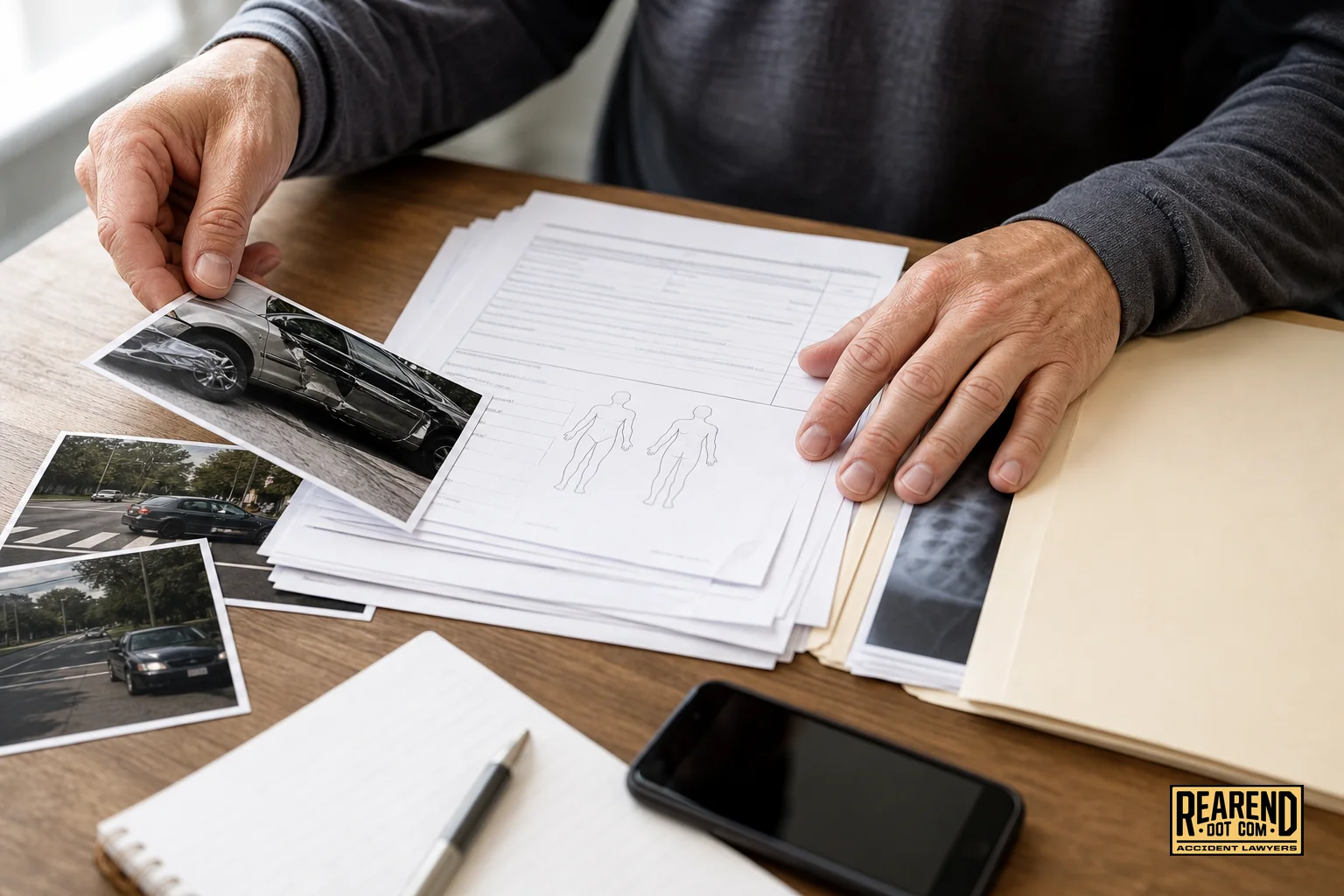
Bring what you already have. A police report number, photos of the vehicles, medical records or appointment summaries, and the other driver’s insurance information all help the conversation move faster and more specifically.
Ask direct questions about communication. Will you speak with the same person each time you call? How often should you expect updates? For a fee arrangement question, ask exactly what percentage applies if your case does recover compensation, and confirm in writing that there is no fee if it does not.
Understanding contingency fee basics before that first call also helps. Representation on a contingency basis generally means no fee unless your case recovers money. This removes much of the upfront financial pressure that keeps unrepresented victims from getting help at all. For a full cost breakdown, including how contingency percentages are typically structured, see Rear-End Accident Lawyer Cost & Fees.
Copyable Checklist: Before Your First Call
- Police report number
- Photos of vehicle damage and the accident scene
- Medical records or appointment summaries
- Other driver’s insurance information
- Any dashcam or witness footage, especially for disputed-fault or chain-reaction crashes
- Written confirmation of the fee percentage and when it applies
FAQ: Rear-End Accidents and Personalized Legal Support
Is my case too small for personalized attention?
No claim is automatically too minor for a free case evaluation. Even crashes with modest vehicle damage can involve delayed injuries like whiplash, and a personalized review looks at your medical situation rather than dismissing a case based on bumper damage alone.
How is a rear-ended claim different from other crashes?
Rear-end crashes often carry a presumption that the trailing driver was following too closely, which can simplify the fault question compared with intersection or multi-vehicle collisions. That said, disputes still arise over sudden stops, brake checks, or chain-reaction pileups, as outlined above under comparative negligence.
How long does the process take?
Timelines vary based on medical treatment length, negotiation with the insurer, and whether litigation becomes necessary. A more detailed timeline breakdown, including typical stage-by-stage duration, is available in How Long Does a Rear-End Accident Settlement Take From Filing to Payment?.
If you were rear-ended in Oceanside and want a direct conversation instead of a generic script, start your claim to begin a free case evaluation. If your vehicle needs repair while your claim moves forward, you can also find trusted local auto body shops, and if you’re weighing whether your situation is worth pursuing, you can calculate an estimate of what your potential claim could be worth before you decide on next steps.
Recommended Resources
Start My Claim Find Trusted Local Auto Body Shops Calculate an estimate of what your potential claim could be worth
Related Articles


Need Legal Help After a Rear-End Accident?
Get a free consultation with our experienced legal team