
Rear-end accident attorney los angeles pedestrian struck by car: A practical guide
If a chain-reaction rear-end crash pushed a car into you while you were walking in Los Angeles, you may have a claim against more than one driver. A rear-end accident attorney Los Angeles pedestrian struck by car cases call for is one who knows how to sort liability between the driver who caused the initial impact and the driver whose car ended up hitting you. This scenario is less common than a standard two-car rear-end crash, but it happens often enough on congested LA streets that victims deserve a clear roadmap.
Key Takeaways
- Multiple drivers may share fault: The driver who initiated the rear-end impact is often the primary target for liability, but the driver whose car struck you may also carry some responsibility depending on how the crash unfolded.
- California’s comparative negligence rule applies: Fault can be split between parties, which means your compensation may come from more than one insurance policy.
- Minimum coverage may not be enough: California requires only $30,000 per person and $60,000 per accident in liability coverage, an amount that could fall short after a pedestrian injury with real medical needs.
- Evidence disappears quickly: Traffic camera footage, skid marks, and witness memories fade fast, so documenting the scene and getting a full police report matters more in multi-vehicle pedestrian cases.
- A free case evaluation can clarify your options: Because these cases often involve two or more insurers, getting an early read on liability can help you avoid an early lowball offer from either company.
At a Glance: Pedestrian Struck in a Chain-Reaction Crash
| Factor | What to Know |
|---|---|
| Who may be liable | The initiating driver, the pushed driver, or both, depending on the facts |
| CA minimum liability coverage | $30,000 per person / $60,000 per accident |
| Key evidence | Police report, traffic camera or dashcam footage, witness statements, medical records |
| Fault standard | California comparative negligence, fault can be divided among parties |
| Typical first step | Medical evaluation, then a free case review with an attorney familiar with rear-end chain reactions |
| Attorney cost model | Many rear-end focused firms work on a contingency basis, no fee unless you recover compensation |
| Common LA locations | Congested corridors and intersections along major boulevards where stop-and-go traffic is frequent |
How a Rear-End Chain Reaction Can Push a Car Into a Pedestrian
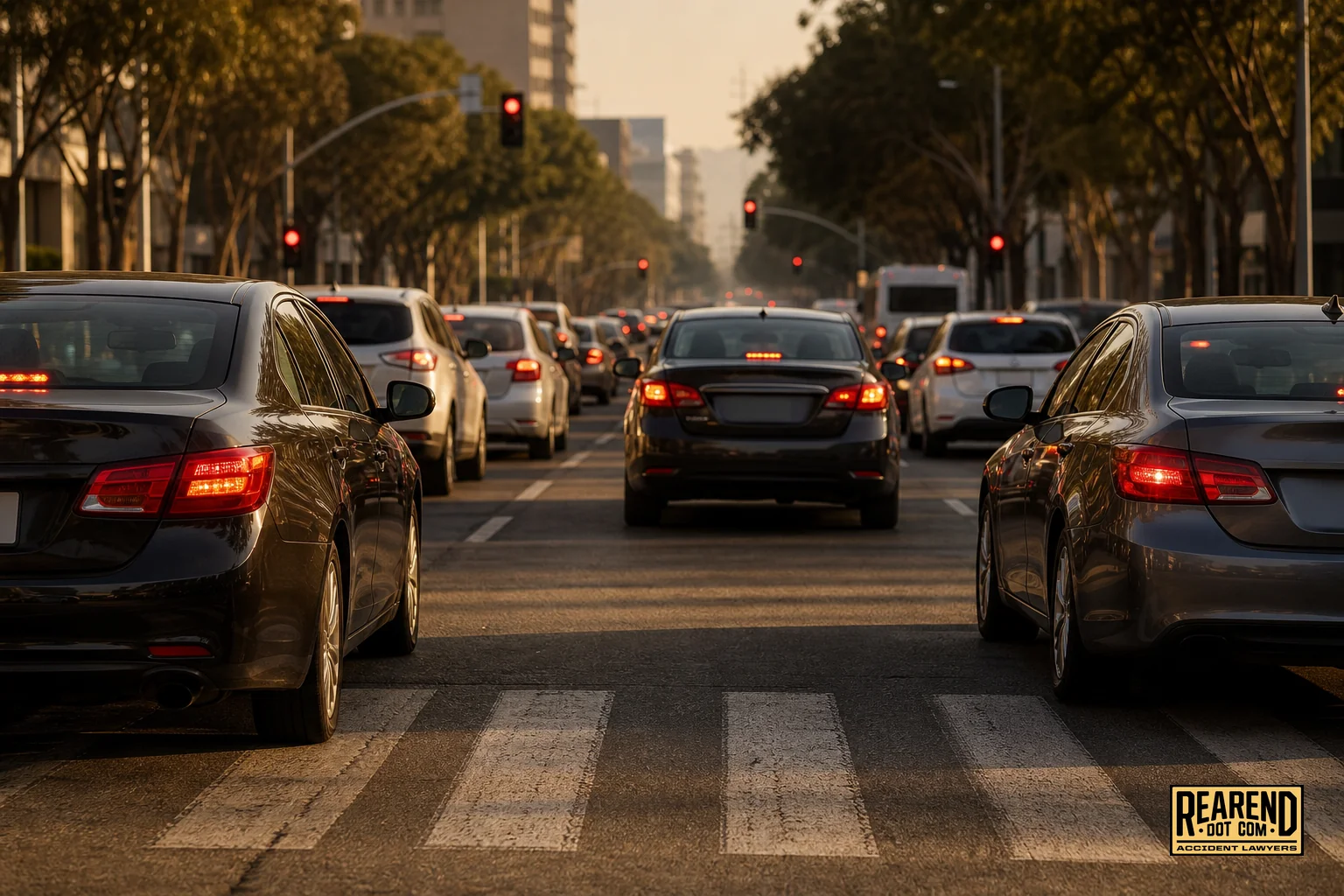
Picture a driver stopped at a crosswalk near a Los Angeles intersection, waiting for pedestrians to clear. A car behind that driver fails to stop in time and rear-ends them. The force of the impact shoves the first car forward, into the crosswalk, striking a pedestrian who had the right of way. This is a chain-reaction rear-end crash, and it creates a legal situation different from a standard two-car collision.
In a typical rear-end case, the driver who struck the vehicle in front is usually the one held responsible. When a pedestrian gets hurt because that impact pushed a car into the crosswalk, the analysis gets more layered. You now have at least three parties in the picture: the striking driver, the driver whose car was pushed, and you, the pedestrian who did nothing wrong but still absorbed the impact.
This pattern tends to show up in dense traffic corridors, near shopping centers, and at signalized intersections where cars queue close together and pedestrians are legally present in the roadway. Los Angeles has no shortage of these spots, and the frequency of stop-and-go congestion across the city makes chain-reaction pushes into crosswalks a real, if less common, risk for anyone on foot.
1. Who Can Be Liable When Multiple Drivers Are Involved
In most chain-reaction rear-end cases, the driver who caused the initial impact bears the largest share of fault. That driver’s failure to stop in time set off the sequence, and California law generally treats the rear driver in any rear-end collision as the one presumed to have followed too closely or failed to react.
That said, the driver whose vehicle was pushed into you isn’t automatically off the hook. If that driver was already too close to the crosswalk, distracted, or could have avoided rolling forward into the pedestrian zone after being hit, an insurer or court could assign some percentage of fault to them as well. California follows a comparative negligence system, meaning liability can be divided between parties based on their share of responsibility, rather than an all-or-nothing outcome.
For you as the pedestrian, this usually works in your favor. It means you may have more than one avenue for compensation instead of depending on a single driver’s policy and its limits. An attorney who focuses on rear-end cases, rather than general personal injury work, is often better positioned to untangle which driver’s actions triggered which part of the chain, and how the fault should be allocated.
2. What Evidence Matters Most in a Multi-Vehicle Pedestrian Case
Because a chain-reaction pedestrian case involves more moving parts than a standard rear-end claim, the evidence needs to establish the sequence of events clearly. A handful of sources tend to carry the most weight:
- Traffic or business camera footage: Intersections and storefronts in Los Angeles frequently have cameras that can capture the moment of impact and the order in which vehicles collided.
- Witness statements: Pedestrians and drivers nearby who saw the sequence unfold can help confirm which car struck which, and in what order.
- The police report: Officers responding to a multi-vehicle crash should document each unit involved, not just the two closest vehicles. If your case involves a wrong or incomplete report, it’s still possible to move forward; you can read more about that scenario in Can I Still File a Claim If the Police Report Is Wrong?
- Vehicle position and damage patterns: Where each car came to rest, and the location of the damage, can help reconstruct how the force traveled from the rear vehicle through to the pedestrian.
- Medical documentation: A pedestrian struck by a vehicle often sustains different injury patterns than an occupant inside a car, so documenting your injuries promptly and consistently matters for both your health and your claim.
The National Highway Traffic Safety Administration tracks pedestrian crash data nationally, and multi-vehicle sequences like this are a recognized, if less frequent, category within broader pedestrian-involved crash statistics. You can review general pedestrian safety data through the NHTSA’s pedestrian safety resources.
3. Steps a Pedestrian Should Take After Being Struck
If you were the pedestrian pushed into by a vehicle in a rear-end chain reaction, a few immediate steps can protect both your health and your ability to pursue compensation later.
- Get medical attention right away. Pedestrian injuries from vehicle impacts can be more severe than they first appear. Even if you feel able to walk away, a medical evaluation creates a documented record tied to the date of the crash.
- Collect information from every driver involved, not just one. In a chain-reaction crash, you’ll want names, insurance details, and contact information for each vehicle in the sequence, not only the car that physically struck you.
- Ask for a complete police report. Confirm the report lists all vehicles and describes the order of impacts, since this document often becomes the starting point for sorting out liability between insurers.
- Be cautious about giving a recorded statement to any insurer before speaking with legal support. With multiple companies potentially involved, an early statement to one insurer could complicate your claim against another.
- Consider a free case evaluation early. Because these cases involve more than one potentially liable party, getting a professional read on how fault might be divided can help you avoid settling too quickly with the wrong company, or for too little.
For a broader first-hours checklist that applies to most rear-end scenarios, including pedestrian-adjacent ones, see The Rear-End Accident Checklist for the First 24 Hours After a Crash.
4. How Liability and Compensation Get Sorted Between Multiple Insurers
When a rear-end chain reaction pushes a car into a pedestrian, more than one insurance policy could end up contributing to a settlement. This is different from a straightforward rear-end accident attorney Los Angeles pedestrian struck by car case involving just one at-fault driver, since the claim may need to be presented to two carriers at once, each representing a different vehicle in the chain.
California’s minimum liability coverage requirement is $30,000 per person and $60,000 per accident. If either driver in the chain carries only the state minimum, that policy alone may not cover a pedestrian’s medical bills, lost wages, and ongoing care, particularly if the injuries are serious. This is one reason multi-driver cases sometimes need to draw compensation from more than one source. For a closer look at how minimum coverage plays out in practice, see Oceanside Rear-End Crash: Is CA Minimum Coverage Enough?.
An attorney who has handled numerous rear-end cases, rather than a broad personal injury generalist, tends to be more familiar with how insurers argue over shared fault in these chain-reaction scenarios. Insurance adjusters representing different drivers may each try to shift more of the blame toward the other vehicle, which can leave a pedestrian caught in the middle without dedicated advocacy. If you’ve already had a company reach out, our guide on whether to talk to an insurance adjuster who called after an accident covers how to handle that conversation carefully.
Review your claim in just a few clicks for free if you’re unsure whether one or multiple insurers should be involved in your case.
5. Common Questions Pedestrian Victims Ask
Can I sue if I was rear-ended and pushed into a pedestrian?
If you were the driver whose car got pushed into a pedestrian, you may still have your own claim against the driver who hit you from behind, separate from the pedestrian’s claim against you. Fault gets evaluated for each party’s role, and it’s possible to be both a claimant and a potentially liable party in the same crash sequence.
How much does a rear-end accident lawyer cost?
Many firms that focus on rear-end and related pedestrian cases work on a contingency fee basis, meaning there’s generally no upfront cost, and payment comes only if compensation is recovered. For a detailed cost breakdown, see Contingency Fee vs Hourly Lawyer Los Angeles Accident Victims: Real Cost Breakdown.
How long does a rear-end accident settlement take?
Multi-vehicle pedestrian cases can sometimes take longer than a standard two-car rear-end claim, since more than one insurer may need to investigate and respond. Timelines vary significantly depending on the severity of injuries and how quickly liability gets sorted between drivers.
What questions should I ask a rear-end accident attorney before hiring one?
Ask how many multi-vehicle or pedestrian-involved rear-end cases the attorney has handled, how they plan to establish fault between multiple drivers, and how their fee structure works. A short list of vetting questions can help you avoid working with someone unprepared for a layered liability case.
Getting Legal Support in Los Angeles After a Chain-Reaction Crash
Los Angeles traffic patterns, from Wilshire Boulevard congestion to stop-and-go stretches near freeway on-ramps, create the kind of dense, close-following conditions where chain-reaction rear-end crashes are more likely to reach a nearby crosswalk. Local familiarity with these corridors, and with how LA courts and insurers typically handle multi-party fault, can make a meaningful difference in how your case gets built.

Rearend.com offers a free case evaluation for pedestrian and multi-vehicle rear-end scenarios, with no fee unless your case results in compensation. The intake process is designed to move quickly, so you’re not left waiting while insurers on both sides begin building their own version of events. If your vehicle also needs repairs as part of a related claim, you can also find trusted local auto body shops through rearend.com’s referral resources.
Being struck as a pedestrian in someone else’s chain-reaction crash is disorienting, and figuring out which driver’s insurance should respond can feel like an uphill fight you didn’t sign up for. You don’t have to sort out multiple insurers or piece together fault on your own. Start my claim today to get a clear, no-cost read on how liability may be divided in your case and what your next step should look like.
Related Articles


Need Legal Help After a Rear-End Accident?
Get a free consultation with our experienced legal team