
Rear-Ended at a Red Light Who Pays? A Step-by-Step Breakdown
If you were stopped at a red light and the car behind you didn’t stop in time, the driver who hit you is usually the one whose insurance pays. That’s because the driver following behind generally has a duty to leave enough space and stopping distance to avoid a crash. But “usually” isn’t “always,” and a few common exceptions can complicate who pays after you’re rear-ended at a red light.
Key Takeaways
- Following driver is usually presumed at fault: Drivers are generally expected to maintain a safe following distance, so rear-end crashes at a stoplight often point to the driver behind as the at-fault party.
- Fault can shift or split: A sudden lane change into your path, a chain-reaction pileup, or a car rolling backward can shift some or all liability, so scene evidence matters.
- California’s minimum liability limits are $30,000 per person and $60,000 per accident: If the at-fault driver only carries the state minimum, that amount could fall short of covering medical bills and lost wages.
- Photos, witness names, and a police report help protect your claim: Evidence gathered in the first hour is often harder for an insurer to dispute later.
- A free case evaluation can clarify your options: If fault is disputed, injuries go beyond minor soreness, or an adjuster offers a quick lowball settlement, it may be worth reviewing your claim with an attorney who focuses on rear-end cases.
At a Glance: Red Light Rear-End Liability
| Factor | What It Usually Means |
|---|---|
| Who typically pays | The rear driver’s liability insurance, since they’re usually presumed at fault for not stopping in time |
| California minimum coverage | $30,000 per person / $60,000 per accident |
| Common fault exceptions | Sudden lane change, broken brake lights, multi-car chain reaction, rolling backward |
| Evidence to collect | Photos of vehicle positions, witness contacts, police report number, dashcam/nearby camera footage |
| When to notify your insurer | As soon as possible after the crash, even if you weren’t at fault |
| Attorney fee model at rearend.com | No fees unless compensation is recovered |
| When a free case evaluation may help | Disputed fault, ongoing pain, multi-car crash, or a fast/low settlement offer |
1. Understand Why the Following Driver Is Usually Presumed at Fault
Traffic laws in most states, including California, generally require drivers to keep enough distance from the car ahead to stop safely. If you’re sitting still at a red light and someone hits you from behind, the assumption most insurers and courts start with is that the trailing driver failed to leave adequate space or wasn’t paying attention.
This presumption exists because a stopped car at a red light isn’t doing anything unpredictable. It’s not swerving, not accelerating, not braking suddenly for no reason. It’s just stopped, the way the law expects it to be. The driver approaching from behind is the one with the responsibility to react in time, whether that means slowing down earlier, checking their phone less, or simply paying attention to traffic ahead.
That said, “usually presumed at fault” is not the same as “automatically found at fault in every case.” Insurance adjusters still look at the full picture, and if you were involved in a crash near a busy intersection in San Diego, Riverside, or another major California city, local traffic patterns and camera coverage can affect how quickly liability gets sorted out.
2. Know the Exceptions That Can Complicate a Red Light Rear-End Claim
A handful of scenarios can shift fault away from a clean “rear driver pays” outcome, or split it between both drivers. It helps to know these before you talk to an adjuster:
- Sudden lane change: If you merged into the lane and stopped abruptly right as the light changed, the following driver may argue they didn’t have a fair chance to react.
- Non-functioning brake lights: If your brake lights weren’t working, the driver behind you might claim they had no visual warning that you were stopping.
- Multi-car chain reaction: In a pileup where car A hits car B, which then hits car C, fault can get distributed across multiple drivers depending on the sequence of impacts.
- Rolling backward: If your car rolled backward into the vehicle behind you, perhaps on a hill or due to a transmission issue, fault could shift toward you instead.
These exceptions are one reason insurance companies sometimes push back on claims that seem straightforward on the surface. An adjuster representing the at-fault driver has an incentive to look for any detail that reduces their client’s exposure, which is part of why insurance companies sometimes try to lowball rear-end victims rather than pay the full value of a claim.
3. Gather Evidence at the Scene Before You Leave
What you document in the minutes after a crash can carry more weight than what anyone says a week later. Memories fade, and insurance companies know that too, which is part of why quick, thorough documentation matters.
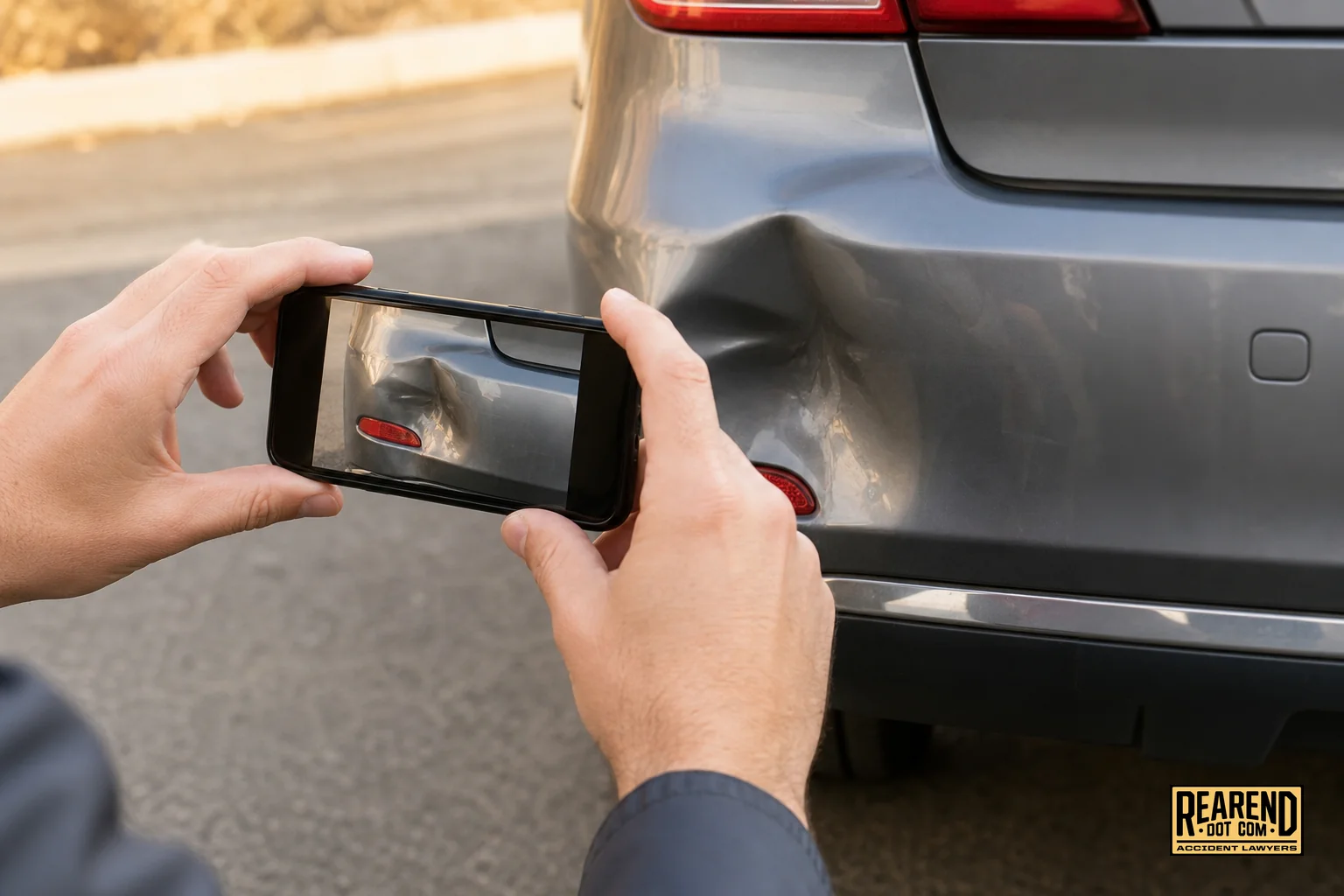
Here’s a practical checklist for the scene, assuming you’re not seriously injured and it’s safe to move around:
- Photograph everything: Get wide shots of both vehicles’ final resting positions, close-ups of damage, the traffic signal itself, and the surrounding intersection.
- Collect witness information: Names and phone numbers of anyone who saw the crash can be valuable if fault is disputed later.
- Request a police report: Even for a minor-seeming crash, an officer’s report can document statements, road conditions, and initial fault impressions.
- Check for camera footage: Nearby businesses, traffic cameras, or the other driver’s dashcam might have captured the moment of impact. Footage tends to disappear or get overwritten within days, so ask promptly.
- Note the other driver’s information: Insurance policy number, license plate, and contact details are essential.
If you’re not sure whether your documentation is strong enough to support a claim, a free rear-end accident case evaluation can help you understand what else might be needed before you talk further with an adjuster.
4. Understand Whose Insurance Pays and How Much Is Available
Once fault is established, the at-fault driver’s liability insurance is typically the source of payment for your vehicle damage, medical bills, and other losses. But there’s a catch worth understanding early: insurance only pays up to the policy’s limits.
California requires drivers to carry minimum liability coverage of $30,000 per person and $60,000 per accident. If the driver who hit you carries only the state minimum, and your medical bills, lost wages, and vehicle repair costs add up to more than that, the shortfall can become a real problem. This is a common issue explored in more detail in Oceanside Rear-End Crash: Is CA Minimum Coverage Enough?, which walks through what happens when policy limits fall short of actual damages.
If the at-fault driver is uninsured or underinsured, your own policy’s uninsured/underinsured motorist coverage, if you carry it, may be able to help fill the gap. It’s worth reviewing your own policy details soon after a crash rather than waiting until a claim stalls.
5. Report the Claim the Right Way
Notify your own insurer about the crash promptly, even if you believe the other driver was clearly at fault. Most policies require timely notice, and delays can sometimes complicate coverage.
Be cautious about giving a recorded statement to the other driver’s insurance company before you’ve had time to think through what happened, and before you’ve seen a doctor if you’re experiencing any pain. Adjusters may ask questions designed to get you to downplay your injuries or agree to a version of events that shifts blame. You’re generally not obligated to give a detailed recorded statement to the other side’s insurer right away.
It’s also worth being wary of an early settlement offer that arrives within days of the crash. Soft tissue injuries like whiplash sometimes don’t fully show symptoms until later, and accepting a quick payout before you understand the full extent of your injuries could mean settling for less than your claim may be worth. For more on how settlement amounts are typically calculated, see Rear-End Settlement Payouts: What Factors Affect the Amount?
6. Know When Talking to an Attorney About a Free Case Evaluation Makes Sense
Not every fender-tap at a red light requires legal help. But several situations tend to warrant at least a conversation with an attorney who has handled rear-end cases before making a decision:

- Fault is disputed: If the other driver or their insurer claims you contributed to the crash, having documentation and legal guidance on your side matters more.
- Injuries persist beyond a few days: Neck or back pain that lingers, or worsens, after a red light rear-end crash may signal something an initial exam didn’t catch.
- Multiple vehicles were involved: Chain-reaction pileups can involve overlapping insurance claims that are difficult to sort out alone.
- You’ve received a quick, low settlement offer: An early offer that feels rushed or too low relative to your bills is a common sign worth a second opinion.
- You’re unsure how to handle communications with the at-fault driver’s insurer: An attorney who focuses on rear-end cases can generally take over that communication for you.
If any of these sound familiar, reviewing your situation with rearend.com costs nothing upfront. Representation works on a no-fees-unless-you-win basis, meaning there’s generally no out-of-pocket cost to find out where you stand. You can review your claim in just a few clicks for free and get a sense of your options before deciding anything.
If you’re weighing whether to hire help at all, How to Choose a Rear-End Accident Attorney Without Getting Burned and 10 Questions to Ask a Rear-End Accident Attorney Before You Sign Anything both cover what to look for before signing with anyone.
Frequently Asked Questions
Can I sue if I was rear-ended at a red light?
In many cases, yes, filing a claim or lawsuit is an option if you were injured or suffered property damage, particularly if the insurance settlement offer doesn’t cover your losses. Whether it makes sense in your specific situation depends on the facts, including how clear liability is and how significant your damages are.
What if the other driver says I stopped short?
This is one of the more common disputes in red light rear-end cases. Evidence like dashcam footage, witness statements, and the police report can help clarify what actually happened. Because you were stopped at a red light rather than braking unexpectedly in moving traffic, this defense is often harder for the other driver to support, but it’s not impossible.
How long does a rear-end accident settlement take?
Timelines vary widely depending on the severity of injuries, how long treatment takes, and whether the insurer disputes fault. Some claims resolve in a few months; others, especially those involving ongoing medical care or litigation, can take considerably longer.
What about rear-end collision repair?
Once fault is established, the at-fault driver’s insurer typically covers reasonable repair costs, up to policy limits. If you need help finding a shop, you can use rearend.com’s tool to find trusted local auto body shops instead of guessing which repair shop will do quality work.
Being rear-ended at a red light is disorienting, and figuring out who pays shouldn’t add to the stress. If you’re dealing with a disputed claim, mounting medical bills, or an insurance adjuster who isn’t taking your injuries seriously, it may be worth getting a second set of eyes on your situation. Start my claim today and find out, at no cost, what your next step should look like.
Related Articles


Need Legal Help After a Rear-End Accident?
Get a free consultation with our experienced legal team