
Rear-Ended in a Black Friday Parking Lot Accident? What Victims Should Do
After a parking lot accident on Black Friday, check yourself and your passengers for injuries first, then photograph both cars and the lot, trade information with the other driver, and report the crash to police and your insurer. Get a medical evaluation even if the pain feels mild. A free review at rearend.com can then help you decide whether to pursue a claim.
Key Takeaways
-
Health comes first: Adrenaline can hide pain after a low-speed hit, so see a doctor soon even when symptoms seem small.
-
Evidence fades fast: Photos, witness contacts and store camera footage can disappear within hours or days, so gather them at the scene.
-
Fault is not automatic: Lot lanes, backing cars and stop signs can turn a simple rear-end hit into a disputed story, and fault rules vary by state.
-
The decision is free: rearend.com offers a free, no-obligation case review, and you don’t pay a dime unless we recover compensation on your behalf.
Parking Lot Accident Steps at a Glance
|
Step |
What to do |
Why it matters |
|---|---|---|
|
1. Check for injuries |
Check yourself and passengers, call 911 for serious symptoms, see a doctor soon |
Pain often shows up hours or days later; medical records tie symptoms to the crash |
|
2. Move to safety |
Pull into an open stall if the car drives, turn on hazard lights, stay at the scene |
Lots are full of pedestrians and slow cars; leaving the scene can create legal trouble |
|
3. Document |
Photograph both cars, plates, lot markings and the crowd; collect witness names |
Lot crashes often turn on disputed facts |
|
4. Exchange information |
Name, phone, insurer, policy number, plate; skip fault talk |
Casual remarks can come back as admissions |
|
5. Report |
Ask for a police report number, tell store management, call your insurer |
An official record prevents a word-against-word dispute |
|
6. Track and decide |
Keep a symptom journal and receipts, then request a free claim review |
Organized records show what the crash cost you |
Black Friday Crowds and the Parking Lot Accident Risk
Picture the scene: you sit stopped in a lane, waiting for a driver to back out of a stall near the entrance. Your foot is on the brake. A car behind you, with a driver watching a space instead of the road, taps your bumper or hits harder.
Black Friday packs parking lots with cars that creep, stop, reverse and circle. Drivers hunt for spaces, shoppers step out from between vehicles, and many people glance at phones or store entrances. That mix often produces low-speed rear-end collisions.
Low speed does not mean low harm. Your body can absorb a jolt in the neck, shoulders and back even when the bumpers show a scuff. Many people leave a lot feeling shaken but fine, then wake up stiff the next morning.
This guide is written for drivers across the United States, including those in San Diego, Los Angeles, Oakland and San Jose, where holiday shopping centers fill fast. The steps below follow the order that protects your health first and your claim second.
1. Check for Injuries and Get a Medical Evaluation First
Start with people, not paperwork. Ask whether anyone in your car hurts, including children in back seats. Check yourself for pain in the neck, back, head, chest and arms. If anyone has severe pain, confusion, trouble breathing or a loss of consciousness, call 911 and stay still until help arrives.
Why adrenaline hides injuries
After a jolt, your body floods with stress hormones that dull pain. That is why many drivers tell the other person “I’m fine” in the first minutes. Whiplash, concussion and back strain often announce themselves later, sometimes the next day or the next week.
Avoid saying “I’m not hurt” to the other driver, a store guard or an officer. Say “I’m not sure yet” instead. It is truthful, and it leaves room for symptoms that appear later.
Symptoms worth a doctor visit
-
Neck stiffness or pain when turning your head
-
Headache, dizziness or blurred vision
-
Shoulder, upper back or low back pain
-
Numbness or tingling in the arms or legs
-
Trouble sleeping, focusing or remembering things since the crash
See a doctor, urgent care clinic or emergency room soon after the crash, ideally the same day or the next. Tell the provider you were in a rear-end collision and describe every symptom, even small ones. A prompt visit gives you care and creates a medical record dated close to the crash.
The first days matter for both health and your claim. Our guide to what to do after being rear-ended in the first 72 hours covers that stretch in more detail.
2. Move to Safety and Stay at the Scene
If your car drives and the collision is minor, pull into an open stall or a spot out of the lane. Turn on your hazard lights. Parking lots are crowded with pedestrians, strollers and drivers who are not watching for you, so a stopped car in a lane invites a second crash.
If you or a passenger has a serious injury, or the car will not move, stay put with hazards on and wait for emergency responders. Do not move anyone with severe neck or back pain unless a fire or another danger forces it.
When the other driver leaves
Some drivers panic and pull away. If that happens, write down the plate number, the make, color and any dents or stickers on the car. Look around for witnesses who saw it and ask for their numbers.
Then call the police and tell store security or management right away, since lot cameras may have recorded the plate. The mistake we hear about most from hit-and-run clients is not seeking treatment for their injuries, so do not skip the doctor just because the other driver is gone.
3. Document the Parking Lot Accident Scene
Parking lot accident cases often come down to who said what and where each car sat. Good evidence settles those questions. Use your phone and take more photos than you think you need.
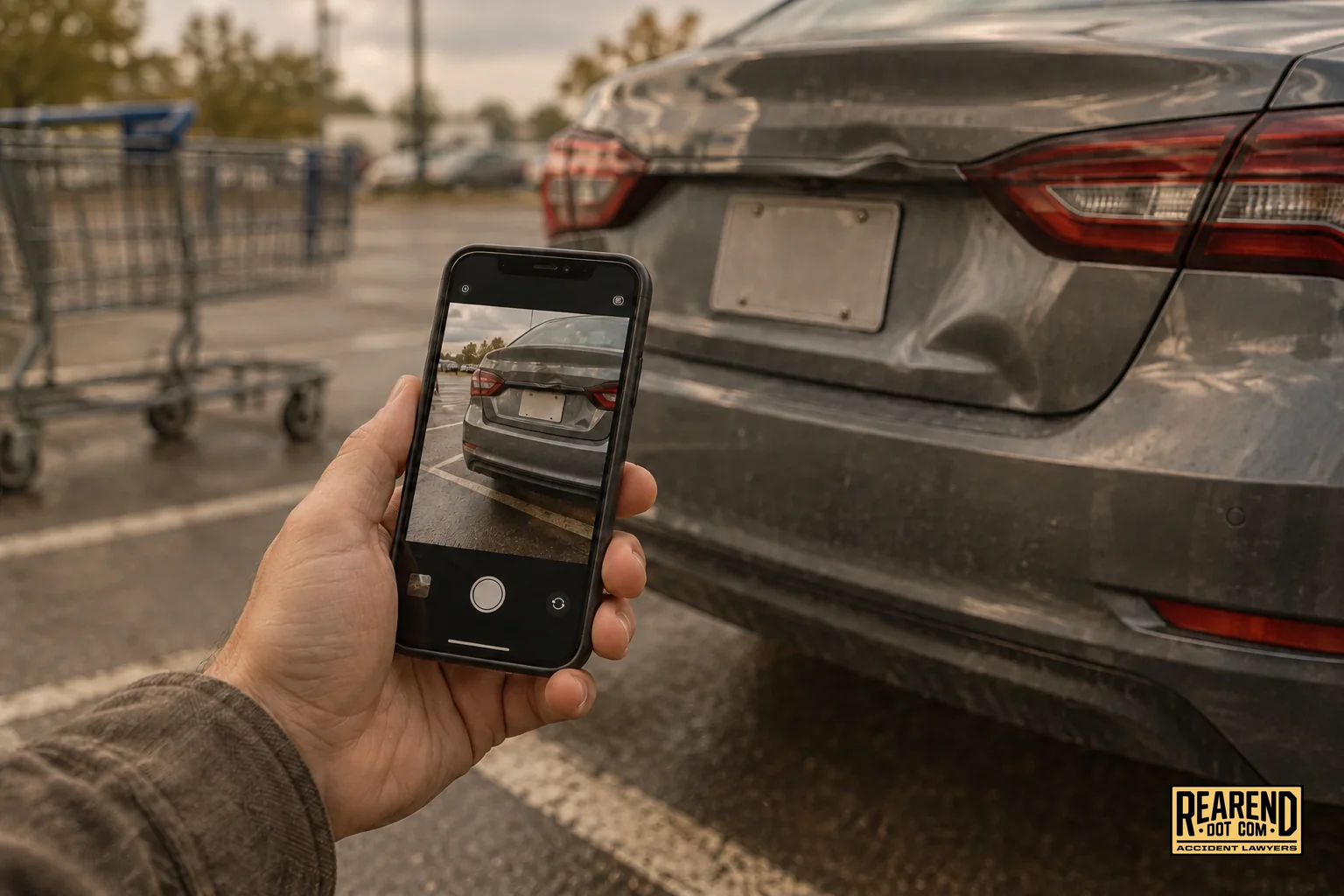
Photos and notes to capture
-
Wide shots of both cars as they sit, showing their position in the lane or stall.
-
Close shots of the damage on both vehicles, including the bumpers, lights and plates.
-
Lot markings nearby: painted arrows, stall lines, stop signs and speed bumps.
-
The weather, lighting and how crowded the lot looked.
-
Any visible injuries, such as bruising from a seat belt, then new photos over the following days.
-
The store name, the nearest entrance and a landmark such as a light pole number.
Record the date, time and exact spot in a note on your phone. Write down what happened while your memory is fresh: how fast you were moving, whether your brake lights were on, and what the other driver said.
Witnesses and store cameras
Shoppers, cart attendants and security guards often see the moment of impact. Ask for names and phone numbers before they leave with their bags. Black Friday crowds clear out quickly.
Ask store management whether cameras cover the lot and request that they save the footage from the time of the crash. Many systems record over old video within days. Get the name of the person you spoke with and the date you asked.
Keep your social media quiet. Posts about the crash, your pain or your weekend plans can end up in front of an adjuster, who may read them differently than you meant.
4. Exchange Information and Watch What You Say
Collect the same details from the other driver that you would give them. Get their full name, phone number, address, insurance company, policy number, driver license number and plate number. Take a photo of their insurance card and license if they allow it.
If the other driver was working, driving a rental or borrowing a car, ask who owns the vehicle. A delivery van or company car can bring a second insurer into the claim.
Keep the conversation short and factual
Stay polite, but skip apologies and guesses about blame. A casual “I’m sorry” or “I didn’t see you” can sound like an admission when an adjuster replays it later. State facts: where you were, which direction you faced and what you felt.
If the other driver argues or gets angry, step back and let police or the lot’s security handle it. You do not owe a debate. Proving who caused the crash takes evidence, and our article on how to prove fault in a rear-end accident shows what that evidence looks like.
5. Report the Crash to Police, the Property Owner and Your Insurer
Call the police even when the damage looks small. Officers sometimes treat private lots differently from public streets, and a busy holiday may delay them, but ask for a report or an incident number before you leave.
If no officer comes, ask the dispatcher how to file a report later, then do it promptly. Write down the date, the time you called and the name of anyone you spoke with. A report is a neutral record of when and where the crash happened and who was involved.
Tell the property owner
Report the crash to store management or the lot’s security office. They may file an incident report of their own, and that report can point to camera footage or other witnesses. Ask for a copy or a reference number.
Call your insurer with facts
Notify your own insurance company soon. Share the basics: date, place, the other driver’s information and the police report number. Keep your description simple and stick to what you know.
Your insurer may ask for a recorded statement. You can take a moment to organize your notes before agreeing. California may also require a crash report to the DMV in some situations, so check the current rules for your state and the type of damage involved.
6. Keep a Symptom and Expense Record
Start a simple folder or note on your phone the day of the crash. Add a short entry each day: where it hurts, how bad it feels on a scale of one to ten, and what you could not do. Rolling over in bed, lifting groceries or sitting at a desk all count.
Save every receipt and bill tied to the crash. That includes urgent care copays, prescriptions, a rental car, rideshares to appointments and parking at the clinic. Note each day of work you miss and ask your employer for written confirmation of lost hours.
These records turn “it hurt” into a clear picture of what the crash cost you. They also help you stay consistent when an insurer asks questions weeks later.
How Fault Works When Cars Collide in a Parking Lot
Fault in a parking lot depends on the facts, not only on which car hit which. A driver who backs into a stopped car, follows too closely in a lane or ignores a stop sign usually carries most of the blame. Insurers may still argue you share some, and fault rules vary by state.
On public roads, a rear-end crash often points to the trailing driver. Parking lots add complications. Lanes may be narrow, cars back out of stalls without a clear view, and traffic rules like right of way can be unclear.
Common parking lot disputes
-
The other driver says you stopped suddenly or without reason.
-
You were stopped to let a pedestrian cross, and the other driver says you blocked the lane.
-
One car was backing out of a stall, and each driver blames the other.
-
Neither driver agrees about who had the right of way at a lane intersection.
If an insurer says you were partly at fault, that argument may reduce what you can recover, but it does not automatically end a claim. Photos of lane markings, damage patterns and camera footage often carry more weight than memory. That is why step three matters so much.
Is a Black Friday Parking Lot Accident Worth a Claim?
It may be worth pursuing when you have symptoms, medical visits, missed work or a disputed account of fault. A free review shows whether your facts support a claim. Low speed and a small dent do not rule out an injury, and the review costs nothing.
Several questions help you decide. Did you see a doctor, and did the provider connect your symptoms to the crash? Is the other driver’s insurer disputing fault? Are you missing work or paying bills out of pocket? Is your pain lasting longer than expected?
If you answered yes to any of these, a claim review is a reasonable next step. If you feel completely fine after several weeks and no provider has found a problem, you may decide that a vehicle damage claim with the at-fault insurer is enough. Both choices are yours to make.
Estimating value without guessing
People often want a number right away. If you want a rough starting point, you can calculate an estimate of what your potential claim could be worth. Treat it as a rough estimate only, not a prediction.
Real value depends on your medical care, how long symptoms last, the work you miss and how fault is decided. Past results, case studies and settlement amounts do not guarantee or predict a future outcome. Our article on settlement amount factors that victims rarely know about goes deeper.
What Insurers Do After a Crowded-Lot Crash
An adjuster for the other driver may call within days, sometimes within hours. The tone is often friendly. The adjuster asks how you feel, how the crash happened and whether you have seen a doctor, and records your answers.
Those early answers can shape the claim. If you say “I’m okay” before symptoms surface, the insurer may later point to that comment when you report neck pain.
Before you give a recorded statement
You can decline to give a recorded statement to the other driver’s insurer until you have talked through your options. Share your claim number, your contact information and the basic facts of the crash. Leave out guesses about your injuries and about fault.
Quick offers and broad releases
A fast settlement offer can feel like relief, especially during the holidays. Before you sign a release, make sure you know your full medical picture. A signed release usually closes the claim, even if pain continues or treatment grows more expensive.
Insurers also ask for medical records and sometimes broad authorizations that cover years of history. Read these forms carefully and ask what each one covers before you sign.
What rearend.com Does After a Parking Lot Accident
rearend.com focuses on rear-end accident cases and offers a free, no-obligation case review. You submit your information in minutes, and our legal team contacts you within 24 hours to discuss your case. You don’t pay a dime unless we recover compensation on your behalf.
Personal injury cases here are handled on a contingency fee basis, with no hourly fees and no upfront cost. If you want the details, our page on how a rear-end accident lawyer is paid on a contingency basis explains how that works.
What the review is and is not
The review is a chance to tell us what happened and ask questions. It is not legal representation by itself. Submitting a contact form does not create an attorney-client relationship, and that relationship starts only through a formal, signed engagement agreement.
We describe ourselves as a firm that focuses on rear-end accident cases, not as holders of any formal specialization, because none exists in this area of law. Past results and settlement amounts do not guarantee or predict future outcomes.
Whether the lot was in San Diego, Los Angeles, Oakland, San Jose or somewhere else, the intake works online, so you can start from your phone while you gather photos and records.
Parking Lot Accident FAQs
Do I need a police report for a parking lot accident?
A police report is not always required to file a claim, but it helps. It creates a neutral record of the date, place and drivers involved. If officers decline to come to a private lot, ask the dispatcher how to file a report later and write down who you spoke with.
Can I still make a claim if the damage was minor?
Yes, minor damage does not rule out a claim. Injuries can happen in low-speed crashes, and symptoms often appear after a delay. Your medical records, photos and notes matter more than the size of the dent. A free review can help you judge whether your facts fit a claim.
What if the other driver left the lot?
Write down the plate, the car’s make and color and any witness contacts, then call the police and notify store security. Lot cameras may have captured the plate. Tell your own insurer soon, since your policy may include coverage for crashes with unidentified drivers. Get medical care regardless.
How long do I have to file a claim after a parking lot accident?
Filing deadlines vary by state and by type of case, so waiting can put your claim at risk. Start early while evidence still exists and memories are fresh. If you are unsure which deadline applies to you, ask during a free case review.
Does submitting a form to rearend.com make you my lawyer?
No. Submitting a contact form does not create an attorney-client relationship. That relationship begins only through a formal, signed engagement agreement. The form starts a free review, and our team follows up within 24 hours to talk through your situation.
Take the Next Step After Your Parking Lot Accident
A Black Friday crash can leave you sore, stressed and unsure who to call. Take care of your health first, keep your photos and records together, and think carefully before you speak to an insurer. Then find out where you stand.
When you are ready, start your claim review at rearend.com. It’s free, it takes a few minutes, and our legal team follows up within 24 hours. You don’t pay a dime unless we recover compensation on your behalf.
Recommended Resources
Start My Claim Find Trusted Local Auto Body Shops Calculate an estimate of what your potential claim could be worth
Related Articles


Need Legal Help After a Rear-End Accident?
Get a free consultation with our experienced legal team