
What Does It Cost to Handle a Rear-End Claim Alone?
Handling a rear-end claim alone rarely costs nothing. Between lost work hours, undervalued medical bills, and missed diminished value claims, unrepresented victims often walk away with less money than they would have collected with help. On a hypothetical $25,000 settlement, a typical contingency fee runs around one-third of the gross amount, so roughly $8,333 goes to the fee. Yet claimants can still net more with representation because adjusters tend to lowball unrepresented claimants on medical bills and skip diminished value entirely. So the real answer to how much a rear-end accident costs without a lawyer isn’t zero: it’s the gap between what an insurer offers you and what your claim may actually be worth.
Key Takeaways
- Time is a real cost: Gathering evidence, calling adjusters, and tracking paperwork can eat dozens of hours that would otherwise go to work or recovery.
- Medical bills get discounted: Adjusters frequently apply lower “usual and customary” rates when no attorney is pushing back on the math.
- Diminished value often goes unclaimed: Many unrepresented victims never file a separate diminished value claim, even though California generally allows it.
- Contingency fees only apply to a win: A no-fee-unless-you-win arrangement means there’s no invoice if the case doesn’t recover money.
- California’s minimum coverage is thin: The state requires only $30,000 per person and $60,000 per accident in liability coverage, which can leave a gap in serious cases.
- When to stop negotiating alone: If your medical bills alone exceed roughly $10,000, if the adjuster’s first offer sits below your total medical bills plus lost wages, or if the settlement discussion is approaching California’s $30,000 per-person liability limit, that’s a strong signal to get a free case evaluation before accepting anything.
At a Glance: Handling It Alone vs. Getting Help
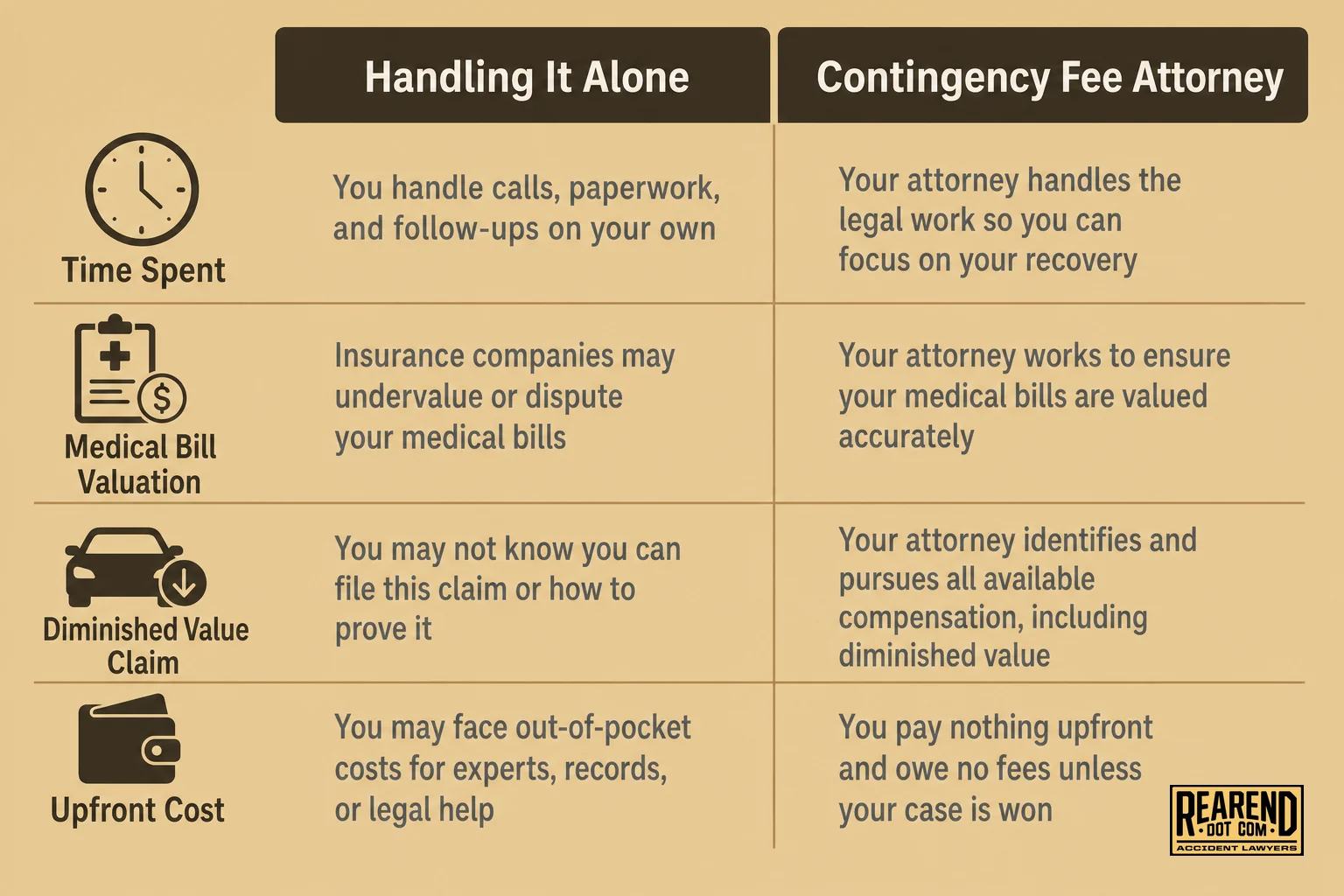
| Factor | Handling the Claim Alone | Contingency Fee Attorney |
|---|---|---|
| Upfront cost | $0, but time and effort are unpaid | $0 in most arrangements |
| Fee if you don’t recover | None (but no compensation gained) | Generally none under no-fee-unless-you-win terms |
| Medical bill valuation | Often reduced by adjuster’s internal formulas | Typically reviewed and challenged line by line |
| Diminished value claim | Frequently missed entirely | Usually identified and pursued separately |
| Time investment | Can be significant, spread over weeks or months | Handled largely by the legal team |
| Fee structure once represented | N/A | Percentage of the gross settlement, commonly around one-third (e.g., ~$8,333 of a $25,000 settlement) |
| California minimum liability limits | $30,000/$60,000, may not cover serious injuries | Same limits apply, but attorney can pursue underinsured motorist coverage |

The Problem: Why the Sticker Price Isn’t the Real Cost
Handling a rear-end claim yourself feels free because no one sends you an invoice. But every hour spent on hold with an adjuster is an hour not spent working, resting, or recovering. Every medical bill that gets quietly discounted is money that stays in the insurer’s pocket instead of yours.
The true cost of going alone shows up later, in a settlement check that’s smaller than it should have been. That’s the piece most people don’t see coming, and it’s the piece this guide walks through, along with the solutions that can close that gap.
How Much Time Does a DIY Rear-End Claim Actually Take?
A DIY rear-end claim can consume 20 to 40 hours or more. That time is spread across calls with adjusters, gathering medical records, requesting repair estimates, and drafting a demand letter. Add missed appointments and follow-ups. The time cost climbs fast for someone already managing an injury.
Most people underestimate just how time-consuming the claims process can be. A single call with an adjuster rarely resolves anything on the first try. You may find yourself calling back for updates, resending documents that supposedly never arrived, and sitting on hold during business hours you can’t afford to lose. Handling a claim on your own means no attorney fees, but it comes at another cost. You’ll need to learn the ins and outs of insurance processes, negotiate with experienced adjusters, and manage a growing pile of paperwork. All of this, more often than not, happens alongside medical appointments and lost wages.
Can Insurance Adjusters Undervalue Medical Bills When You Have No Lawyer?
Yes, adjusters frequently apply reduced “usual and customary” rate calculations to medical bills when no attorney is involved to challenge the math. Without someone pushing back with billing codes, comparable rates, or a formal demand package, the initial number an adjuster offers tends to sit near the low end of what’s defensible.
This isn’t necessarily bad faith on the adjuster’s part. Insurance companies build their offers around internal software that flags line items as “above average” for a given zip code. Without a counterargument, that flagged number often becomes the final one. A represented claimant is more likely to see those line items challenged before a number gets finalized, which is one of the clearest solutions to this problem.
What Is a Diminished Value Claim, and Why Do Unrepresented Victims Miss It?
A diminished value claim seeks compensation for the drop in a vehicle’s resale value after a collision. This applies even when repairs are done well. Many unrepresented victims never file this claim separately. They assume the repair bill covers everything, and insurers rarely bring it up on their own.
In practice, diminished value is usually argued as a percentage of the vehicle’s pre-accident value rather than a flat number. The loss scales with what the car was worth before the crash. A newer or higher-value vehicle with a rear-end collision on its title history typically sees a larger dollar hit in resale negotiations than an older car of modest value, even when the percentage drop is similar. Because there’s no fixed formula the insurer volunteers, an appraisal and comparable sales data are what turn that percentage into a defensible dollar figure.
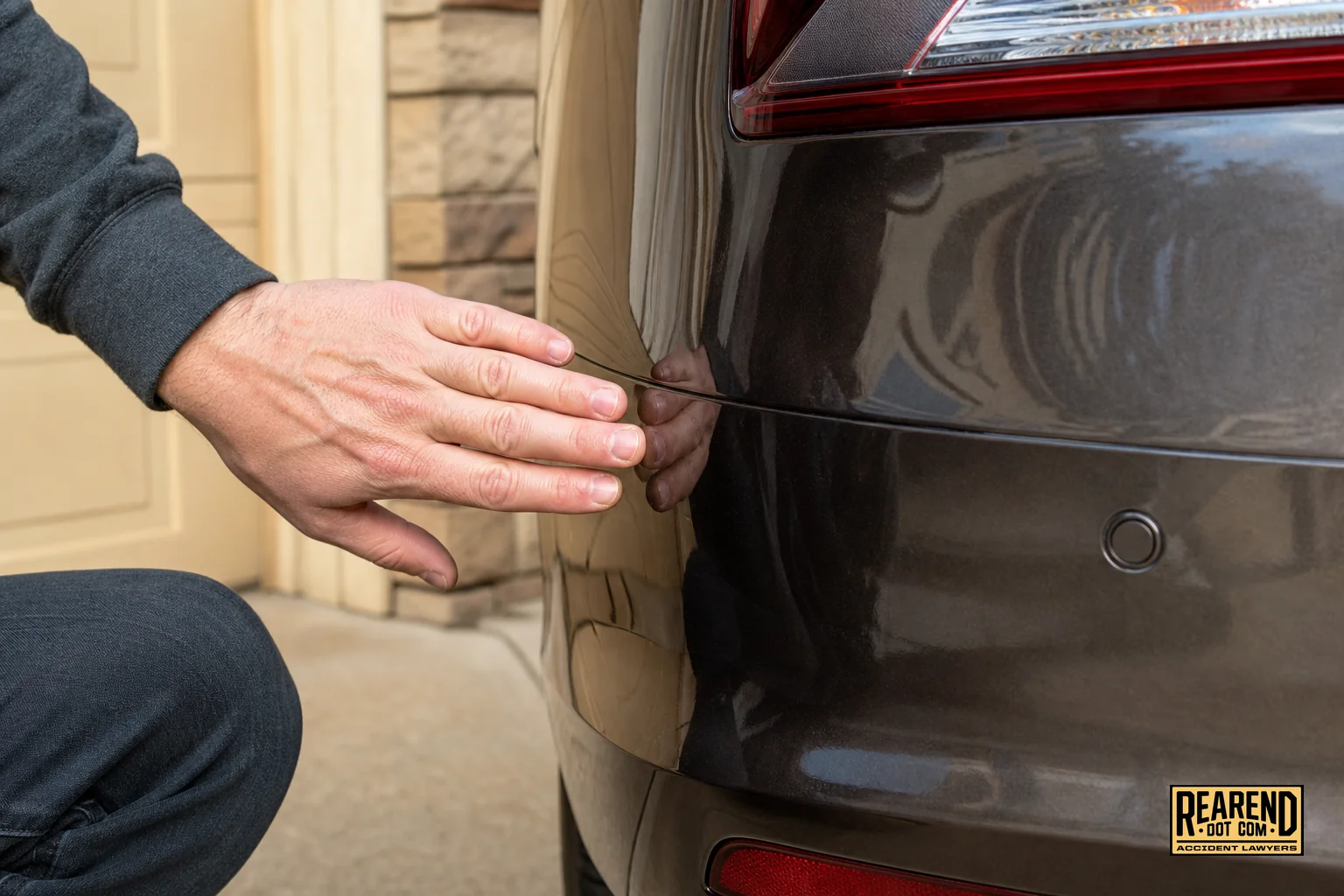
California generally allows diminished value claims against an at-fault driver’s insurer, but this is a separate claim from your injury settlement and it runs on its own clock. Treat it as its own filing, not a line item the adjuster adds automatically.
Here is a practical sequence for building and filing a diminished value claim yourself:
- Confirm the vehicle’s pre-accident value. Pull a valuation from a source like Kelley Blue Book or NADA before repairs, since diminished value is calculated as a percentage of this number.
- Get a written repair estimate and completed repair invoice from the shop, noting any structural or frame damage found along the way.
- Order an independent diminished value appraisal. This is the document that converts the percentage loss into a specific dollar figure the insurer can evaluate.
- Gather comparable sales data showing that similar vehicles with a rear-end collision on the title history sell for less than accident-free comparables.
- Submit a written diminished value demand to the at-fault driver’s insurer, separate from your injury demand, including the pre-accident value, the appraisal, and the comparable sales data.
- Track your filing deadline. Diminished value claims are subject to a statute of limitations, so confirm the applicable deadline for your case as soon as possible rather than waiting until repairs are finished.
If you’re curious how this factors into a broader settlement, our piece on rear-end accident settlement amount factors that victims rarely know about goes deeper into what adjusters weigh and what they hope you never ask about.
The Solution: How Much Does a Rear-End Accident Cost Without a Lawyer, in Real Numbers?
The gap without a lawyer usually shows up as a lower gross settlement, not as a separate bill. Results differ by insurer and by the facts of each case.
Even after a contingency fee is deducted, some claimants walk away with more money than they would have secured on their own, though this depends on the specifics of each case. To illustrate how contingency fees work in practice: on a $25,000 settlement, a standard one-third contingency fee amounts to approximately $8,333. That fee represents the cost of having an attorney in your corner, one whose negotiating experience may ultimately strengthen your claim.
Where does California’s minimum insurance requirement fit into this? The state mandates liability coverage of $30,000 per person and $60,000 per accident. In a serious rear-end crash with real medical bills, that ceiling can be reached quickly. This is one reason underinsured motorist coverage and a careful claim strategy matter more than people expect going in.
How Does a No-Fee-Unless-You-Win Model Compare?
A no-fee-unless-you-win arrangement means the attorney’s fee comes only from money recovered, generally a percentage of the settlement. Nothing is owed if the case doesn’t win. For many injury victims already facing medical bills, this fix removes the upfront affordability question entirely.
One resource addressing this concern directly notes that for most injury victims, hiring an attorney after a rear-end collision is financially accessible precisely because of this fee structure. If you want a plainer explanation of the terms involved, we’ve broken it down in Contingency Fee vs Hourly Lawyer Los Angeles Accident Victims: Real Cost Breakdown.
The Problem: What About Rear-End Collision Repair Costs?
Rear-end collision repair costs are generally billed to the at-fault driver’s liability insurer, separate from any injury settlement. This process typically involves a claims adjuster, a repair estimate, and sometimes a supplemental estimate once hidden damage is found. Repair cost and injury settlement are tracked and negotiated as two different pieces of the same claim, which can create confusion without a clear plan.
Choosing a shop matters too. If the insurer’s preferred shop feels rushed or dismissive about hidden frame damage, you’re generally not obligated to use it. You can review our list of trusted local auto body shops before committing to a repair estimate.
Can You Negotiate a Rear-End Settlement Yourself?
Yes, you can negotiate a rear-end settlement yourself, but it carries real risk. Without a benchmark for what similar claims settle for, it’s difficult to know whether an offer is fair. Our detailed breakdown, How to Negotiate a Rear-End Accident Settlement Without a Lawyer: Risks to Know, walks through the specific traps adjusters use during direct negotiations and how to avoid them.
If you’re weighing whether a no-fee arrangement fits your situation, our plain-language explainer on What Does “No Win, No Fee” Actually Mean? covers how the percentage is calculated and what happens if a case doesn’t settle.
Local Considerations Across California
Claim handling can look different depending on where the crash happened. In San Diego, claim intake and evaluation often move quickly through digital-first processes, while in Los Angeles, dense traffic corridors mean adjusters see a high volume of rear-end claims and may lean on standardized offers more heavily.
Oakland and San Jose claimants sometimes face longer waits tied to court backlogs or shared fault disputes at intersections. Riverside and Oceanside crashes, meanwhile, occasionally involve out-of-area drivers or military families managing a claim around a move, which can add complexity to timing and communication.
Wherever you’re located across the service area, from San Diego to Riverside, the underlying math is similar: a lower initial offer, a possible diminished value gap, and a real time cost to handling it solo.
The Solution: Steps to Decide What’s Right for Your Claim
Ask yourself a few honest questions before choosing a path:
- Do you have the time to spend evenings and lunch breaks on the phone with an adjuster?
- Are your medical bills modest, or do they include ongoing treatment, imaging, or specialist visits?
- Is there visible or hidden vehicle damage that might affect resale value, and have you filed a separate diminished value claim for it?
- Would you know how to respond if the adjuster’s first offer felt low?
- Are your combined medical bills and lost wages approaching $10,000, or is the claim nearing California’s $30,000 per-person liability cap?
If more than one of these gives you pause, or if your claim is near that $10,000-plus threshold, a free case evaluation can clarify whether pursuing the claim with help makes sense for your situation, at no upfront cost to you.
Start your claim today for a free case evaluation, or use the settlement estimate calculator below to see where your case might land before you commit to any path forward. Start your claim today, or use our settlement estimate calculator. Whichever direction you choose, understanding the real cost of handling a rear-end claim without a lawyer is the first step toward a fair outcome.
Prior results do not guarantee a similar outcome. – Rearend.com
Recommended Resources
Start My Claim Find Trusted Local Auto Body Shops Calculate an estimate of what your potential claim could be worth
Related Articles


Need Legal Help After a Rear-End Accident?
Get a free consultation with our experienced legal team