
San Diego Rear-End Attorney: What the 24-Hour Follow-Up Means
Submitting your claim through rearend.com’s online intake starts a 24-hour clock: a member of the legal team reviews your submission and calls or emails you within that window to confirm details, flag urgent next steps, and explain what happens next. For a rear-end accident attorney san diego 24 hour follow up, that call is less about paperwork and more about making sure nothing time-sensitive slips through the cracks.
Key Takeaways
- Timing: The goal for submissions through rearend.com’s online intake is legal team contact within 24 hours.
- Preparation matters: Having your police report number, insurance details, and medical notes ready shortens the call and speeds up next steps.
- Adjusters move faster than you’d like: Some insurance adjusters call within a day of the crash, before your own follow-up happens, so know how to respond in the meantime.
- California’s minimum liability coverage is $30,000 per person and $60,000 per accident, which can matter if the at-fault driver is underinsured.
- Deadlines apply. California law sets strict time limits for filing a personal injury claim after a crash; see what to do after a car accident in California for the specific duties and deadlines that apply to your situation.
- The follow-up call is a starting point, not the whole legal process, and connects to a longer sequence of evidence-gathering and negotiation.
At a Glance: The 24-Hour Follow-Up
| Step | What Happens | Typical Timing |
|---|---|---|
| Online intake submission | You answer questions about the crash, injuries, and insurance on rearend.com | A few minutes |
| Confirmation | You receive an acknowledgment that your submission was received | Immediately after submission |
| Legal team review | Your details are checked for fault indicators, injury severity, and insurance status | Within 24 hours |
| Follow-up contact | A member of the legal team calls or emails to discuss your case and gather missing details | Within 24 hours of submission |
| Document requests | You may be asked for the police report, photos, or medical records | During or shortly after the call |
| Next steps outlined | You learn what the firm will do, what’s expected of you, and the fee structure | Same call or follow-up email |
What Happens the Moment You Submit Your San Diego Claim?
The online intake asks for the basics: when and where the crash happened, whether you were injured, and whether the other driver has insurance. That information routes directly to the legal team, not a general queue, so someone familiar with rear-end cases sees your submission first.
Speed matters here for a practical reason. San Diego drivers dealing with a rear-end crash are often also fielding calls from the at-fault driver’s insurance company, sometimes within a day of the collision. A quick legal team response means you’re not left guessing whether anyone read your submission while the other side is already working the phones.
Speed also matters because certain gaps in the record can weaken a claim before it starts. Common issues that make a claim harder to pursue include: no police report and no independent witness account, a long gap between the crash and your first medical visit, giving a recorded statement to the other driver’s insurer before speaking with your own legal team, and inconsistent descriptions of the impact or your injuries across different conversations. None of these automatically disqualify a claim, but each one gives an adjuster a reason to dispute value, which is exactly why the intake call asks for these details up front.
Who Actually Calls You Within 24 Hours?
A member of the legal team who reviews rear-end cases contacts you, not an automated system reading a script. They ask follow-up questions specific to your crash: where the impact happened, whether you saw a doctor, and whether a police report was filed.
That distinction matters if you’ve dealt with larger, generalist firms before. A team that spends its time on rear-end cases specifically works through details like whether the other driver’s insurer has a history of disputing soft tissue injuries. For a broader look at what this process covers overall, see what happens if insurance denies a rear-end claim.
1. Have Your Accident Basics Ready
Before the call, jot down the date, time, and location of the crash. Note the other driver’s name, license plate, and insurance company if you have it. If a police report was filed, have the report number handy, or note which station or CHP office took it.
- Date, time, and cross-street or freeway location of the crash
- Other driver’s name, phone number, and insurance carrier
- Police report number, if one exists
- Names of any witnesses who stopped or offered contact info
These same details matter for statute of limitations purposes. California sets a filing deadline for personal injury claims arising from a crash, and that clock generally starts running from the date of the collision. Because the exact deadline and its exceptions depend on your specific facts, review this breakdown of California accident duties and deadlines or ask your legal team directly during the 24-hour follow-up call so nothing is left to guesswork.
2. Gather Insurance Information
Locate your own policy declarations page along with anything you have on the other driver’s insurance. California requires drivers to carry minimum liability coverage of $30,000 per person and $60,000 per accident, which sometimes falls short of covering serious injuries.
If the at-fault driver only carries the state minimum, your own underinsured motorist coverage may become relevant. Having both policies ready during the follow-up call helps the legal team flag that possibility early instead of discovering it weeks later.
3. Collect Medical and Injury Notes
If you saw a doctor, urgent care, or an ER after the crash, have those visit dates and any discharge paperwork nearby. Note your symptoms even if they started a day or two after the impact, since delayed pain from whiplash or soft tissue injuries is common in rear-end crashes.
An ER visit after a rear-end crash typically generates an itemized bill covering the physical exam, any imaging performed that day, and instructions for follow-up care. If the treating doctor suspects an injury beyond visible bruising or a minor strain, they may refer you to a specialist for further evaluation, which is when a follow-up MRI or similar imaging can come into play. Ask the treating provider directly how soon that referral and imaging should happen in your case, and keep a copy of the referral paperwork with your other documents so the timeline is easy to show later.
Write down what hurts, when it started, and how it’s affected your daily routine, whether that’s missed work or trouble sleeping. This isn’t about building a script, it’s about giving the legal team an accurate starting picture so they know what kind of documentation to request going forward.
4. Pull Together Photos and Any Video
Photos of vehicle damage, the accident scene, and any visible injuries help establish what happened. If your car or a nearby business has dashcam footage, save it before it gets overwritten. Video that shows following distance or brake lights can support your account of the crash.
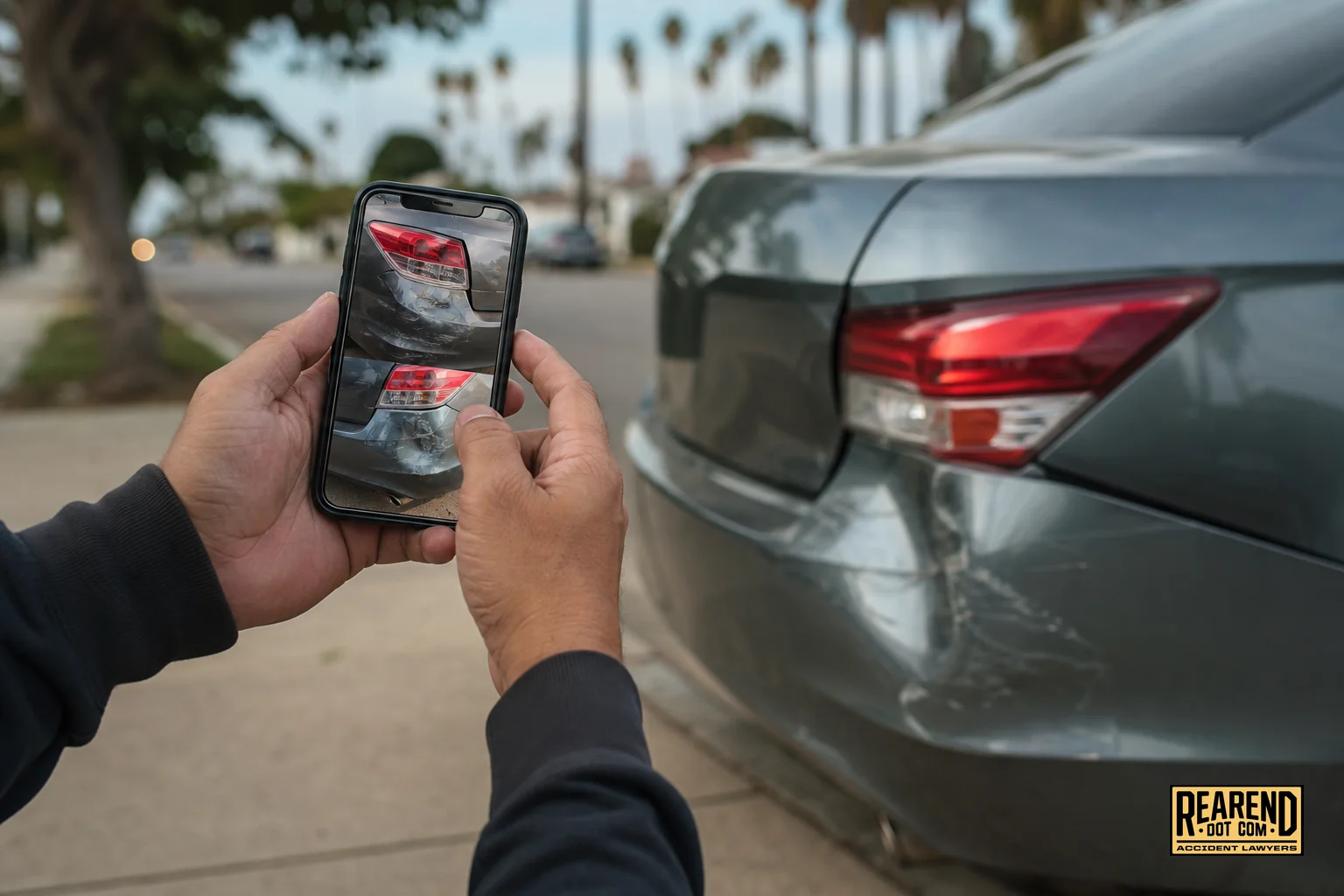
You don’t need to organize everything into a folder before the call. Just know roughly what you have, so the legal team can tell you what else might be useful to gather over the next few days.
5. Know What Questions to Ask During the Call
The follow-up call goes both directions. Ask how the firm’s fee structure works, what the realistic timeline looks like for a case like yours, and who your point of contact will be going forward. Settlement timelines vary depending on how long medical treatment continues, how quickly records and bills are gathered, and whether the insurer disputes fault or injury severity, so ask your legal team to walk through the specific stages that apply to your claim rather than relying on a generic estimate. For a breakdown of how contingency fees typically work, see rear-end accident lawyer cost and fees.
It’s reasonable to ask directly whether the firm has handled rear-end cases similar to yours. A team that focuses on this type of crash should be able to answer specifically, not with a vague generality.
What If the Insurance Adjuster Calls Before Your Follow-Up?
If an adjuster calls before your legal team follow-up happens, you can decline to give a recorded statement and let them know you’re working with counsel. Adjusters sometimes call within 24 hours of a crash hoping to get a statement locked in before you’ve had guidance.
You’re not obligated to accept a quick settlement offer or answer detailed questions about your injuries on that first call. Use this short checklist if an adjuster reaches you first:
- Confirm your name and that a crash occurred, but do not describe fault or how the impact happened.
- Say: “I’m not able to give a recorded statement right now. I’ll have my attorney follow up with you,” and get the adjuster’s name, direct line, and claim number.
- Decline any request to sign a medical release or accept a settlement figure during that call.
- Write down the date and time of the call and what was asked, then pass that note to your legal team at your next contact.
A polite version of that script is enough to hold the line until your own team is looped in. For a closer comparison of how adjusters and attorneys operate, see rear-end accident lawyer vs insurance adjuster.
Do I Need a Lawyer If I Was Rear-Ended in San Diego?
You’re not required to hire a lawyer after being rear-ended, but a legal team can help handle communication with insurers, gather documentation, and evaluate whether an offer reflects the full value of your claim. Many San Diego drivers reach out precisely because they’re unsure how to respond to an adjuster’s first call.
If you’re weighing whether legal help makes sense for your situation, reviewing your options after a rear-end crash without visible injuries can help clarify what factors matter, even in cases that seem minor at first.
How the 24-Hour Follow-Up Fits Into the Bigger Legal Process
The follow-up call is the entry point, not the entire process. After that initial contact, the legal team typically works through gathering records, communicating with the insurance company, and evaluating your claim’s value before any settlement discussion begins.
For a fuller walkthrough of what comes after this first call, including how evidence gets organized and how negotiations typically unfold, read Rear-End Accident Attorney in San Diego: What to Expect. San Diego’s mix of freeway commuter traffic and dense downtown intersections means fault and injury patterns can look different case to case, which is part of why an early, thorough intake call matters.
If you were rear-ended in San Diego and haven’t submitted your details yet, you can start your claim online and expect a legal team member to follow up within 24 hours. While you wait for that call, it can help to calculate an estimate of what your potential claim could be worth, and if your vehicle needs repair work, rearend.com can help you find trusted local auto body shops near you. Getting these pieces moving early means you’re not scrambling once the insurance company starts calling.
Recommended Resources
Start My Claim Find Trusted Local Auto Body Shops Calculate an estimate of what your potential claim could be worth
Related Articles


Need Legal Help After a Rear-End Accident?
Get a free consultation with our experienced legal team