
Rear-end accident attorney oakland ca bike lane collision: A practical guide
Picture Telegraph Avenue during evening rush hour: a line of cars stopped at a red light, a cyclist waiting in the painted lane beside them, and one distracted driver who doesn’t brake in time. The impact doesn’t just crumple a bumper, it can shove the lead car forward into the bike lane. A rear-end accident attorney oakland ca bike lane collision case starts exactly here, and untangling who pays generally depends on following distance, lane position, and how the cars ended up where they did.
Key Takeaways
- Primary fault usually falls on the rear driver: California’s following-distance expectations mean the driver who struck from behind generally carries the heavier share of liability, even in a chain-reaction bike lane crash.
- The pushed vehicle can still face scrutiny: If the middle driver had drifted toward the bike lane before impact, comparative fault could reduce, though rarely eliminate, the rear driver’s responsibility.
- Multiple policies may be involved: A bike lane rear-end crash can pull in the rear driver’s insurer, the pushed driver’s insurer, and occasionally a city claim if faulty infrastructure played a role.
- California’s minimum coverage may not cover severe injuries: State law requires only $30,000 per person and $60,000 per accident in liability coverage, an amount that can fall short for a cyclist facing serious trauma.
- Evidence disappears fast: Traffic camera footage, paint condition, and witness memory fade within days, so acting quickly often matters more in these cases than in a standard two-car rear-end.
Bike Lane Rear-End Collision: Quick Facts
| Factor | What It Usually Means |
|---|---|
| Typical fault starting point | Rear driver presumed at fault absent contrary evidence |
| California minimum liability coverage | $30,000 per person / $60,000 per accident |
| Common secondary parties | Pushed vehicle’s driver, sometimes the City of Oakland for infrastructure issues |
| Key early evidence | Traffic camera video, dashcam footage, bike lane paint/signage photos |
| Fault-reduction rule | California comparative negligence: any assigned fault can lower recovery proportionally |
| Injury pattern | Often more severe for the cyclist due to lack of vehicle protection |
| Legal fee model to look for | No fee unless compensation is recovered (contingency basis) |
How Does a Rear-End Crash Push a Vehicle Into a Bike Lane?
A rear-end crash pushes a vehicle into a bike lane when the force of impact from behind shoves the front car forward or sideways, out of its travel lane. On streets where a bike lane sits directly beside vehicle traffic, that displacement can be a matter of just a few feet.
Oakland’s street grid makes this scenario more common than many drivers assume. Corridors like Telegraph Avenue, Broadway, and Lakeshore Avenue carry painted and, in some stretches, physically protected bike lanes right next to congested traffic. When a rear driver misjudges stopping distance at a light or a stop sign, the chain reaction can send a vehicle drifting into that adjacent lane.
Dense intersections compound the risk. Mixed infrastructure, delivery trucks parked partly in bike lanes, and drivers checking phones instead of following distance all raise the odds of a collision that involves more than just the two vehicles in the original rear-end. If you’re a cyclist who was riding or stopped in the lane when this happened, the resulting case has more moving parts than a typical two-car crash, but it’s still built on the same foundation: someone failed to stop in time.
Who Is Liable When a Rear-End Pushes a Car Into a Cyclist?
Liability in a bike lane rear-end collision typically starts with the rear driver, since California law generally expects drivers to keep enough distance to stop safely. That presumption can shift, though, if evidence shows the pushed vehicle had already drifted toward the bike lane before impact.
California follows a pure comparative negligence rule. That means fault can be divided among multiple parties, and each party’s recovery is reduced by their own percentage of responsibility. If the rear driver is found 90% at fault and the pushed driver 10%, an injured cyclist’s claim against the pushed driver could be reduced accordingly, while the claim against the rear driver stays close to full value.
Bike lane markings and signage also factor into the analysis. If the lane was clearly painted and visible, a driver who fails to account for a cyclist’s presence there has a harder time arguing they couldn’t have anticipated the crash extending into that space. An attorney who has handled numerous rear-end cases involving vulnerable road users will typically pull the police report, any available surveillance video, and lane geometry to sort out how fault should be divided among the parties involved.
For a broader look at how fault gets established in more conventional rear-end scenarios, see how fault gets proven in a rear-end accident, since many of the same principles carry over even when a cyclist is involved.
What Evidence Matters Most in a Bike Lane Rear-End Collision Claim?
The evidence that matters most is footage and documentation that shows exactly where each vehicle was positioned before, during, and after impact. Because these crashes often involve three parties instead of two, precise sequencing evidence carries more weight than in a standard rear-end claim.
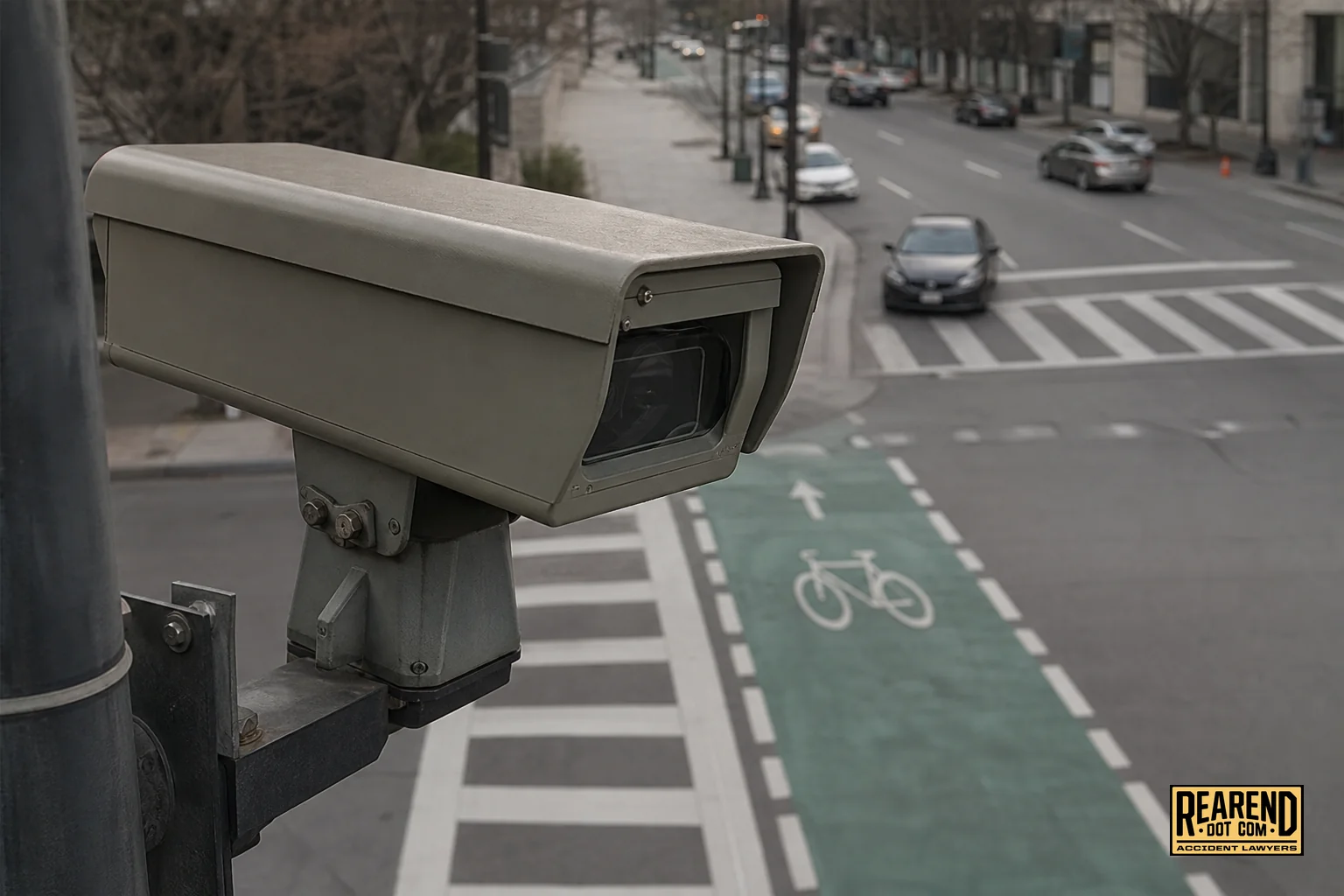
Traffic cameras at Oakland intersections, along with any nearby business surveillance systems, can capture the moment of impact and the direction vehicles traveled afterward. Dashcam footage from either driver, or from a passing car, often fills in gaps that a police report alone can’t answer.
Photos of the bike lane’s paint, signage, and any physical barriers are also worth gathering quickly, since the California Department of Transportation notes that lane markings and roadway conditions can degrade or get repainted within weeks of a reported incident. Witness statements from other cyclists, pedestrians, or drivers who saw the sequence unfold can help corroborate what the footage shows.
Medical documentation deserves particular attention here. Cyclists lack the structural protection of a vehicle, so injuries from even a modest impact speed can be more severe than they first appear. Getting evaluated promptly and keeping consistent records connects the crash to the injury in a way that supports the claim later.
How Does a Bike Lane Collision Claim Differ From a Standard Rear-End Case?
A bike lane collision claim differs from a standard rear-end case mainly in how many parties and policies get involved, and in how much more severe the resulting injuries tend to be for the cyclist. That added complexity generally means a longer investigation phase.
In a typical two-car rear-end, liability usually settles on one driver fairly quickly. When a third party, the cyclist, gets pulled into the sequence, the claim may require piecing together two separate impacts: car-to-car, then car-to-bicycle. Occasionally, if faulty road design or poor lane visibility contributed, a claim against the city becomes part of the picture too.
| Factor | Standard Rear-End Case | Bike Lane Rear-End Collision |
|---|---|---|
| Number of typical parties | Two drivers | Two drivers plus a cyclist, occasionally a municipal entity |
| Injury severity pattern | Often moderate (whiplash, soft tissue) | Can range from moderate to severe due to lack of vehicle protection |
| Investigation complexity | Usually straightforward | Requires sequencing two impacts and lane positioning |
| Insurance policies potentially involved | Two auto policies | Two auto policies, possibly municipal liability coverage |
| Evidence priority | Police report, photos | Traffic camera footage, lane markings, witness statements |
Cost concerns come up often at this stage too. If you’re weighing what legal help might cost given the added complexity, rear-end accident lawyer cost and fee structures covers how contingency arrangements generally work.
Comparing Your Legal Options After an Oakland Bike Lane Rear-End Collision
Your main options after this kind of crash are handling the claim yourself, working with a general personal injury lawyer, or working with an attorney who focuses specifically on rear-end and vulnerable-road-user cases. Each path carries different tradeoffs given how many parties can be involved.

Handling it alone can work for very minor property damage with no injury, but a bike lane crash rarely stays that simple once a cyclist’s medical needs enter the picture. Insurers may try to divide fault in ways that minimize what they owe, and without independent investigation, that division can go unchallenged.
An attorney who has handled numerous rear-end cases, particularly ones involving cyclists, generally knows how to pull traffic camera footage before it’s overwritten, how to interview witnesses while memories are fresh, and how to push back when an insurer tries to assign disproportionate fault to the cyclist. Many firms, including rearend.com, offer a no-fee model where payment only comes from recovered compensation, which matters when a cyclist is facing mounting medical bills with no income to spare.
If you’re unsure whether your situation is worth pursuing formally, a free, no-obligation review can help clarify that before you commit to anything. You can review your claim in just a few clicks for free to get a sense of where things stand.
For Oakland residents specifically weighing the no-fee model, how Oakland’s no-fee representation works and who qualifies breaks down the details further.
What Should You Do Right After a Bike Lane Rear-End Collision in Oakland?
The first thing to do after a bike lane rear-end collision is get yourself and anyone else involved to a safe spot and call for medical help if there’s any possibility of injury. From there, a few practical steps can protect both your health and your claim.
- Call 911 and request police response, since an official report helps establish an initial record of the sequence of events, even if it later needs correction.
- Photograph everything, including vehicle positions, the bike lane markings, any visible damage, and your surroundings before anything gets moved.
- Get contact information from witnesses, including other cyclists or pedestrians who may have seen the crash unfold from a different angle than the drivers did.
- Seek medical evaluation promptly, even if you feel able to walk away, since some injuries take hours or days to fully present.
- Avoid giving a recorded statement to an insurer before speaking with an attorney, since early statements can be used to minimize your claim later.
- Keep your bicycle and any damaged gear until an attorney or investigator has had a chance to document the condition.
Keep California’s minimum liability requirement in mind here. State law sets that floor at $30,000 per person and $60,000 per accident, an amount that may not stretch far if injuries require surgery, physical therapy, or extended time away from work. Understanding this early can shape whether you pursue additional coverage sources, like your own underinsured motorist policy.
Frequently Asked Questions
Can I sue if I was the cyclist and had no visible injuries at the scene?
Yes, you can generally still pursue a claim even without visible injuries at the scene, since symptoms like soft tissue damage or a concussion sometimes take hours or days to surface. Prompt medical evaluation helps document the connection between the crash and any injury that develops later.
Does it matter if the bike lane was painted versus protected or physically separated?
Yes, lane type can influence how fault gets analyzed, since a physically protected bike lane makes it harder for a driver to argue the intrusion was unforeseeable. A painted lane still carries legal weight, but the visual distinction matters less to the underlying following-distance obligation of the rear driver.
What if the police report blames the cyclist?
A police report that blames the cyclist doesn’t end your options, since it’s one piece of evidence among several, not a final determination of fault. Traffic camera footage, witness statements, and an independent investigation can sometimes tell a different story than the initial report captured.
How much could a bike lane rear-end collision claim be worth?
Claim value depends heavily on injury severity, medical costs, lost income, and how fault gets divided among the parties involved, so there’s no single figure that applies broadly. You can get an estimate of what your potential claim could be worth based on your specific circumstances.
A rear-end crash that pushes into a bike lane leaves you dealing with more than a routine claim, and insurers know that complexity can work in their favor if you don’t have someone pushing back on your side. If you or someone you know was hurt in an Oakland bike lane collision, start your claim today and get a clear read on your options before you talk to an adjuster on your own.
Related Articles


Need Legal Help After a Rear-End Accident?
Get a free consultation with our experienced legal team