
Rear-end accident attorney san diego dashcam footage helps: A practical guide
A rear-end accident attorney san diego dashcam footage can help address a key question insurers often dispute: who actually caused the impact. Video from before a crash may help show details like speed, following distance, and brake lights, and can support a claim alongside other evidence.
Key Takeaways
- Speed matters: dashcam and nearby camera footage is often overwritten within 3 to 14 days, so requesting it quickly is generally the difference between having it and losing it.
- Multiple sources exist: your own dashcam, the other driver’s dashcam, traffic signal cameras, and nearby storefront or gas station cameras can all potentially capture a San Diego rear-end crash.
- Written requests hold more weight: a polite verbal ask to a business manager is easy to forget; a written preservation request is harder to ignore.
- Footage feeds directly into intake: mentioning available video during an online case evaluation can help an attorney assess your claim more quickly.
- Video supports, but doesn’t replace, other evidence: police reports, medical records, and photos still matter alongside any footage you gather.
At a Glance: Dashcam Evidence in a Rear-End Claim
| Evidence Source | Typical Retention Window | Who to Contact | Why It Helps |
|---|---|---|---|
| Your own dashcam | Loops and overwrites in hours to days, depending on device | You, immediately | Direct view of the impact and following distance |
| Other driver’s dashcam | Varies; may be deleted or altered without a request | Other driver or their insurer | Can confirm or contradict their account |
| Storefront or gas station cameras | Often 3 to 14 days | Business manager or owner | Wide-angle view of the crash and surrounding traffic |
| Traffic signal cameras | Varies by city system and policy | City traffic department, sometimes police | Confirms signal timing and lane position |
| Ride-hail or delivery vehicle cameras | Varies by company | Company support line | May capture the crash if a rideshare or delivery car was nearby |
| Police body or dash cameras | Set by department policy | Records request to the responding agency | Neutral third-party record of the scene |
1. Why Dashcam Footage Can Strengthen a Rear-End Claim
Rear-end crashes usually come with an assumption that the trailing driver was following too closely or not paying attention. That assumption often holds up, but insurers still look for ways to shift blame, sometimes arguing that you stopped suddenly or without cause.
Video from a dashcam can help clarify the actual distance between vehicles, the timing of brake lights, and whether traffic ahead required a sudden stop. A short clip can be a useful piece of evidence alongside other documentation.
Footage doesn’t argue with itself. A recorded sequence of events can help clarify conflicting accounts of who braked first.
2. How Nearby Business Surveillance Cameras Factor In
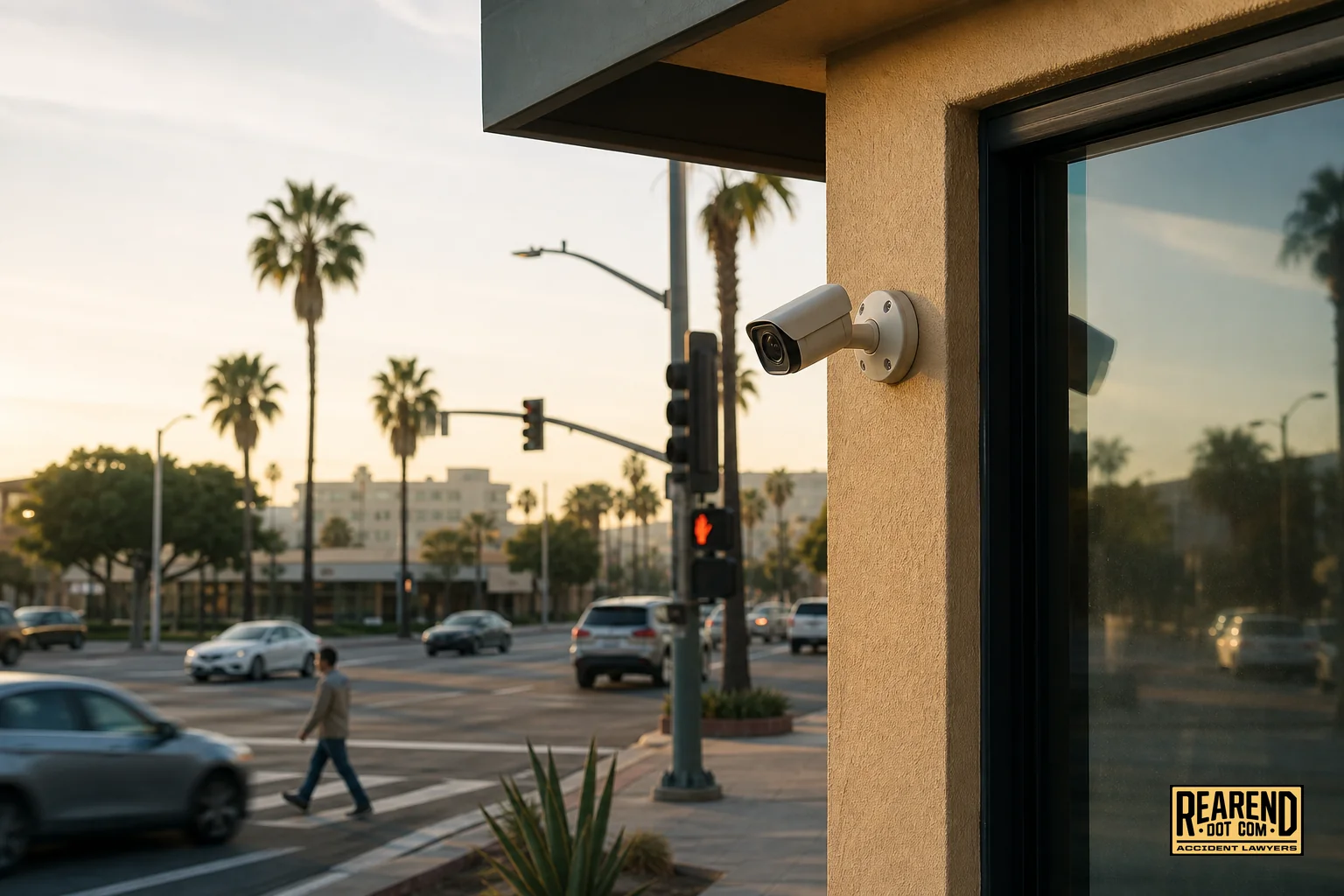
San Diego’s mix of dense commercial corridors and highway on-ramps means a rear-end crash often happens within view of a gas station, coffee shop, or retail storefront. Many of these businesses run surveillance systems that loop and overwrite footage on a set schedule, frequently somewhere between three and fourteen days.
If your crash happened near a business with a visible camera, it may be worth walking over shortly after the scene is cleared, if it’s safe to do so, and asking whether their system covers the area where the collision occurred. Some managers will let you know the retention window on the spot.
Intersections with traffic signal cameras present a separate path. Availability and access policies vary by city department, so a formal records request is often a reliable way to find out if footage exists and can be released.
3. What to Do in the First 24-48 Hours to Preserve Footage
Acting within the first day or two after a rear-end crash gives you a good chance of capturing evidence before it disappears. A few practical steps can make a real difference:
- Save your own dashcam clip immediately: transfer the file off the device’s memory card before it loops and records over the crash.
- Photograph nearby businesses and cameras: note names, addresses, and camera positions while you’re still at or near the scene.
- Ask for the other driver’s dashcam footage: if they had one running, request a copy or ask that it be preserved before it’s cleared.
- Check for a police report reference number: some agencies collect footage as part of their own investigation.
- Avoid editing or trimming clips yourself: keep the original file intact so it isn’t questioned later for authenticity.
How Do You Prove Fault in a Rear-End Accident?
Fault in a rear-end accident is generally proven by combining physical evidence, like dashcam or surveillance footage, with the police report, photos of vehicle damage, and witness statements. No single piece of evidence usually settles a claim on its own; together, they build a consistent account of what happened.
Insurers weigh evidence differently depending on how complete and how quickly it was gathered. A detailed breakdown of this process is available in our guide on how fault gets proven in a rear-end accident, which walks through how each piece of evidence typically gets used.
5. Requesting Footage From a Business or Property Owner

A verbal request to a store manager is easy to forget once the shift changes. A written preservation request, even a short one, gives the business a record to act on and reduces the chance that footage is deleted before you follow up.
Many managers won’t hand over a copy on the spot, and that’s normal. What matters at this stage is simply asking them to hold the footage rather than let the system auto-delete it. An attorney can often send a formal preservation letter that carries more authority than an individual request, particularly for businesses that are cautious about liability or privacy.
If you’re unsure how to approach a manager or worry about being brushed off, reviewing your options with a rear-end accident attorney in San Diego early on can help you understand what to expect from this part of the process.
6. Rear-End Collision Repair and Evidence Timing
Getting your car assessed for repair doesn’t need to wait until every piece of footage is collected, but it’s worth sequencing the two carefully. Photograph the damage thoroughly before any repair work begins, since those images pair with video evidence to show the force and direction of impact.
Once documentation is handled, connecting with a trusted local shop can move things along without slowing your claim. You can find trusted local auto body shops that are familiar with working alongside insurance claims and attorney requests for damage records.
7. How This Evidence Factors Into Fast Attorney Matching

When you submit an online case evaluation, mentioning that dashcam or surveillance footage exists can help an attorney gauge the strength of your claim more quickly. It’s one of several details the intake questionnaire asks about, alongside the police report, medical treatment, and insurance information.
Rearend.com’s model is built around a no-fees-unless-you-win structure, so the goal of fast matching isn’t to rush you into a decision, it’s to get someone reviewing your specifics, footage included, before evidence disappears. If you’re still weighing whether to hire outside help at all, our guide on how to choose a rear-end accident attorney covers questions worth asking before you commit.
For a rough sense of what your case might be worth once evidence like this is factored in, you can also calculate an estimate of what your potential claim could be worth.
Frequently Asked Questions
Does dashcam footage still help if I was found partly at fault?
Yes, footage can still help even under a partial fault finding, since California follows a comparative fault system where compensation is reduced by your percentage of fault rather than eliminated. Clear video showing the other driver’s role can limit how much fault gets assigned to you.
What if I don’t have a dashcam?
You can still build a strong case without one. Nearby business cameras, traffic cameras, witness statements, and the police report often fill that gap, and an attorney can help identify which sources are worth pursuing for your specific crash location.
How long until footage is deleted?
Retention periods vary widely, from a few hours on some consumer dashcams to about two weeks for many business surveillance systems. Because there’s no fixed rule, treating the first 48 hours after a crash as your main window to act is generally the safer approach.
If you were rear-ended anywhere in San Diego and there’s a chance a dashcam or nearby camera caught it, don’t wait for footage to loop over itself. Start my claim today, or review your claim in just a few clicks for free to find out what evidence might still be recoverable and how it could shape your case.
Prior results do not guarantee a similar outcome. – Rearend.com
Related Articles


Need Legal Help After a Rear-End Accident?
Get a free consultation with our experienced legal team