
Winter Rear-End Accident Risk: Why Crashes Rise in Cold Months
Winter rear-end accident risk tends to climb because wet or icy roads lengthen stopping distances, early sunsets shorten the time drivers can see brake lights, and holiday traffic packs more stop-and-go cars onto the road. If you were hit from behind in California this season, get a medical evaluation first, document the scene, and consider a free case review at rearend.com.
Key takeaways
- Why risk tends to rise: Wet pavement, shorter daylight and crowded holiday roads put more cars close together with less time to react.
- Medical care comes first: Neck, back and head symptoms often appear hours or days later, so get checked even when you feel fine.
- Records start at the scene: Photos of the road, the lighting, both vehicles and your injuries give your claim a dated starting point.
- Weather is not an automatic excuse: Drivers are expected to adjust speed and following distance to conditions, and fault rules vary by state.
- The first step costs nothing: rearend.com offers a free, no-obligation case review, and you pay nothing unless we recover compensation on your behalf.
Winter rear-end accident risk at a glance
| Winter factor | What changes on the road | What to do if you were hit |
|---|---|---|
| Wet or icy pavement | Cars need more distance to stop, and sudden braking catches followers off guard | Photograph the road surface and any standing water or ice |
| Shorter daylight | Evening commutes happen in the dark, with glare and weaker visibility | Note the time, the lighting and whether brake lights and headlights worked |
| Holiday traffic | More cars, more stop-and-go driving, more distracted and rushed drivers | Collect the other driver’s contact and insurance details |
| Delayed symptoms | Pain and stiffness may surface after the adrenaline fades | Get a medical evaluation promptly, even if symptoms seem minor |
| Insurer contact | Adjusters may call quickly and ask for a statement | Gather your records before you discuss the details |
| Legal help | A free review sorts out your options | Submit your information at rearend.com; our legal team follows up within 24 hours |
Why does winter raise rear-end accident risk?
Winter tends to raise rear-end accident risk because several conditions stack up at once. Wet or icy pavement lengthens the distance a car needs to stop, early sunsets cut visibility during the evening commute, and holiday traffic adds more stop-and-go driving. When drivers follow too closely in those conditions, the car ahead pays for it.
A rear-end crash needs two things: a car that stops and a car behind it that cannot. Winter squeezes both sides of that equation. Drivers in front brake earlier and harder for hazards they spot late, and drivers behind have less margin to respond.
Public data points the same way. Four years of Colorado State Patrol crash data show that winter still accounts for just over a quarter of total crashes (25.42%), even though drivers travel fewer miles. A study of fatal crashes found that most regions show a higher risk during the winter. Federal data adds that speeds decline by 30 to 40 percent on snowy or slushy pavement.
We do not put our own percentage on the winter increase here. How much crash risk rises depends on the region, the weather in a given season, and how many people travel. What holds steady is the pattern of conditions that makes a hit from behind more likely.
Wet and slick roads
Rain, frost, fog and slush all reduce grip. A driver who is comfortable following at a certain distance in dry weather may need much more room on wet pavement, and many drivers do not adjust.
The first rain after a dry stretch is a good example. Dust and oil that built up on the road mix with water and leave a slick film. Drivers who expect normal braking often find the car ahead of them stopping sooner than they planned for.
Water also hides trouble. Puddles conceal potholes, and cold mornings leave patches of ice on bridges and shaded stretches. A driver who swerves or brakes hard for one of these surprises can set off a chain of braking behind them.
Shorter daylight and glare
By December the sun sets early in most of California, which means the late-afternoon commute now happens at dusk or in the dark. Drivers are tired after work, and their eyes are still adjusting.
Low winter sun adds glare during morning and late-afternoon drives. Wet roads reflect headlights and brake lights, which can blur the signals drivers rely on to judge how fast traffic is slowing.
Shorter daylight also changes who is on the road. More people walk, bike and run errands in the dark, so drivers brake for movement they did not expect. A sudden stop for a pedestrian is a common setup for a rear-end collision.

Holiday traffic
From late November through the New Year, shopping centers, airports and freeways fill up. More cars share the same lanes, and traffic compresses and releases in waves. That stop-and-go rhythm is where many rear-end crashes start.
The holidays also change how people drive. Some are rushing to reach family or finish errands, some are unfamiliar with the roads, and some have a drink or two at a party before heading home. Distraction rises when the car is full of kids, gifts and navigation prompts.
Parking lots and shopping-center entrances add another layer. Cars crawl, stop without warning and pull out between lanes, and a driver glancing at a phone or a parking space can tap the bumper ahead.
California winters across our service area
California winter is milder than much of the country, but it brings hazards of its own. Fog in the Central Valley around Fresno can cut sight lines in the early morning. Coastal drizzle around San Diego and Oceanside slicks the pavement, and storms across the Bay Area affect commutes in Oakland and San Jose.
In Los Angeles and Riverside, holiday congestion is often the bigger factor, with freeways that already run heavy getting heavier. If you were rear-ended in any of these areas, the same steps below apply.
What should you do first after being rear-ended in cold weather?
Move to a safe spot if your car can still be driven, turn on your hazard lights, and call 911 if anyone feels hurt. Then get a medical evaluation, photograph the scene, and exchange information with the other driver. Cold, dark or wet conditions make the roadside riskier, so safety comes before paperwork.
Here is the order we suggest:
- Check yourself and your passengers for pain, dizziness or confusion, and call 911 if anyone needs help.
- Pull out of traffic if you can do so safely, and turn on your hazard lights. At night, stay away from the lane of travel.
- Exchange names, phone numbers, license plate numbers and insurance details with the other driver.
- Photograph the scene, the vehicles, the road surface and the lighting before anything moves.
- Ask for a police report number if officers respond.
- Schedule a medical evaluation the same day or as soon as you can.
- Tell your own insurer a crash happened, and keep the conversation short and factual.
- Request a free case review before you agree to anything the other driver’s insurer offers.
Resist the urge to apologize or to guess about fault at the roadside. In the cold and the dark, with adrenaline running, people say things they regret. Stick to the facts: where you were, what you saw and how you feel.
Why should you get a medical evaluation even if symptoms seem minor?
Neck, back and head symptoms often show up hours or days after a rear-end crash, and adrenaline can hide pain at the scene. A prompt medical evaluation protects your health first. It also creates a dated record that connects your symptoms to the collision, which matters when an insurer reviews your claim.
Winter adds a complication. Cold weather tightens muscles, so stiffness in your neck or shoulders can feel like a normal winter ache. Many people shrug it off, wait, and then find the pain has grown. A doctor can tell the difference and document what they find.
The mistake we see most often in the first week, among our hit-and-run clients, is not seeking treatment for their injuries. The same pattern shows up after other rear-end crashes. Gaps between the collision and the first appointment give an insurer room to argue that something else caused the pain.
Watch for these signs in the days after a crash:
- Neck or shoulder pain, or a stiff neck that gets worse
- Headaches, dizziness or trouble concentrating
- Back pain, numbness or tingling in arms or legs
- Trouble sleeping, irritability or unusual anxiety
Follow your provider’s treatment plan and keep each appointment. If you need a step-by-step view of the first day, our rear-end accident checklist for the first 24 hours walks through it.
How do you keep records of the scene, your vehicle and your injuries?
Photograph the scene, both vehicles, the road surface and the lighting if it is safe to do so, then keep a running log of symptoms, appointments and missed work. Save repair estimates and medical bills in one folder. Dated, specific records give a claim a clear starting point.
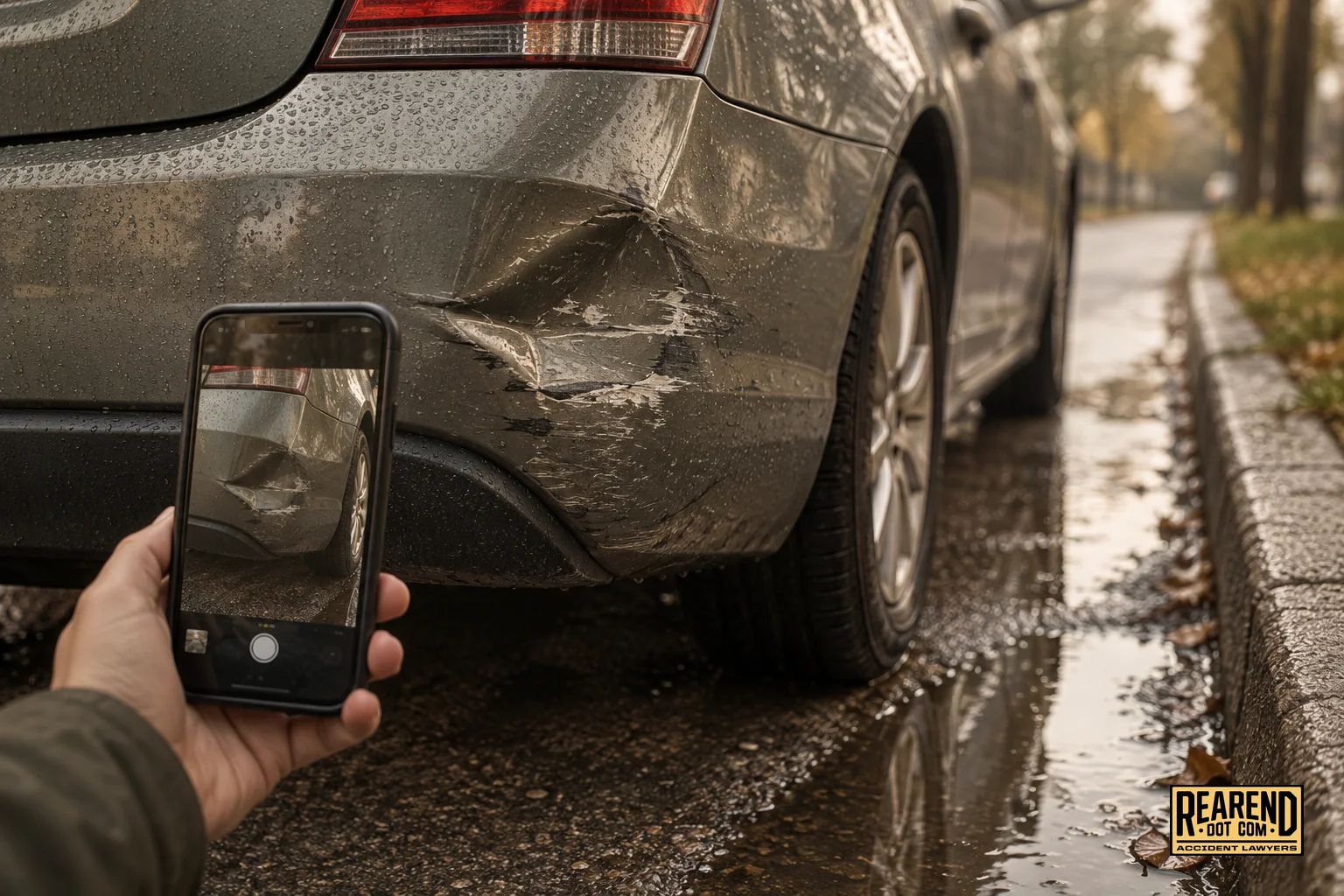
The scene and the weather
Winter conditions can change within minutes. Rain stops, ice melts and puddles drain, so take your photos at the scene while the evidence is still there.
Capture wide shots that show the lanes, traffic signals and signs, then close-ups of wet pavement, ice patches, skid marks and debris. Photograph the sky and streetlights as well, since they show the lighting at the time of the crash. Note the time and write down what the weather was doing.
If your car has a dashcam, save the footage right away. Ask any witnesses for their names and phone numbers before they leave.
Your vehicle
Photograph the rear of your car, the front of the other car, the license plates, and any damage inside, such as a cracked seat back, broken headrest or loose items that flew around the cabin. Take photos again in daylight, since some damage shows up better than it does at night.
Get a repair estimate before the damage gets worse, because hidden frame or sensor damage often appears after a teardown. If you need a shop, you can find trusted local auto body shops through rearend.com. For a closer look at who covers repair bills, read our guide on who pays for repairs after a rear-end accident.
Your injuries and your costs
Write down your symptoms each day: where it hurts, how bad it is on a scale of one to ten, and what you could not do. Save every medical bill, prescription receipt and appointment summary. Track mileage to appointments and any days you miss at work.
Small details count. A note such as “could not lift grocery bags” or “woke up twice from neck pain” gives a fuller picture than a general statement that you hurt. Keep the log in a notebook or a notes app and add to it daily.
Does bad weather change who is at fault?
Bad weather does not automatically shift blame to the driver who was hit. Drivers are expected to adjust their speed and following distance to the conditions, and fault rules vary by state. Each crash turns on its own facts, so a rain, fog or ice rear-end collision may still support a claim.
Insurers sometimes point to the weather and argue that nobody could have avoided the crash, or that the lead driver stopped too suddenly. Those arguments are worth challenging with evidence. Photos, witness accounts, dashcam video and the police report help show what happened.
Suppose an insurer says fog made a pile-up unavoidable. Dashcam video showing the other driver following closely, plus photos of the road and a police report, answer that argument with evidence of what the driver could have done.
Fault can also be shared. An insurer may claim you were partly responsible, for example if you braked hard or had a burned-out brake light. Our guide on how to prove fault in a rear-end accident explains the evidence that tends to matter.
Multi-car winter crashes
Slick roads and fog sometimes produce chain reactions, where several cars hit one after another. In those cases, sorting out who struck whom can take more work, and more than one insurer may be involved. Keep your own record of what you saw and felt, since your account may differ from others’.
Insurers and recorded statements
After a winter crash, the other driver’s insurer may call within a day or two. The adjuster may sound friendly and ask for a recorded statement. You can take time to gather your records and your thoughts first.
Stay with facts you know. Skip guesses about speed, distance or your injuries, and do not agree to a quick settlement before you understand your medical picture. Early offers often arrive before the full extent of an injury is clear.
What happens in a free, no-obligation case review?
You submit your information through a short online form, and rearend.com matches you with an attorney at no charge. Our legal team contacts you within 24 hours to discuss your case. The review is free and carries no obligation, and submitting the form does not create an attorney-client relationship.
The review is a chance to ask where you stand. You describe the crash, your injuries and your treatment so far, and the team talks through your options. If you decide to move forward, an attorney-client relationship begins through a formal, signed engagement agreement.
On cost, personal injury cases at rearend.com run on a contingency fee basis. There are no hourly fees, you pay nothing up front, and you don’t pay a dime unless we recover compensation on your behalf. For a closer look at how fees work, see how a rear-end accident lawyer is paid on a contingency basis.
We focus on rear-end collision cases, and we describe that plainly: it is our area of practice, not a formal title. The focus means the people reviewing your claim see this type of crash often.
What to have ready
You do not need a complete file to start. It helps to have the date and location of the crash, the other driver’s insurance details, any photos, your police report number, and a list of the doctors you have seen. If something is missing, share what you have.
What to expect after you submit
Our legal team follows up within 24 hours. You can learn what comes next in what happens after you submit a rear-end accident claim.
Curious about a rough sense of your claim? You can calculate an estimate of what your potential claim could be worth. Treat the result as a starting point for a conversation. It is an estimate, not a prediction, and past results and settlement amounts do not guarantee or predict a future outcome.
Winter rear-end crash FAQ
Can I file a claim if I was rear-ended in rain, fog or ice?
Yes, you may still have a claim. Weather does not automatically shift blame to the driver who was hit, and drivers are expected to adjust to road conditions. Fault rules vary by state, and the facts of your crash will shape the outcome, so a case review can help you understand your options.
Should I see a doctor if I feel fine after a winter crash?
Yes, get checked even when you feel fine. Adrenaline can mask pain, and symptoms often appear hours or days later. A prompt evaluation protects your health and creates a dated record linking any injury to the collision, which may matter later if you pursue a claim.
How much does it cost to talk to an attorney about a rear-end crash?
The case review at rearend.com is free and carries no obligation. If you hire us, personal injury cases run on a contingency fee basis, with no hourly fees and no upfront cost. You pay nothing unless we recover compensation on your behalf, and the details are set out in a signed agreement.
How soon should I contact a rear-end accident lawyer?
Contact a lawyer once you have been medically evaluated and have your basic records together, ideally before you give a recorded statement or accept an offer. Personal injury filing deadlines vary by state and by type of case, so waiting too long may limit your options.
Take the next step after a winter rear-end crash
Winter makes rear-end collisions more likely, and being hit from behind during the holidays can leave you with pain, a damaged car and an insurer calling before you have caught your breath. You do not have to sort it out alone.
Get checked by a doctor, save your photos and notes, and keep your questions for people who focus on this kind of crash. When you are ready, start your claim at rearend.com for a free, no-obligation review. Our legal team follows up within 24 hours, and you pay nothing unless we recover compensation on your behalf.
Recommended Resources
Start My Claim Find Trusted Local Auto Body Shops Calculate an estimate of what your potential claim could be worth
Related Articles


Need Legal Help After a Rear-End Accident?
Get a free consultation with our experienced legal team